

The Lifetime ISA Withdrawal Penalty: What It Costs and How to Avoid It
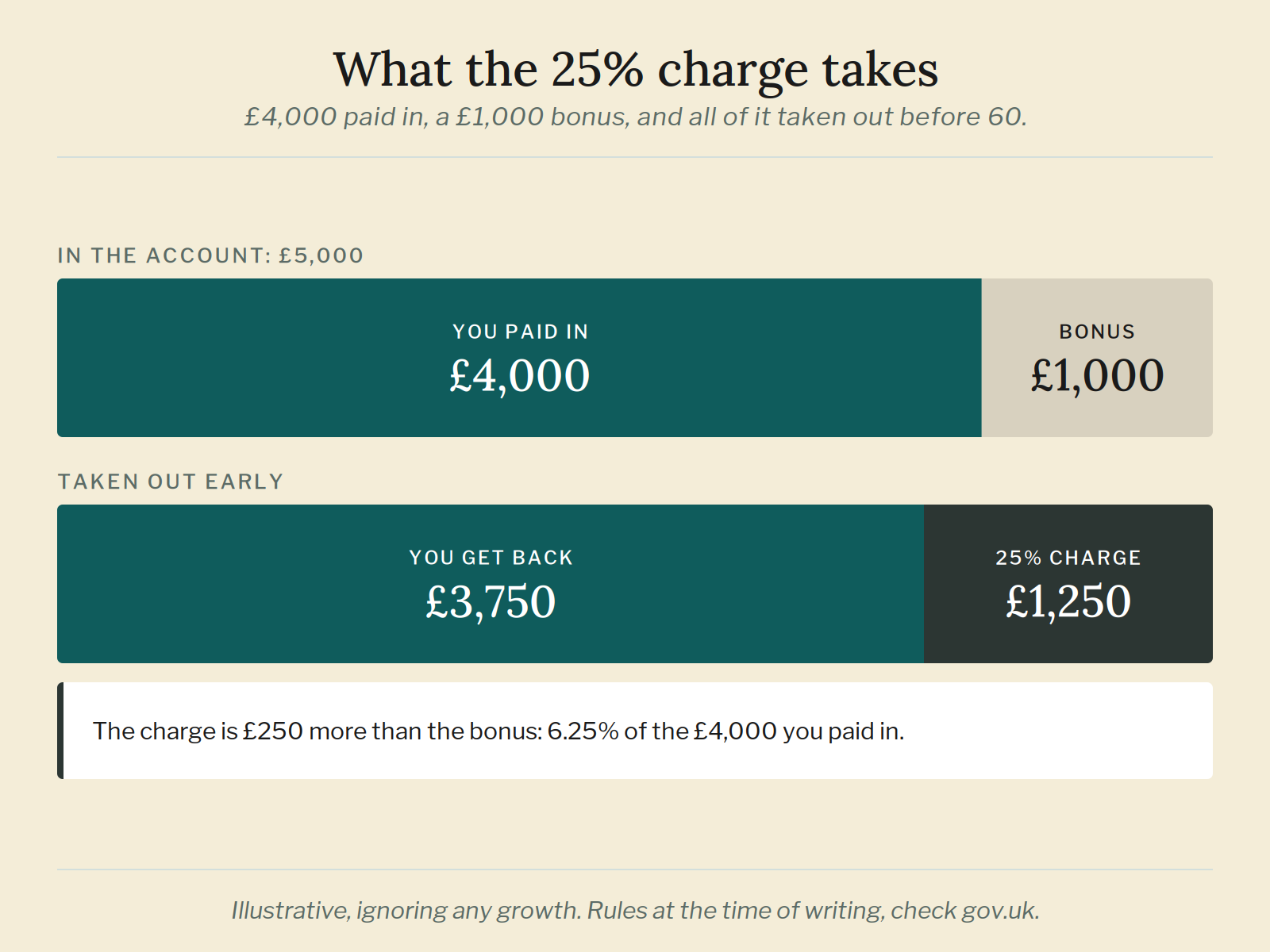
Take money out of a Lifetime ISA for anything other than your first home, turning 60 or terminal illness, and you pay a 25% withdrawal charge on everything you take out. The bonus was only 25% of what you paid in, so the charge takes back more than the bonus: you lose about 6.25% of your own money as well. Pay in £4,000, collect the £1,000 bonus, take the £5,000 out early, and you get £3,750 back. Moving a Lifetime ISA into another type of ISA before 60 counts as a withdrawal too.
When the 25% charge applies
| What you do with the money | Withdrawal charge |
|---|---|
| Buying your first home: £450,000 or less, with a mortgage, at least 12 months after your first payment | No charge |
| Taking money out at 60 or over | No charge |
| Terminally ill, with less than 12 months to live | No charge |
| Moving it to another Lifetime ISA provider | No charge |
| After your death | No charge |
| Taking money out for anything else before 60 | 25% of what you take out |
| Moving it to a cash or stocks and shares ISA before 60 | 25% |
| A home costing more than £450,000, or one that isn’t your first | 25% |
Rules at the time of writing, so check gov.uk for the current position.
What the 25% charge actually costs
The charge looks like it simply cancels the bonus. It doesn’t, because the two 25%s are measured on different numbers. The bonus is 25% of what you pay in. The charge is 25% of what you take out, and what you take out includes the bonus.
A worked example
You pay in £4,000 and the government adds £1,000, so the account holds £5,000. Withdraw all of it early and the charge is £1,250. You get £3,750 back, which is £250 less than you put in. That £250 is the 6.25% of your own money. If the account has grown, the charge takes 25% of the growth too.
Getting a set amount in hand
Because the charge comes off what you take out, you have to withdraw more than you need. Divide the amount you need by 0.75. To have £3,000 in your hand, you’d take out £4,000 and the charge would keep £1,000. The Lifetime ISA calculator works out the charge and what you’d receive for any amount.
The first-home rules that catch people out
Buying your first home is penalty-free only if every condition is met. The property must cost £450,000 or less. You must buy at least 12 months after your first payment into the Lifetime ISA. You have to be buying with a mortgage, and the money goes from your provider straight to your conveyancer or solicitor, not to you. Miss any one of those and the withdrawal is charged at 25%, even though you’re buying a home. If you’re buying with someone who also has a Lifetime ISA, you can both use yours, as long as you’re both first-time buyers.
The home route is well used. In the 2025 to 2026 tax year, 99,750 people took money out of a Lifetime ISA to buy their first home, with an average withdrawal of £15,407, according to HMRC’s annual savings statistics.
How to avoid paying the charge
The simplest way is to be sure a Lifetime ISA is the right account before you put money in. It’s built for two jobs, a first home or later life, and I explain both in the Lifetime ISA explained. If you might need the money for something else, it belongs somewhere else.
Keep an emergency fund outside it
Most early withdrawals happen because something unexpected needs paying for. A few months of spending in an ordinary savings account or a cash ISA means you never have to break into the Lifetime ISA. It’s the first step in where your money should go first.
If your plans change, stop paying in rather than taking it out
There’s no charge for stopping. The money stays invested, keeps any bonus it has earned, and comes out penalty-free at 60. The £4,000 you’d have paid in can go into a different ISA instead, because it’s part of the same £20,000, as how the ISA allowance works explains.
Match cash or investments to your timeline
A Lifetime ISA can hold cash or stocks and shares. If you’re saving for a deposit you’ll need within a few years, a fall in value just before you buy hurts, so cash usually suits short timelines and investments suit long ones. The same reasoning is behind cash ISA vs stocks and shares ISA.
Check the house price early
If the homes you’re looking at cost more than £450,000, the Lifetime ISA can’t be used for them without the charge. Better to know that before you’ve built up years of savings in one.
The Lifetime ISA is due to be replaced by a First-Time Buyer ISA, with no start date set yet. People who already have one are expected to keep the current rules, but the details depend on the government’s response to the First-Time Buyer ISA consultation, which hadn’t been published at the time of writing.
If you’re setting up your first ISA, my free ISA Starter guide walks you through it step by step, and the book covers how the Lifetime ISA fits alongside the rest.
How much is the Lifetime ISA withdrawal penalty?
25% of the amount you take out, at the time of writing. On a withdrawal of £5,000 made up of £4,000 you paid in and a £1,000 bonus, that’s £1,250, leaving you £3,750.
Why do I lose more than the bonus?
The bonus is 25% of what you paid in. The charge is 25% of what you take out, which is a bigger number because it includes the bonus. The difference comes out of your own money, about 6.25% of it.
Can I withdraw from a Lifetime ISA without a penalty?
Yes, to buy your first home within the rules, from age 60, or if you’re terminally ill with less than 12 months to live. There’s no charge after death either.
Do I pay the charge if I move my Lifetime ISA to a stocks and shares ISA?
Yes, before 60. Moving it into any other type of ISA counts as a withdrawal and is charged at 25%.
Can I switch to a different Lifetime ISA provider?
Yes, with no charge, as long as it’s done as a proper transfer between providers. How to transfer an ISA covers the process. You can only pay into one Lifetime ISA each tax year, as I explain in can you have more than one ISA.
What happens when I turn 50?
You can’t pay in any more and the bonus stops, but the account stays open and keeps growing. You can take it out without the charge from 60.
What if the home I buy costs more than £450,000?
Then the withdrawal is charged at 25%, even if it’s your first home.
Key takeaways
All figures are correct at the time of writing and can change, so always check gov.uk for the current numbers. The value of investments can go up and down, and you can get back less than you put in. This is general information, not financial advice. If you are unsure, speak to a regulated financial adviser.