

The First Time Buyer ISA: What the Government Has Decided
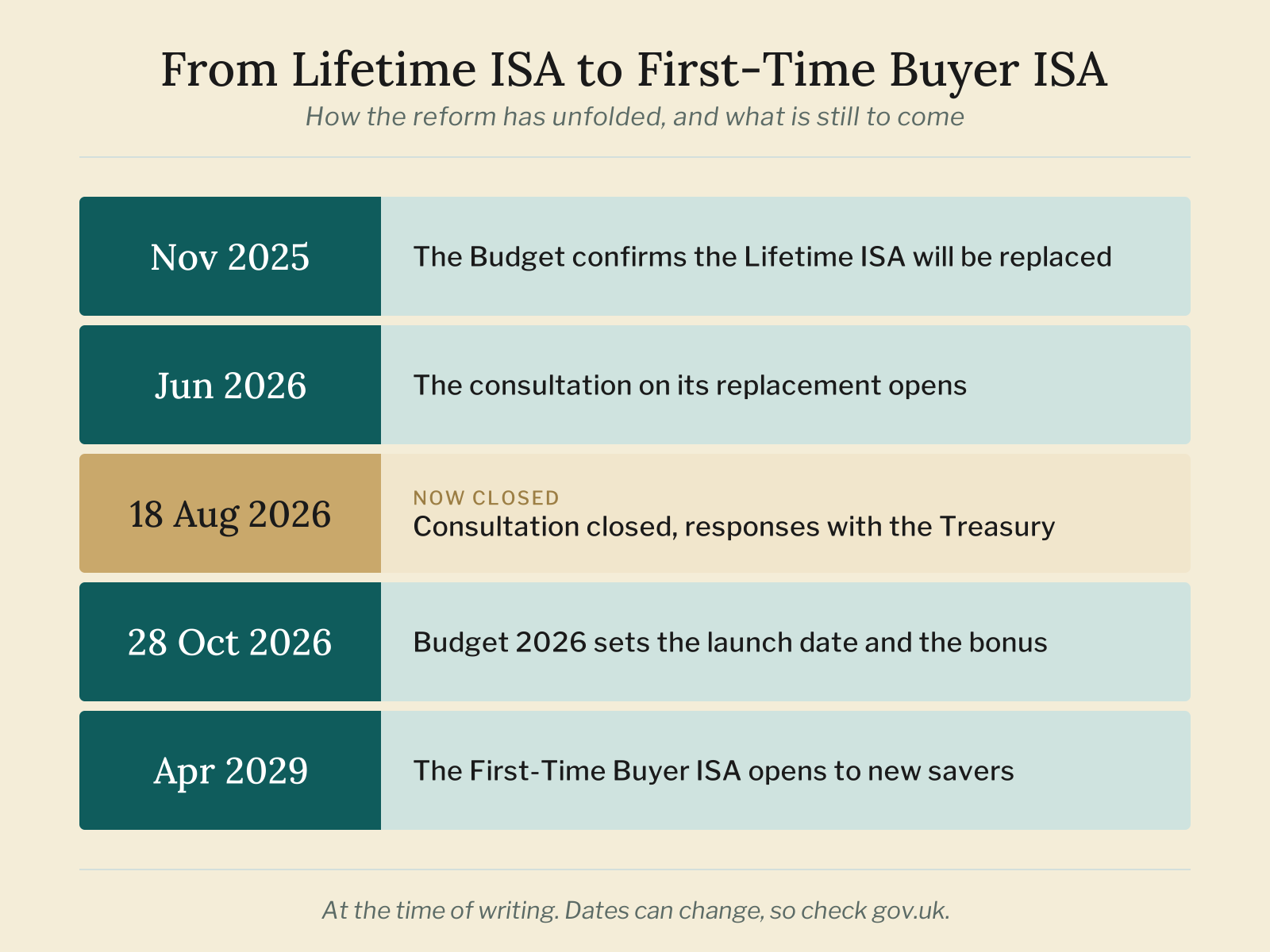
The government has published its response to the First Time Buyer ISA consultation, and the new account launches in April 2029. It will take up to £4,000 a year, with a 25% government bonus towards a first home worth up to £450,000, at the time of writing. If you hold a Lifetime ISA, nothing changes for you today: it carries on under its current rules, and you can still open one until the new account launches.
I’ve written in full about what the consultation proposed. This is the shorter piece: what the government decided, and what it means for your money now.
What did the government decide?
The consultation ran from 22 June to 11:59pm on 18 August 2026, and drew 194 responses. The government published its response on 28 October 2026, alongside the Autumn Budget, and finalised the design:
| First Time Buyer ISA | |
|---|---|
| Launches | April 2029 |
| Most you can pay in | £4,000 a year, within your £20,000 overall ISA allowance |
| Government bonus | 25%, worked out on the final balance, capped at £20,000 in total |
| Home price cap | £450,000 |
| How many you can hold | One at a time |
| Withdrawal charge | None |
| Transfers in | From a cash, stocks and shares or Innovative Finance ISA, up to the £4,000 yearly limit |
| Transfers out | Not limited |
| From a Lifetime ISA | Not allowed, but both can be used towards the same home |
| From a Help to Buy ISA | The full balance can move in between 6 April 2029 and 1 December 2030 |
All at the time of writing, from HMRC’s tax-free savings newsletter 24 and the government’s response on gov.uk.
How the bonus works
The 25% bonus is worked out on the account’s final balance and paid towards an eligible first home purchase. You’ll need to have held the account for a year before you can claim the bonus, at the time of writing, according to the design summary in the government’s response (Chapter 3). Because it’s tied to buying a home, there’s no withdrawal charge: take the money out for anything else and you simply don’t get the bonus.
How transfers work
Money can be transferred in from a cash, stocks and shares or Innovative Finance ISA, up to the £4,000 yearly limit, and transfers out aren’t limited. Money paid in counts towards your £20,000 overall ISA allowance, which how the ISA allowance works explains.
What does it mean for your Lifetime ISA?
The Lifetime ISA is planned to close to new savers when the First Time Buyer ISA launches in April 2029, at the time of writing. Until then you can still open one, and existing holders can carry on under the current rules. You won’t be able to move a Lifetime ISA into the new account, but both can go towards the same first home.
One Lifetime ISA rule has already changed. Since 29 October 2026, the withdrawal charge is 20%, not 25%, if you use it for a first home above the £450,000 price cap.
If a Lifetime ISA fits your plans, opening or keeping one now still earns the bonus today. My guide to the Lifetime ISA walks through the bonus, the penalty and the age window. Check the current position on gov.uk before you act, and remember none of this is personal advice.
What happens next?
The government will now put the legislation in place and work with providers on the detail of offering the account. Until it’s in law, details can still change, so check gov.uk for the latest.
Can I still open a Lifetime ISA?
Yes. It stays open until the First Time Buyer ISA launches in April 2029, at the time of writing, and existing holders can keep paying in under the current rules.
When does the First Time Buyer ISA start?
April 2029, at the time of writing.
Can I move my Lifetime ISA into a First Time Buyer ISA?
No. Transfers from a Lifetime ISA won’t be allowed, but you can use both towards the same home.
Is there a charge for taking money out?
No. There’s no withdrawal charge. The bonus is tied to buying a first home, so money used for anything else doesn’t get it.
Does it count towards my ISA allowance?
Yes. Money paid in counts towards your £20,000 overall ISA allowance, at the time of writing.
Key takeaways
All figures are correct at the time of writing and can change, so always check gov.uk for the current numbers. The value of investments can go up and down, and you can get back less than you put in. This is general information, not financial advice. If you are unsure, speak to a regulated financial adviser.