

What is a Stocks and Shares ISA, and How Does It Work?
A Stocks and Shares ISA is a tax-free account for investing. You buy shares, funds or bonds inside it, and everything they earn, the growth and the dividends, is yours to keep: no tax to pay and nothing to report to HMRC. ISA stands for Individual Savings Account, and this is the one built for investing.
Most people in the UK walk past it, or barely use it. I did exactly that for years. It sounded technical and slightly official, so I left it alone, and that was time I do not get back. The rest of this is how it works and why it matters.
It is a wrapper, not an investment
Start with the word itself, because it trips people up. An ISA is not an investment. It is a wrapper that goes around your investments and shields them from tax.
Picture two accounts side by side, holding exactly the same things. On a normal account, when you sell at a profit you can be hit with capital gains tax, and when your investments pay you dividends or interest, those can be taxed too. Inside the ISA, none of that happens. No capital gains tax. No tax on dividends. No tax on interest. You do not even put it on a tax return. The growth just builds, year after year, with the taxman left outside.
That sounds dull until you let it run. A small slice lost to tax each year looks like nothing on its own. Stretch it over decades, on a growing balance, and it becomes one of the biggest costs an ordinary investor carries. The ISA removes it. And with the tax on dividends up since April 2026 and the tax on savings interest going up from April 2027, that shelter is worth more now, not less. To put a figure on it for your own investments, try the ISA tax calculator.
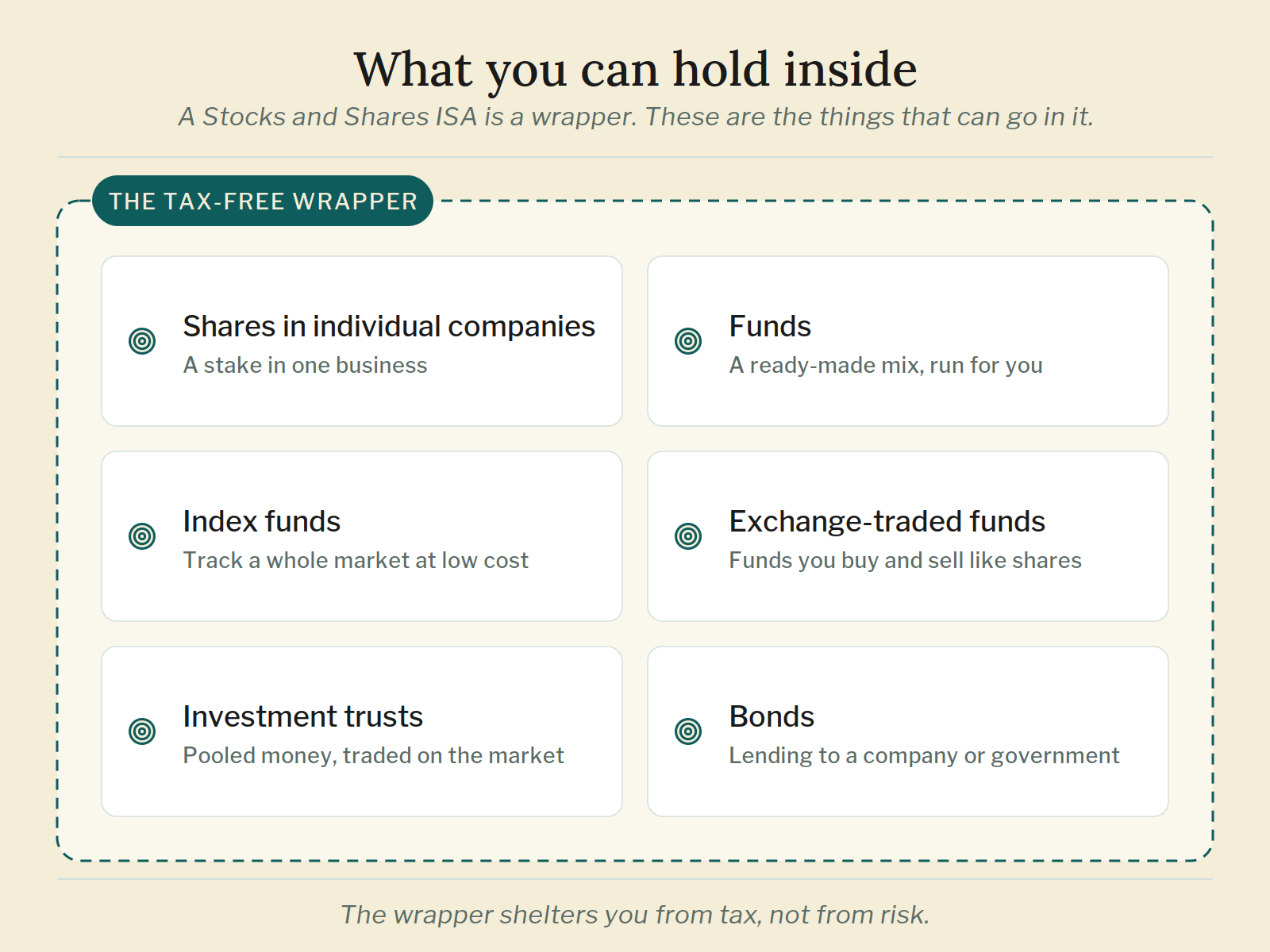
What you can hold inside one
A Stocks and Shares ISA can hold a fair range of things: shares in individual companies, funds, index funds, exchange-traded funds, investment trusts, bonds. What you put inside it is your call, and not something I can advise you on here.
What I will be straight about is the catch. These are investments, not savings. Their value rises and falls. Unlike cash, you can get back less than you put in. That is the trade. You take the ups and downs in exchange for the chance of growth that cash will rarely match over the long run. The wrapper protects you from tax. It does not protect you from that risk, and anyone who tells you otherwise is not being straight with you.
How much you can put in
At the time of writing, you can pay up to £20,000 a year into ISAs. That is the total across every ISA you hold, not £20,000 each. The figure is set by the government and it changes, so check the current number at gov.uk before you act on it.
A few things worth knowing:
- The allowance resets every tax year, which runs from 6 April to 5 April. Use it or lose it. Nothing rolls over.
- The £20,000 is a cap on new money going in, not a cap on what the ISA can grow to. There is no ceiling on what it becomes once it is invested.
- You can split it across different types of ISA, and since April 2024 you can even pay into more than one ISA of the same type in a year, as long as the total stays inside the allowance.
Where it fits in the ISA family
The ISA is not one product. It is a family of five, all sharing that same tax-free wrapper:
- Cash ISA, a tax-free savings account.
- Stocks and Shares ISA, the investing one, and the subject of this article.
- Lifetime ISA, which adds a 25% government bonus and is built around a first home or later life.
- Junior ISA, for children under 18.
- Innovative Finance ISA, which holds peer-to-peer loans.
I take each of them apart properly in The ISA Family Explained.
Cash ISA or Stocks and Shares ISA?
This is where people get tangled, so here is the cleanest way I can put it. A cash ISA and a stocks and shares ISA share the same tax-free wrapper. They do completely different jobs.
A cash ISA is a savings account. Your money earns interest, it is safe, and it does not fall in value. That makes it right for money you might need soon, or an emergency fund you cannot afford to watch drop.
A stocks and shares ISA is for the long game. Money you can leave alone for years, and leave alone when markets fall, in exchange for the chance of it growing faster than cash over time. The rough rule I use in my own head: cash for the next year or two, stocks and shares for the years and decades after that.
One change is coming that is worth knowing now. From April 2027, if you are under 65, the most you can put into a cash ISA each year drops from £20,000 to £12,000. The stocks and shares ISA allowance stays at £20,000, and the overall £20,000 limit across all your ISAs does not move. If you are 65 or over, your cash ISA limit stays at £20,000. It is a deliberate nudge from the government towards investing rather than saving. I go through what the Budget changed, and what it means in practice, in the News piece.
There is a second change worth knowing, and it is specific to this account. From April 2027, any interest earned on cash you leave sitting uninvested inside a stocks and shares ISA will be charged at a flat 22%, whatever your tax band. It bites only on interest from idle cash, not on your shares, funds or dividends, which keep their tax-free treatment. The point is to stop people using an investing ISA to shelter cash, so the simple answer is to keep only the money you actually mean to invest in here. HMRC confirmed this in June 2026, and the regulations were made that September. Check gov.uk for the detail. I go through it in full in the News piece.
So is it right for you?
I cannot tell you that, and I would be wary of anyone who tried to from behind a screen. It depends on your circumstances, how long you can leave the money untouched, and how you feel watching its value move around. This is general information, not financial advice.
What I can hand you is the principle I use myself. Money I might need soon stays in cash, where it is safe. Money I am happy to leave invested for the long term, through the falls as well as the rises, is the money the stocks and shares ISA is built for. If you are unsure, gov.uk has the official rules, and a regulated financial adviser can look at your actual situation.
Can I lose money in a Stocks and Shares ISA?
Yes. It holds investments, so the value can fall as well as rise, and you can get back less than you put in. The wrapper shelters you from tax, not from risk.
Do I pay any tax on it?
No. No capital gains tax on profits, no tax on dividends or interest earned inside it, and nothing to report to HMRC.
How much can I pay in?
At the time of writing, up to £20,000 a year across all your ISAs combined. Check gov.uk for the current figure, as it changes.
Can I have more than one?
Yes. Since April 2024 you can pay into more than one stocks and shares ISA in the same tax year, as long as your total across all ISAs stays inside the annual allowance.
Can I take my money out?
Yes. You can sell your investments and withdraw the cash. It is built for the long term, though, so it works best when you leave it alone.
Key takeaways
None of this is as complicated as it looks from the outside. Once someone lays the ISA out clearly, most of the mystery falls away. That is the whole reason this site exists.
All figures are correct at the time of writing and can change, so always check gov.uk for the current numbers. The value of investments can go up and down, and you can get back less than you put in. This is general information, not financial advice. If you are unsure, speak to a regulated financial adviser.