

Cash ISA vs Stocks and Shares ISA: What’s the Difference?
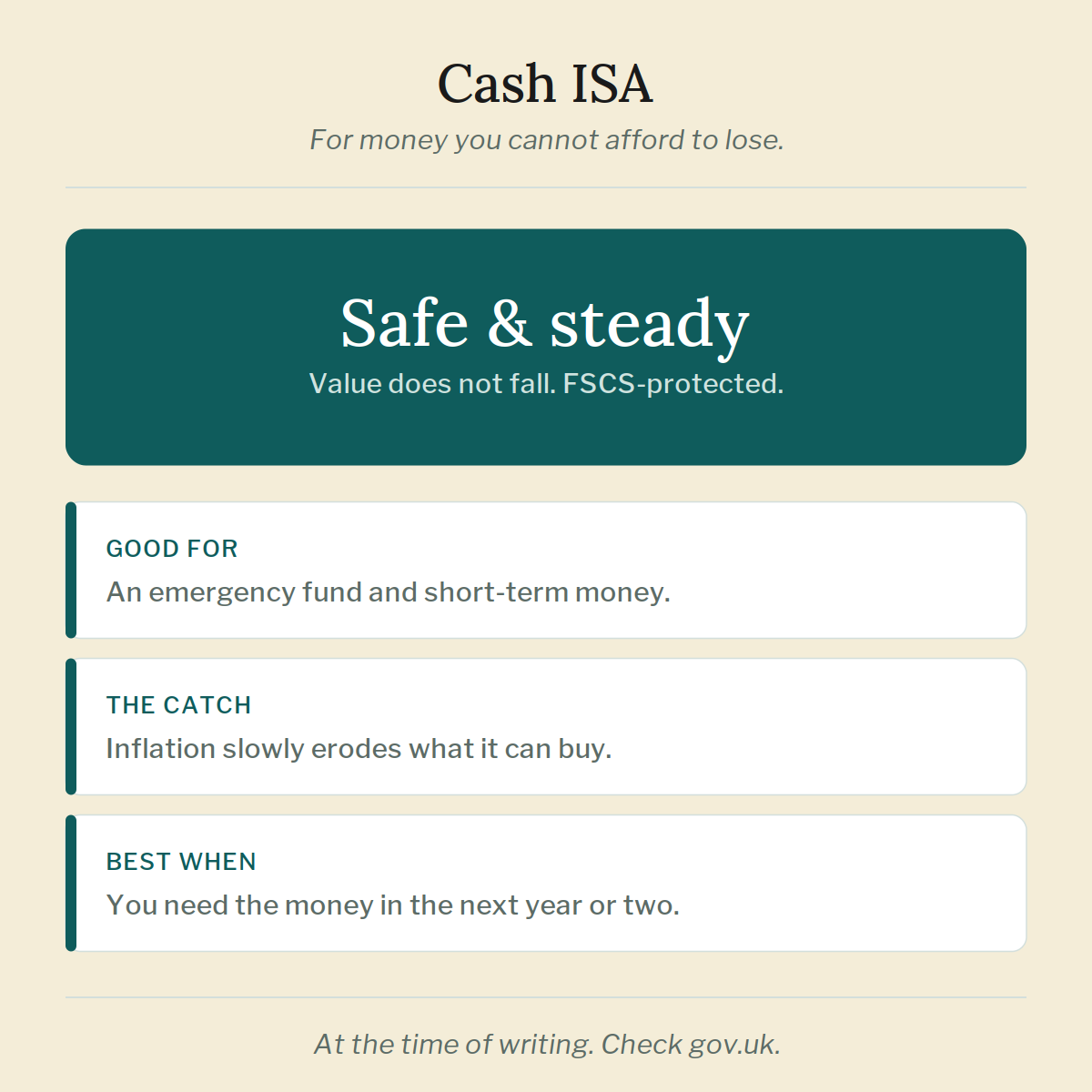
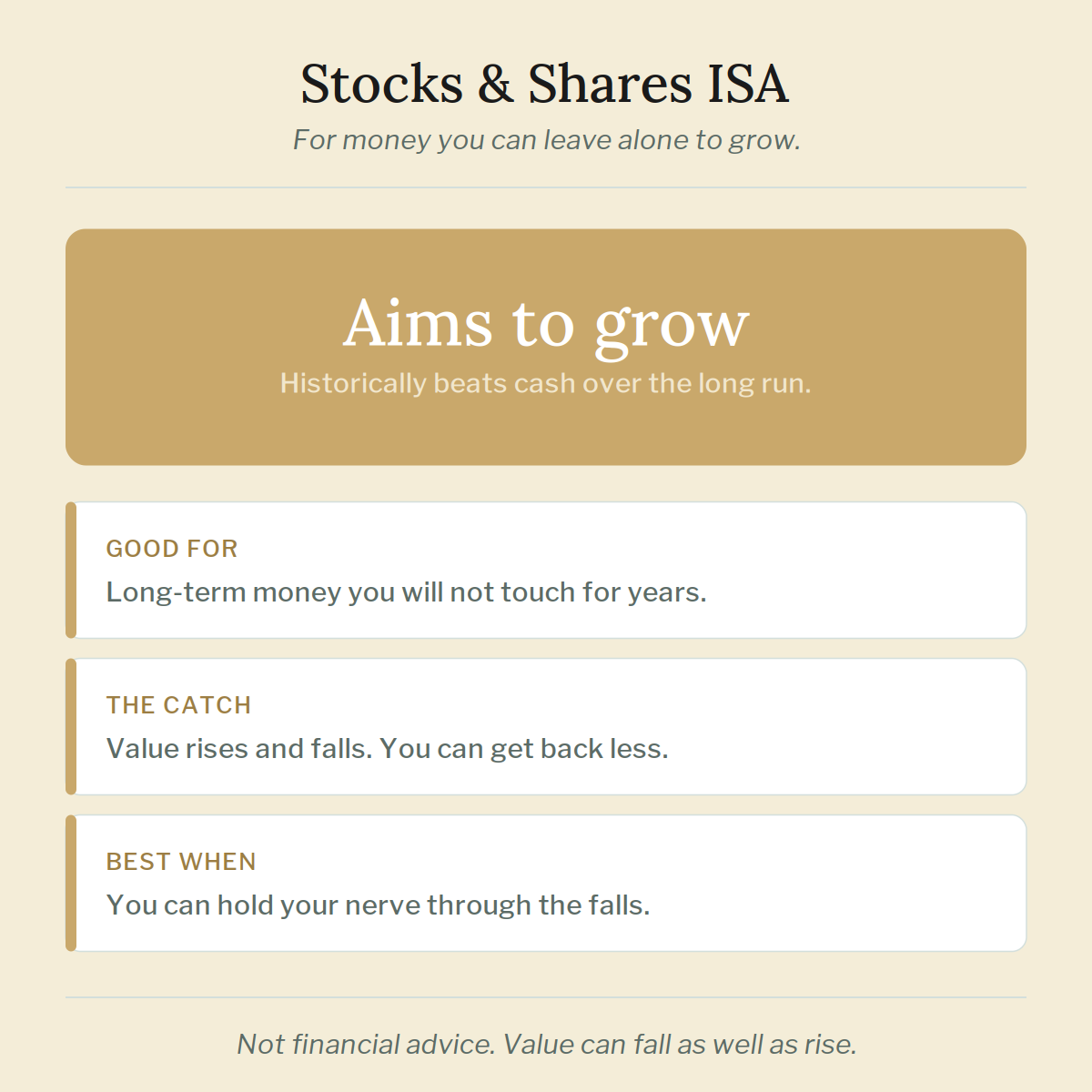
A cash ISA is for money you cannot afford to lose. A stocks and shares ISA is for money you can leave alone for years. Same tax-free wrapper, completely different jobs, and once you know which job your money is doing, the choice mostly answers itself.
If you’ve got £5,000 or £20,000 sitting there and you’ve got as far as the word ISA before hitting the fork in the road, this is the part that decides it.
What is the difference between a cash ISA and a stocks and shares ISA?
Both are ISAs, so both sit inside the same tax-free shell and neither is taxed on what it earns. The difference is entirely what goes inside. One holds cash and pays interest. The other holds investments and aims for growth, and if you want the longer version of that, here is what a stocks and shares ISA actually is. That single difference changes how each one behaves, what it is good for, and what it costs you to get it wrong.
| Cash ISA | Stocks and shares ISA | |
|---|---|---|
| What it holds | Cash | Shares, funds and bonds |
| What it earns | Interest | Returns from what you own |
| Can the value fall? | No | Yes, sometimes sharply |
| Protection | FSCS-protected up to the limit | No protection against markets falling |
| The real risk | Inflation eroding what it buys | Selling after a fall |
| Right for | Money you need in the next year or two | Money you can leave for ten years or more |
| Annual limit | £20,000, falling to £12,000 for under-65s from April 2027 | £20,000 |
Which one actually gives better returns?
Over long periods, shares. It is not close, and it is worth seeing the size of it rather than taking the claim on trust.
The Barclays Equity Gilt Study has tracked UK shares and cash since 1899. Over that run, shares returned roughly 5% a year above inflation. Cash returned roughly 0.5%. That gap is the whole argument for investing, and it is not a small one: £20,000 left alone for 20 years at 5% above inflation becomes about £53,000 in today’s money. At 0.5% it becomes about £22,100. Illustrative, not a forecast.
The same study answers the question people are really asking, which is how often it works out. Over the periods it covers, shares beat cash in 91% of ten-year stretches and 75% of five-year stretches. Even over two years, shares have come out ahead about 70% of the time (Barclays Equity Gilt Study 2024), but the periods when they don’t can be painful.
So the honest version is this. Shares are not safer than cash. They are more rewarding over long periods and more uncomfortable over short ones, and the odds move in your favour the longer you leave them alone. None of that is a promise. Past performance is not a guide to the future, the value rises and falls, and you can get back less than you put in.
Can I have both a cash ISA and a stocks and shares ISA?
Yes, and most people should. You can pay into both in the same tax year and split your allowance between them however you like: £15,000 into one and £5,000 into the other, or any other split. The £20,000 limit is the total across all your ISAs, not a separate allowance for each one.
This is the part the “which one?” framing gets wrong. They are not rivals competing for the same money. They are two tools for two jobs, and most financial lives need both: a cash buffer you can reach tomorrow, and a long-term pot compounding in the background.
So which one should you choose?
Two questions decide it, and neither is about which product is better.
When will you need this money?
Inside two years, cash, without hesitation. Ten years or more, and the historical case for shares is strong. In between is genuinely a judgement call.
Can you hold your nerve when it falls?
This is the one people underestimate. A stocks and shares ISA only delivers those long-run numbers if you are still holding when the recovery comes. Someone who sells in the middle of a fall gets the volatility without the returns, which is the worst of both. If you know you would not sleep, that is useful information about yourself, not a weakness.
If you are ready to go ahead, opening a stocks and shares ISA takes about ten minutes, and you do not have to choose your investments the same day.
What changes in April 2027
From 6 April 2027 the amount under-65s can pay into a cash ISA each year drops from £20,000 to £12,000. The overall £20,000 allowance does not change, so the balance simply shifts towards investing. If you are 65 or over you keep the full £20,000 in cash, and that entitlement starts at the beginning of the tax year in which you turn 65.
One detail worth knowing now: from the same date, under-65s will not be able to transfer money from a stocks and shares ISA back into a cash ISA. Moving the other way stays allowed. These are the confirmed figures at the time of writing and they can change, so check gov.uk before you act. I go through the whole package in the November 2025 Budget reforms.
Is a cash ISA completely safe?
It carries no investment risk and is FSCS-protected up to the limit, so you will not watch it fall. Its one risk is inflation slowly reducing what the money can buy, which never shows up as a loss on the statement but is a real cost over decades.
Can I move money from one to the other?
Yes, through an ISA transfer. Transferring, rather than withdrawing and paying back in, keeps the money’s tax-free status. Transferring an ISA without losing the tax break covers how to do it.
Should I cash in my stocks and shares ISA if markets fall?
Selling turns a fall on paper into a real loss, and it takes you out of the recovery. That is the mechanism behind most poor outcomes in investing. The time to decide how much you can stomach is before you invest, not during a drop.
What if I already have a cash ISA and want to start investing?
You do not have to choose between them. Keep the cash ISA as your emergency fund and start the stocks and shares ISA with money you genuinely will not need. My free ISA Starter guide walks through opening one from scratch, and the book sets out the whole method if you want the long view.
Key takeaways
All figures are correct at the time of writing and can change, so always check gov.uk for the current numbers. The value of investments can go up and down, and you can get back less than you put in. This is general information, not financial advice. If you are unsure, speak to a regulated financial adviser.