

ISA vs Savings Account: What’s the Difference, and Which Suits You?
An ISA is a tax-free wrapper, so interest earned inside a cash ISA is never taxed, while interest in an ordinary savings account is tax-free only up to your allowance: £1,000 a year for a basic-rate taxpayer, at the time of writing. For many savers the difference is small today. It grows with the size of the savings and the interest rate, and it grows again from April 2027, when tax on savings interest outside an ISA goes up.
So the question isn’t really which account pays more. It’s how much of the interest you get to keep. Here’s how the two compare, with the numbers.
What’s the difference between an ISA and a savings account?
An ISA is a container, not a different kind of money
ISA stands for Individual Savings Account. A cash ISA can look exactly like an ordinary savings account: same bank, same app, an interest rate, easy access or a fixed term. The difference is the wrapper around it. Anything earned inside an ISA is free of tax, and none of it goes on a tax return.
There are four types of ISA for adults: the cash ISA, the stocks and shares ISA, the innovative finance ISA and the Lifetime ISA. Children have their own, the Junior ISA. The one that compares directly with a savings account is the cash ISA. I’ve set out the whole family in the ISA family explained.
Do you pay tax on savings interest?
Outside an ISA, sometimes. Most people can earn some interest tax-free thanks to the Personal Savings Allowance. At the time of writing, that’s:
- £1,000 a year if you’re a basic-rate taxpayer
- £500 if you’re a higher-rate taxpayer
- nothing if you’re an additional-rate taxpayer
Interest above that is taxed at your income tax rate. HMRC adds together the interest from all your savings accounts to work out the total, so several small accounts can still go over. Your bank tells HMRC what it paid you, and HMRC sends a calculation if tax is due.
There’s also a starting rate for savings. If your other taxable income is below £17,570, up to £5,000 of interest can be tax-free on top. Every £1 of other income above your Personal Allowance reduces it by £1, so for most people in work it has gone. The details and current figures are on gov.uk.
ISA interest doesn’t use up any of these allowances, which leaves them free for anything you hold outside. I go through the rest of the tax picture in do you pay tax on an ISA.
How much can you put into ISAs?
At the time of writing, up to £20,000 in the 2026 to 2027 tax year, across all your ISAs together. You can split it however you like, and up to £4,000 of it can go into a Lifetime ISA. The tax year runs from 6 April to 5 April, and any allowance you don’t use is gone when it ends. How the ISA allowance works covers the detail. An ordinary savings account has no yearly limit.
What’s the difference on real numbers?
A worked example
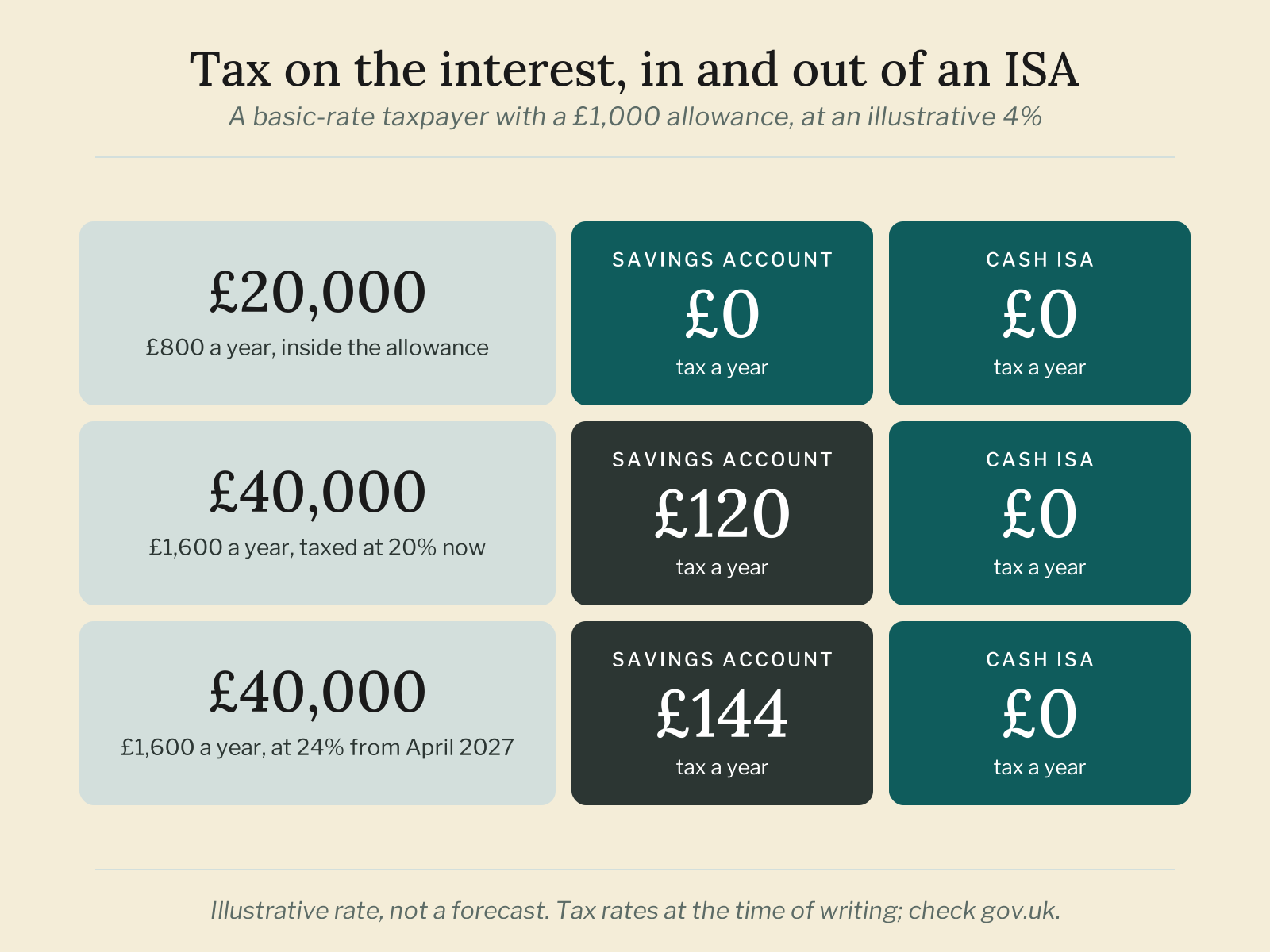
Here’s an illustrative interest rate of 4% a year. It’s an assumption to show the maths, not a real or promised rate. Take a basic-rate taxpayer with no other savings interest:
- £20,000 at 4% earns £800 a year. That’s inside the £1,000 allowance, so there’s no tax whether it sits in a savings account or an ISA.
- £40,000 at 4% earns £1,600 a year. £600 of that is above the allowance. In an ordinary savings account, at the basic rate of 20% this tax year, that’s £120 in tax. Inside a cash ISA, it’s nothing.
- From 6 April 2027 the savings basic rate is due to rise to 24%. The same £600 would then cost £144 a year outside an ISA, at the time of writing. Inside an ISA, still nothing.
Building £40,000 in a cash ISA takes at least two tax years, because £20,000 is the most that can go in each year. These are illustrative figures, not a forecast. For a higher-rate taxpayer the gap opens sooner, because their allowance is £500, not £1,000.
What changes in April 2027?
From 6 April 2027, tax on savings interest outside an ISA rises to 24% at the basic rate, 44% at the higher rate and 49% at the additional rate. The Personal Savings Allowance and the starting rate for savings stay the same. Interest inside an ISA stays tax-free.
The cash ISA limit stays at £20,000. The planned cut to £12,000 for under-65s was reversed in the Budget on 28 October 2026. HMRC confirmed on 29 October that the rules due to come with it won’t take effect either. Those were the ban on transfers from a stocks and shares ISA into a cash ISA for under-65s, and the charge on interest from cash held in a stocks and shares ISA. I explain what that reversal means in the 22% charge on cash in your stocks and shares ISA won’t go ahead, and the rest of the Budget in Autumn Budget 2026: what it means for your ISA. All at the time of writing.
When does an ordinary savings account still make sense?
When the interest stays inside your allowance
If your total interest from every account is below your Personal Savings Allowance, there’s no tax to save, so the wrapper adds nothing yet. Some people keep their ISA allowance for later, or for investing.
When the account terms suit the money
Rates, notice periods and access rules differ from product to product. A cash ISA paying less can leave you with less than a taxed account paying more, so the fair comparison is what you’d keep after tax, like for like.
When you need the money soon
For money you’ll spend in the next few months, access matters more than tax. Some cash ISAs are flexible, which means you can take money out and put it back in the same tax year without using more allowance. Flexible ISAs explained covers how that works.
How do they compare?
| Ordinary savings account | Cash ISA | Stocks and shares ISA | |
|---|---|---|---|
| Tax on what it earns | Interest taxed above your allowance (£1,000, £500 or nothing) | None | None on interest, dividends or gains |
| Most you can put in each year | No limit | Up to £20,000 across all your ISAs | Shares the same £20,000 |
| Access | Depends on the account | Depends on the account; flexible ISAs let you put withdrawals back | Usually means selling investments first |
| Protection | FSCS, up to £120,000 per person per banking licence | FSCS, the same £120,000, shared with your other savings at that bank | FSCS, up to £85,000 per person per firm if the firm fails; not against falls in value |
| From April 2027 | Tax on interest rises to 24%, 44% or 49% | Still tax-free, limit still £20,000 | Still tax-free; the planned charge on cash won’t go ahead |
Figures are at the time of writing and can change, so check gov.uk and fscs.org.uk for the current numbers.
And a stocks and shares ISA?
That’s investing, not saving. The money goes into shares, funds or bonds, the value can fall as well as rise, and you can get back less than you put in. It’s usually for money left alone for years, not months. Cash ISA vs stocks and shares ISA compares the two side by side.
If you’re starting from scratch, my free ISA Starter guide, sent when you join the newsletter, walks through opening and using a stocks and shares ISA step by step. You can also run your own figures through the ISA tax calculator, or start at Getting Started.
Can you have an ISA and a savings account?
Yes. Holding both is common, and nothing stops you. You can also hold more than one ISA. Can you have more than one ISA sets out the rules.
Do you lose your ISA allowance if you don’t use it?
Yes. The allowance resets on 6 April each year, and anything unused doesn’t carry over. Money already in an ISA stays tax-free, however long it’s there.
Is money in a cash ISA protected?
Yes, in the same way as a savings account. The Financial Services Compensation Scheme (FSCS) protects up to £120,000 per person per authorised bank or building society, at the time of writing. That limit rose from £85,000 on 1 December 2025. It covers all your money with that firm together, ISA or not, and brands that share one banking licence share one limit. Check at fscs.org.uk.
Do you need to declare ISA interest on a tax return?
No. ISA interest isn’t declared, and it doesn’t count towards your Personal Savings Allowance.
Key takeaways
All figures are correct at the time of writing and can change, so always check gov.uk for the current numbers. The value of investments can go up and down, and you can get back less than you put in. This is general information, not financial advice. If you are unsure, speak to a regulated financial adviser.