

Do You Pay Tax on an ISA? What’s Tax-Free and What Isn’t
No. You don’t pay income tax, dividend tax or capital gains tax on anything that happens inside an ISA, and you don’t declare any of it on a tax return. Interest, dividends and the profit when you sell all stay yours, every year the money stays in. Tax can still reach an ISA in three places, though: inheritance tax, a small stamp duty charge when you buy UK shares, and, from April 2027, a new charge on cash held in a stocks and shares ISA.
What is and isn’t taxed
| Tax | Inside an ISA | Outside an ISA (2026 to 2027) |
|---|---|---|
| Tax on interest | None | Taxed above £1,000 a year for basic-rate taxpayers, £500 for higher rate |
| Tax on dividends | None | 10.75%, 35.75% or 39.35% above the first £500 |
| Capital gains tax | None | 18% or 24% above the first £3,000 of gains |
| Telling HMRC | Nothing to declare | Needed if you owe tax |
| Inheritance tax | Counts as part of your estate | Counts as part of your estate |
| Stamp duty on UK shares | 0.5% when you buy | 0.5% when you buy |
Figures are for the 2026 to 2027 tax year, at the time of writing, and can change, so check gov.uk for the current numbers.
Why the tax-free part matters more than it used to
For years plenty of people could hold shares outside an ISA and never pay a penny, because the allowances covered them. That’s no longer true. The tax-free allowance for dividends was £2,000 until April 2023. It’s now £500. The capital gains allowance was £12,300. It’s now £3,000. The ceiling came down on everyone at once, and it’s stayed down.
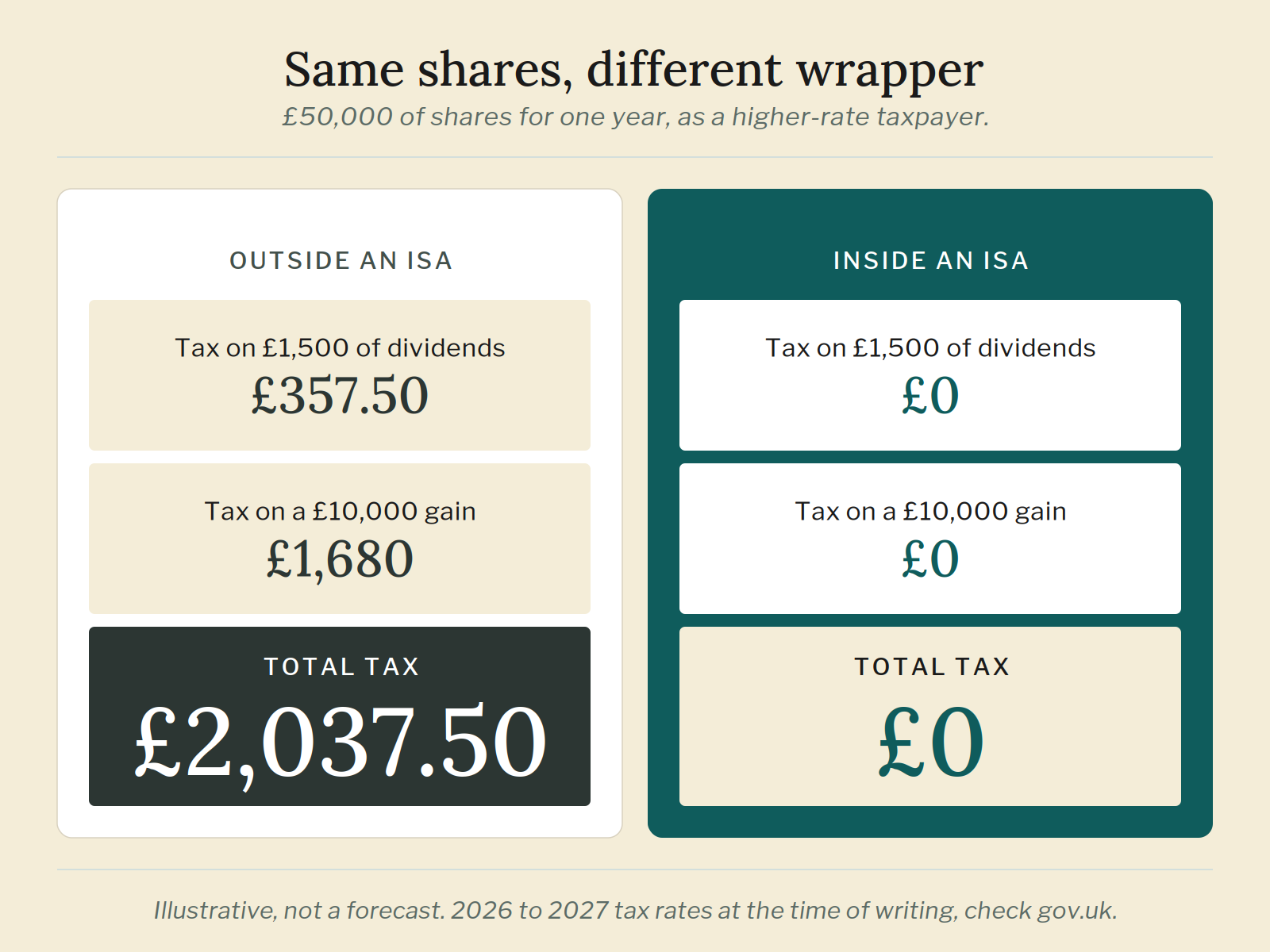
Here’s what that means on real numbers. Say you hold £50,000 of shares yielding 3%, so £1,500 a year in dividends. Outside an ISA the first £500 is free and the other £1,000 is taxed: £107.50 a year for a basic-rate taxpayer, £357.50 for a higher-rate one. Sell some of those shares at a £10,000 profit and £7,000 of it is taxable, which is £1,260 at 18% or £1,680 at 24%. Inside an ISA, all of that is zero. These are illustrative figures, not a forecast.
The saving compounds, too. Tax you don’t pay stays invested and earns returns of its own, year after year, which is why the gap between an ISA and an ordinary account widens the longer you hold. You can run your own numbers through the tax saved calculator, and how the ISA allowance works covers how much you can shelter each year.
Do I need to put my ISA on my tax return?
No. If you fill in a tax return, you don’t include any ISA interest, dividends or gains on it. ISA income doesn’t use up your Personal Savings Allowance, your dividend allowance or your capital gains allowance either, so those stay free for anything you hold outside.
Where tax can still reach your ISA
The wrapper covers the tax on what your money earns. It doesn’t cover everything around it.
Inheritance tax.
An ISA counts in full as part of your estate. It stays free of income tax and capital gains tax for up to three years and a day after death while the estate is sorted out, and a husband, wife or civil partner inherits an extra ISA allowance equal to its value. I explain how that works in what happens to your ISA when you die.
Stamp duty when you buy UK shares.
Buy shares in a UK company and you pay 0.5% Stamp Duty Reserve Tax, inside an ISA or out. It’s charged when you buy, not when you sell. Unit trusts and OEICs bought from the fund manager don’t carry it.
Tax taken off overseas dividends.
Some countries deduct tax from dividends before they’re paid out. An ISA shelters you from UK tax, not foreign tax, and that deduction generally can’t be reclaimed inside one. It’s a small drag rather than a reason to avoid overseas shares, but it’s worth knowing if you buy them for the income.
Cash held in a stocks and shares ISA, from April 2027.
From 6 April 2027, interest paid on cash sitting uninvested in a stocks and shares ISA will carry a 22% charge. Your provider pays it to HMRC, so there’s still nothing for you to declare. At the same time the cash ISA limit falls to £12,000 for under-65s, inside the same £20,000 overall allowance. The regulations were made in September 2026. I cover what it means in practice in the 22% charge on cash in your stocks and shares ISA.
If you’re setting up your first ISA, my free ISA Starter guide walks you through it step by step, and the book sets out the whole method for using the allowance year after year.
Do I pay tax on interest in a cash ISA?
No. Interest in a cash ISA is tax-free, and the April 2027 charge doesn’t apply to it: that’s only for cash held inside a stocks and shares ISA. If you’re weighing up which to use, cash ISA vs stocks and shares ISA compares the two.
Do I pay tax when I take money out of an ISA?
No. Withdrawals are tax-free. The exception is a Lifetime ISA, where taking money out for anything other than a first home, turning 60 or terminal illness costs a 25% withdrawal charge. That’s a penalty rather than a tax, but it lands the same way.
Is an ISA free of inheritance tax?
No. It counts as part of your estate, like everything else you own.
What happens to the tax break if I move abroad?
You can keep your ISA and it stays free of UK tax, but you can’t pay into it while you’re not UK resident, and you need to tell your provider. The country you move to may tax it under its own rules.
Is there a limit to how much tax an ISA can save?
Only the allowance: £20,000 a year going in, at the time of writing. There’s no cap on how large the pot can grow, and everything it earns stays tax-free however big it gets.
Key takeaways
All figures are correct at the time of writing and can change, so always check gov.uk for the current numbers. The value of investments can go up and down, and you can get back less than you put in. This is general information, not financial advice. If you are unsure, speak to a regulated financial adviser.