

The Junior ISA: Building Wealth for a Child from Day One
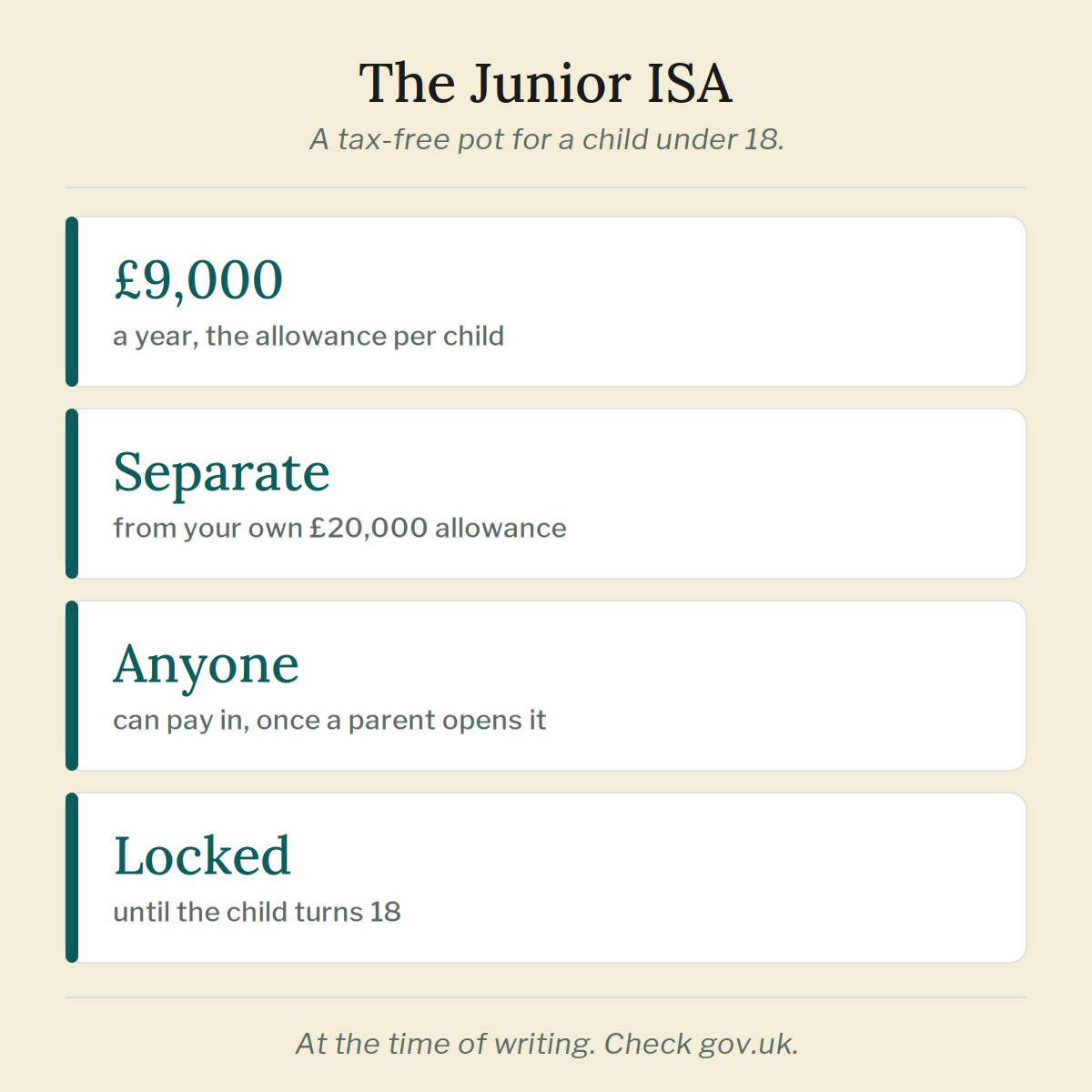
A Junior ISA is a tax-free savings and investment account for a child under 18, with its own allowance of £9,000 a year at the time of writing, separate from yours. The money belongs to the child and is locked until they turn 18, which is exactly what makes it powerful: eighteen years of untouched time.
Most parents who could use one never open it. Here is how it works: how much you can put in, who can contribute, the cash and investment versions, and what happens at 18.
The Junior ISA rules at a glance
| Rule | At the time of writing |
|---|---|
| Who it is for | A child under 18 living in the UK |
| Yearly limit | £9,000 per child, separate from your own £20,000 |
| Who opens it | A parent or guardian with parental responsibility |
| Who can pay in | Anyone, within the £9,000 total |
| Types | Cash, stocks and shares, or one of each |
| When the child takes over | They can manage it from 16 |
| When the money can come out | From 18, when it becomes an adult ISA |
| Child Trust Fund | A child cannot hold both; an existing Child Trust Fund can be transferred into a Junior ISA |
What it is
A Junior ISA is a tax-free savings and investment account for a child under 18. ISA stands for Individual Savings Account, and like every ISA it shields whatever is inside from tax. At the time of writing the allowance is £9,000 a year per child, and it sits entirely separate from your own £20,000 allowance, so paying into it does not eat into yours at all. As always, the figure is set by the government and can change, so check gov.uk.
Who can open it, and who can pay in
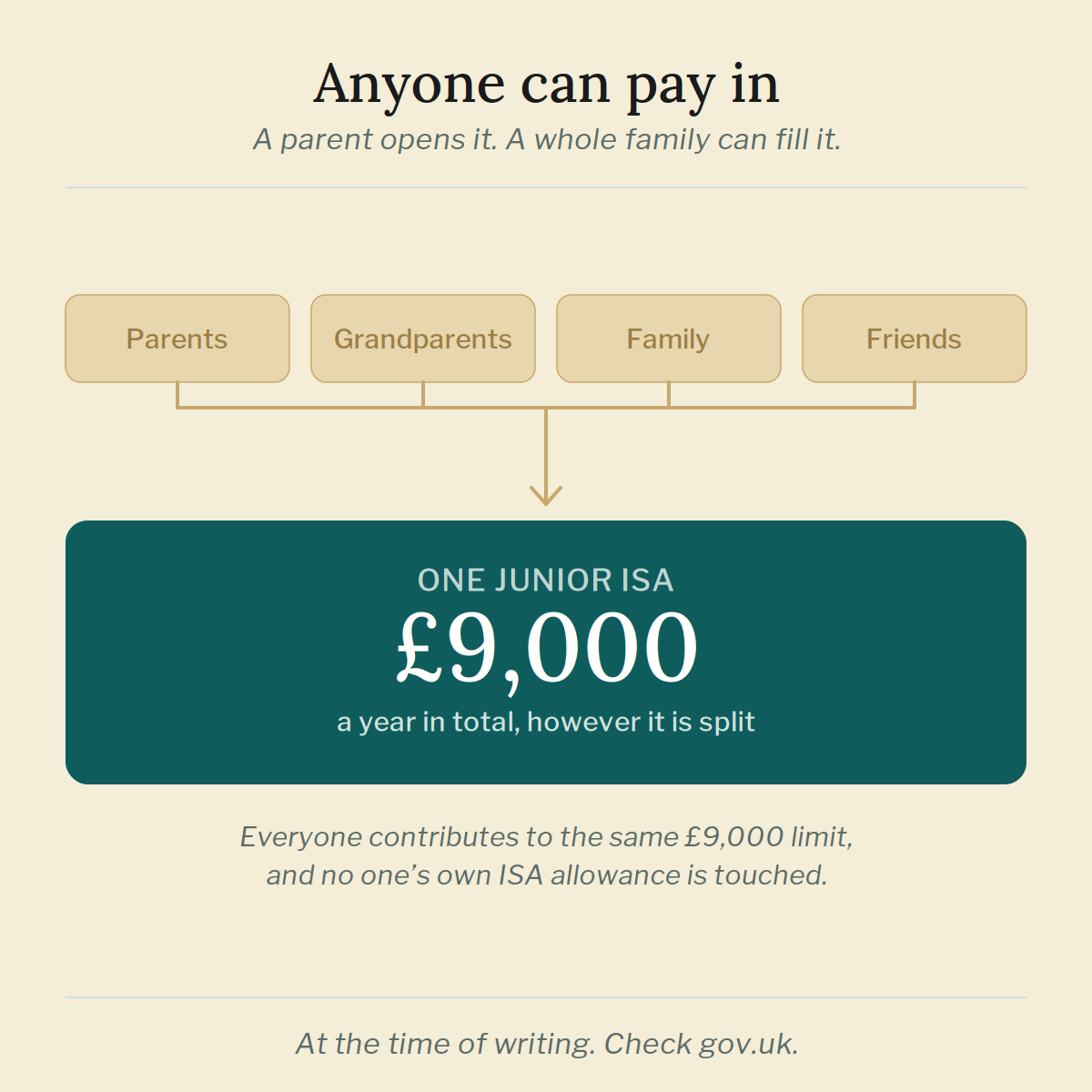
A parent or guardian opens the account, but once it exists, anyone can contribute, grandparents, family, friends, up to the £9,000 total for the year. It is a tidy way for a whole family to club together for a child without anyone’s own ISA allowance being touched.
Cash or investments
There are two versions, a cash Junior ISA and a stocks and shares Junior ISA. A child can hold one of each, and you can split the £9,000 between them. Cash is steady. The investment version can rise and fall in value, but given the long runway before the child turns 18, it has the kind of time horizon over which growth has historically had room to work. That is the historical pattern, not a promise, and the value can still fall.
Locked until 18
This is the part to be clear-eyed about. The money belongs to the child and cannot be withdrawn until they turn 18, other than in exceptional circumstances. From age 16 they can take over managing the account, and at 18 it automatically becomes an adult ISA, in their name, theirs to do with as they please. That last point is worth sitting with before you start: at 18 it is entirely their decision, whether that is a house deposit, university, or something you would not have chosen.
When is the best time to start a Junior ISA?
The best time to start a Junior ISA is as early as you can, ideally in the child’s first year, because how long the money is invested matters more than how much goes in. It’s still worth starting later, though. Five years of tax-free growth is better than none.
Here’s the same £100 a month, started at different ages and left until 18:
| Start at | Years to 18 | Paid in | Worth at 18 | Of which growth |
|---|---|---|---|---|
| Birth | 18 | £21,600 | about £43,100 | about £21,500 |
| Age 5 | 13 | £15,600 | about £25,300 | about £9,700 |
| Age 10 | 8 | £9,600 | about £12,800 | about £3,200 |
| Age 13 | 5 | £6,000 | about £7,200 | about £1,200 |
£100 a month at an illustrative 7% a year, not a forecast. Investments go up and down, and the value can fall.
Compare the first and third rows. Starting at birth rather than at 10 means paying in £12,000 more, but the pot at 18 is about £30,300 bigger. Growth alone is about £21,500 against £3,200. The difference comes from time, not from money. I explain the mechanics in The Maths That Changes Everything, and you can try your own numbers in the ISA growth calculator.
How much can I put in each year?
Up to £9,000 per child, at the time of writing. It is separate from and on top of your own £20,000 ISA allowance.
Who can contribute?
A parent or guardian opens it, but anyone can pay in, as long as the total stays within £9,000 for the year.
When can the child access the money?
At 18, when it becomes an adult ISA. They can start managing it themselves from 16, but cannot withdraw before 18 other than in exceptional cases.
Cash or stocks and shares?
Either or both. A child can hold one cash Junior ISA and one stocks and shares Junior ISA, with the £9,000 split between them as you choose.
Is it too late to start a Junior ISA at 12 or 13?
No. Five or six years still gives tax-free growth time to add something. At 18 the pot becomes an adult ISA, and it can keep growing for decades. A later start mostly means the money paid in does more of the work than the growth does.
Is it better to pay in monthly or as lump sums at birthdays?
Both count towards the same £9,000 a year. A monthly amount is easy to keep going and spreads the ups and downs of the market. A lump sum invested earlier has longer to grow. Plenty of families do both: a small monthly amount, with birthday and Christmas money from grandparents on top. I compare the two approaches in Lump Sum or Monthly?
Does it matter when in the tax year I pay in?
The £9,000 runs from 6 April to 5 April and resets each year. Any part you don’t use doesn’t carry over to the next year. Money paid in earlier in the year simply has a little longer to grow.
Key takeaways
All figures are correct at the time of writing and can change, so always check gov.uk for the current numbers. The value of investments can go up and down, and you can get back less than you put in. This is general information, not financial advice. If you are unsure, speak to a regulated financial adviser.