

What Happens to Your ISA When You Die?
You spend thirty years filling an ISA, and if it goes well it becomes one of the larger things you own. What it actually takes to reach £1 million is a long game, and almost nobody tells you what happens to the money at the end of it. It is worth knowing, because two of the rules are the opposite of what most people assume.
The short version. An ISA does not lose its tax-free status the moment you die, but it is not free of inheritance tax either. And if you are married or in a civil partnership, your other half inherits an extra ISA allowance, which is not at all the same thing as inheriting the money.
Does an ISA stay tax free after you die?
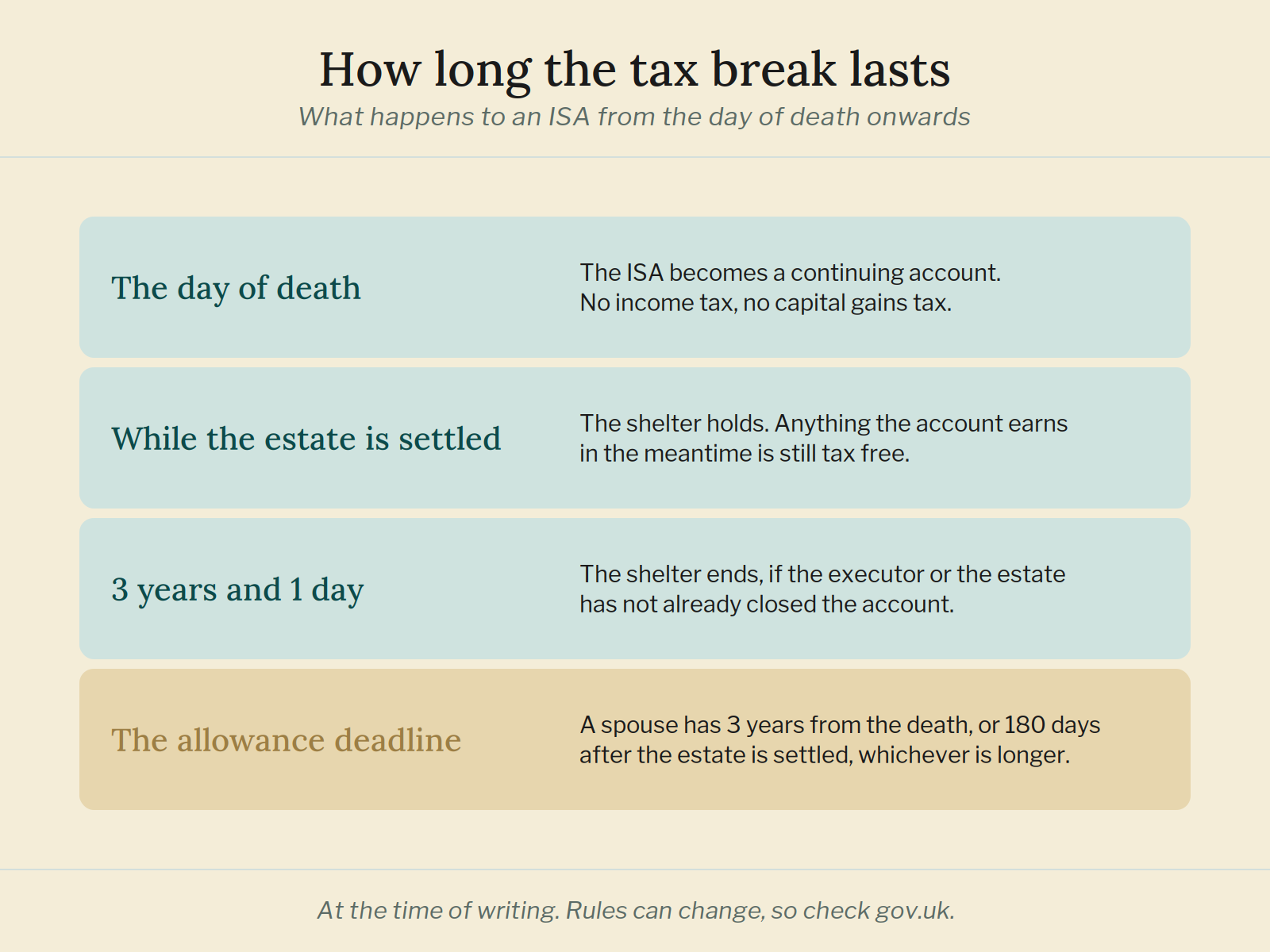
For a while, yes. Since April 2018 the account becomes what HMRC calls a continuing account of a deceased investor, and there is no income tax or capital gains tax on it while that lasts.
It ends at whichever of these comes first: the executor closes the account, the administration of the estate finishes, or three years and one day after the death. After that the tax shelter stops and any further growth or income is taxable in the normal way.
But it is not free of inheritance tax
This is the part that catches people. Everything inside an ISA forms part of your estate for inheritance tax. Tax free for your whole life, and counted in full the moment it ends.
That is worth sitting next to pensions, which have been treated differently and are changing: from April 2027 unused pension pots come into the inheritance tax net too. I go through how the two fit together in the pension isn’t the whole plan.
What your husband, wife or civil partner actually inherits
They get something called an Additional Permitted Subscription, and the name is doing a lot of work. It is an extra ISA allowance, on top of the normal £20,000, equal to the value of your ISA either at the date of death or when the account is closed. Here is how the ordinary allowance works, for context.
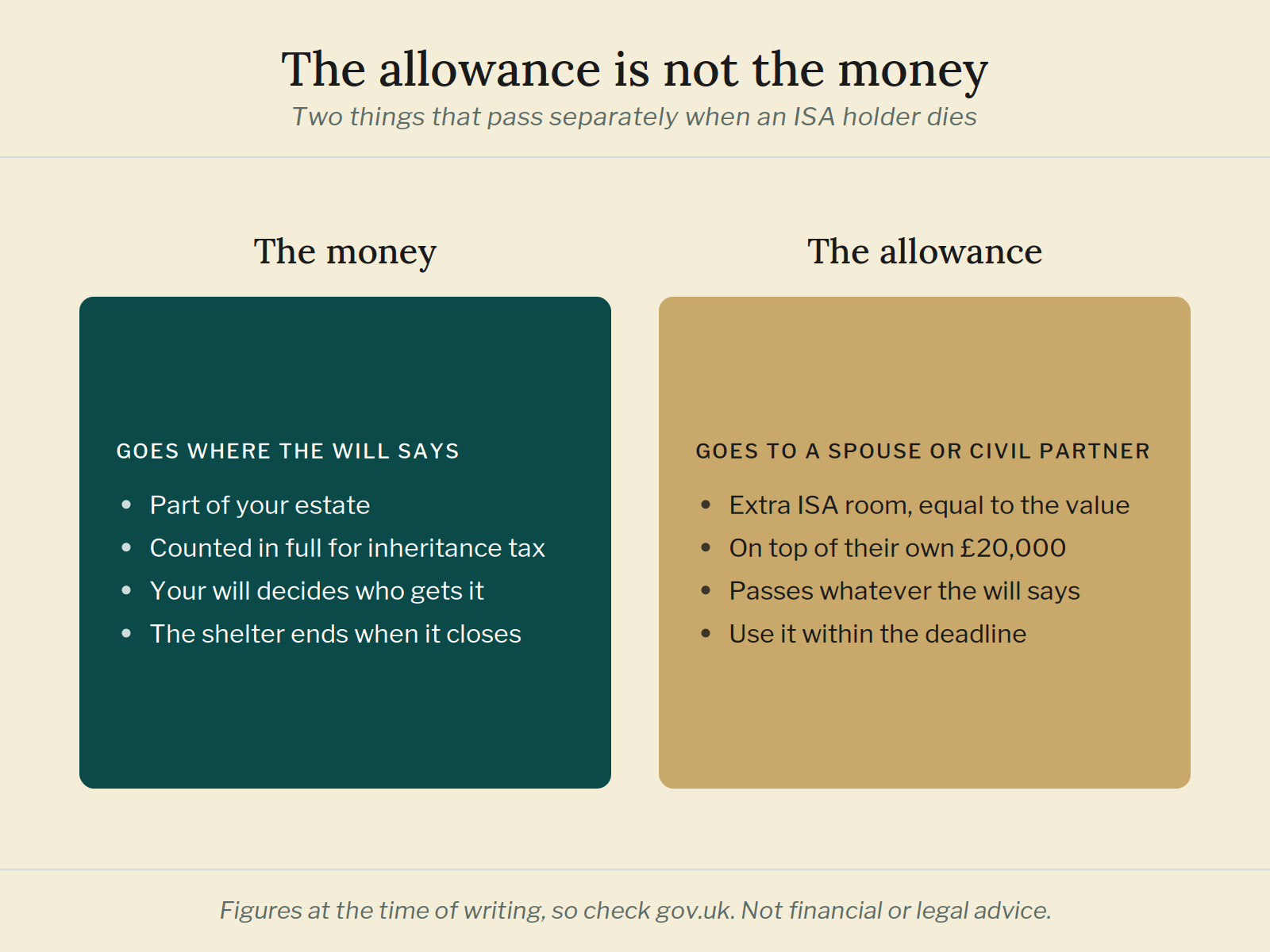
It is the allowance that passes, not the money.
This is the single most misunderstood rule in the whole area. The money in your ISA goes wherever your will sends it, like everything else you own. The extra allowance goes to your spouse or civil partner automatically, whatever the will says.
So if you leave the pot to your children, your spouse still gets an allowance the size of your ISA, and has to fill it from their own savings. And if you leave everything to your spouse, they get both: the money, and the room to shelter it without using up their own £20,000.
The deadlines are generous, and they are not the same for everyone
For a cash subscription, the allowance has to be used within three years of the death, or 180 days after the administration of the estate completes, whichever is longer. Where the investments are moved across as they are rather than sold, it is 180 days from the date the assets are distributed. Providers vary in how smoothly they handle this, so it is worth asking early rather than close to the deadline.
Three things worth doing while it is easy
None of this needs a decision today, but all three are cheaper to sort out now than later.
Write down where the accounts are.
Executors cannot claim an allowance they do not know exists. A list of providers, kept with the will, saves months.
Ask your provider how they handle the inherited allowance.
The rules are the same everywhere, the administration is not. Some handle it in weeks, some in months, and you will find out at the worst possible time.
Check the will and the allowance point the same way.
Leaving the pot to the children and the allowance to your spouse is perfectly legal and occasionally not what anyone intended. It is worth a conversation with whoever drafts the will.
If you are earlier in the journey than this, my free ISA Starter guide covers opening and running one from scratch, and the book sets out the whole method.
If you are not married or in a civil partnership
Then there is no extra allowance, whatever the relationship. An unmarried partner, a child, a sibling or a friend can inherit the money through your will, but not the wrapper and not the allowance. Whatever they do with it afterwards happens in the open, taxable like any other savings or investment, unless they have their own ISA room to use.
It is a blunt rule and it catches long-term unmarried couples in particular. Worth knowing before it matters rather than after.
Do my beneficiaries pay tax on money they inherit from an ISA?
Not on receiving it. Inheritance tax, if any is due, is paid by the estate before anything is distributed. Once the money is theirs, any future interest, dividends or gains are taxed in the normal way unless they put it inside their own ISA.
Does my spouse have to use the same provider?
Not for the allowance itself, which can usually be used with another provider. But if the investments are to be moved across as they are, rather than sold and repurchased, that generally does need both accounts to be with the same provider. Ask before assuming.
What if the ISA grows after I die?
Growth inside the continuing account is still sheltered until the account closes. For deaths from April 2018 the inherited allowance can be based on the value when the account closes rather than the value at the date of death, so growth in between is not lost to the allowance.
Can I leave my ISA to my children?
Yes. The money follows your will like any other asset. What your children cannot inherit is the tax shelter: the wrapper ends and only a spouse or civil partner gets the extra allowance.
Does a Junior ISA work the same way?
No. The rules here are about adult ISAs. The Junior ISA has its own treatment, and the money belongs to the child from the start.
Rules and allowances change, so check gov.uk for the current position, and this is an area where a solicitor earns their fee.
Key takeaways
All figures are correct at the time of writing and can change, so always check gov.uk for the current numbers. The value of investments can go up and down, and you can get back less than you put in. This is general information, not financial advice. If you are unsure, speak to a regulated financial adviser.