

The Pension Isn’t the Whole Plan: Where the ISA, LISA and JISA Come In
A pension shouldn’t be your whole plan, because an ISA does what a pension can’t: everything comes out tax-free, and you can reach it at any age. Take any employer pension match first, because that is free money no ISA beats. Then let the ISA, the Lifetime ISA and the Junior ISA do the jobs the pension leaves untouched: a bridge to early retirement, a first home, and a child’s head start.
Ask most people how they’re saving for later and you’ll hear one word: pension. It’s the default, and for a good reason. If your employer matches what you pay in, that match is free money, and no ISA on earth beats it. Auto-enrolment put most of us into one automatically, so the pension ticks along in the background whether we think about it or not.
Then the conversation stops. The pension gets all the attention, and the rest of the plan, the part this whole site is about, gets skipped. The ISA, the Lifetime ISA (LISA) and the Junior ISA (JISA) do things a pension simply can’t, and together they cover a life the pension leaves untouched. This isn’t a case for dropping your pension. It’s a case for noticing what sits next to it.
Here’s the honest version of the pension. On the way in, the tax relief is real, and for a higher-rate taxpayer it’s hard to beat. But there’s a bill waiting on the way out: only 25% comes out tax-free, capped at £268,275, and the other 75% is taxed as income when you draw it (figures at the time of writing, check gov.uk). You can’t touch any of it until you’re 55, and that rises to 57 in April 2028. And from 6 April 2027, unused pension pots start counting towards inheritance tax, which for years they didn’t. A pension is a good box. It’s just a box with a lock and a tax gate, and one plan built entirely around it leaves a lot of your life uncovered.
Pension, ISA and Lifetime ISA at a glance
| Pension | Stocks and shares ISA | Lifetime ISA | |
|---|---|---|---|
| Going in | Tax relief, often plus an employer match | No relief: paid from taxed money | 25% government bonus, up to £1,000 a year |
| Coming out | 25% tax-free (capped at £268,275), the rest taxed as income | Tax-free | Tax-free for a first home or from 60 |
| When you can reach it | From 55, rising to 57 in April 2028 | Any time | First home or from 60; otherwise a 25% charge |
The ISA does the thing a pension can’t
A stocks and shares ISA is funded from money you’ve already been taxed on, so there’s no relief going in. That’s the trade. In return you get the one thing the pension withholds: everything comes out tax-free, and you can reach it whenever you like.
Nothing is taxed on the way out
No income tax, no tax on growth, no tax on dividends, ever. The £20,000 you can pay in each year (2026/27, check gov.uk) shelters compound returns for as long as you hold it, and when you take the money, all of it is yours. Set that against a pension’s taxed 75% and the ISA closes a lot of the gap the relief opened.
You can actually reach it
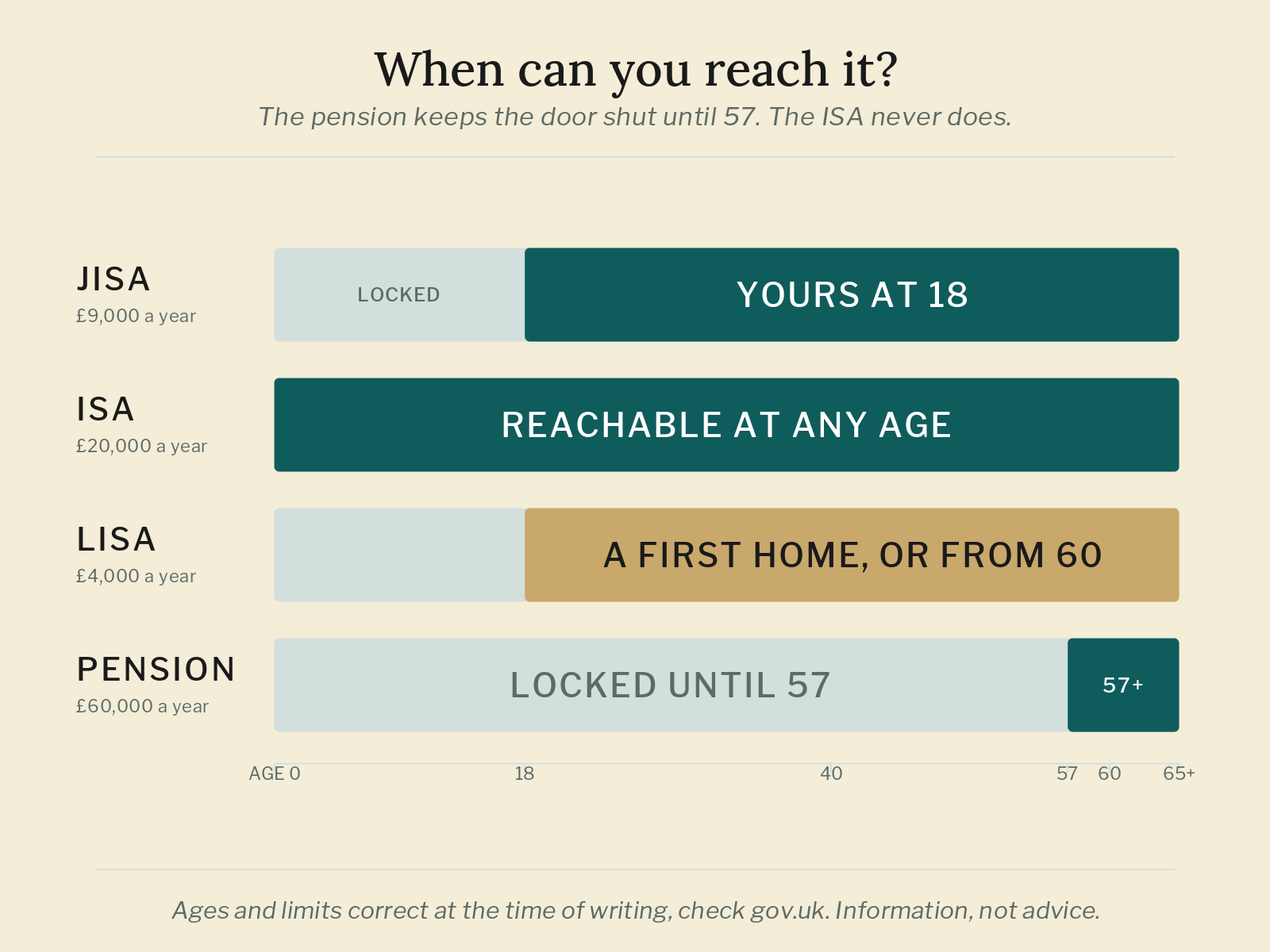
This is the part people miss. Money in an ISA isn’t locked to an age set by the government. Retiring at 52 and need something to live on until the pension unlocks, at 55 today and 57 from 2028? The ISA is the bridge. A pension can’t do that, because a pension won’t let you in yet. Flexibility isn’t a nice-to-have here, it’s the whole point.
The LISA and the JISA finish the picture
The plain ISA is the engine. The other two members of the family cover the moments a pension never reaches: buying your first home, and giving a child a head start.
The LISA hands you a bonus and a way into a first home
A Lifetime ISA pays a 25% government bonus on what you put in, up to £1,000 a year on a £4,000 limit (which sits inside your £20,000 overall allowance). That bonus works like basic-rate relief going in, except the money comes out tax-free rather than taxed. You can use it for a first home costing up to £450,000, or from age 60. The catches are worth knowing: you have to open it between 18 and 39 and can pay in until 50, and if you take the money out for anything other than a first home or age 60 there’s a 25% charge that claws back the bonus and a slice of your own money too (all check gov.uk). Inside those rails, it’s the most generous way into a first property most people will ever be offered.
The JISA gives a child two decades of compounding
A Junior ISA lets you put up to £9,000 a year away for a child, and it sits on top of your own £20,000, not inside it. Anyone can pay in, the money is locked away until they turn 18, and then it becomes their own ordinary ISA. Start one early and you’re handing an 18-year-old two decades of tax-free compound returns before they’ve earned a penny themselves. A pension has no answer to this.
Where the pension still wins, and it does
None of this makes the pension the loser. If your employer matches contributions, take that match before anything else, because doubling your money on the way in beats every ISA advantage listed here. The honest picture isn’t ISA instead of pension. It’s the match first, then the ISA family doing the work the pension can’t.
So should I stop paying into my pension?
No. If there’s an employer match on offer, that’s the best return you’ll get anywhere, and walking past it to fund an ISA would cost you. The point isn’t to choose one box, it’s to stop pretending the pension is the only box. Most people can run a pension and an ISA side by side, and the two cover different jobs.
Isn’t the pension’s tax relief better than an ISA?
It depends on when you’d rather pay the tax. A pension gives relief now and taxes you later; an ISA takes no relief now and never taxes you again. For a higher-rate taxpayer expecting a lower rate in retirement, the pension’s timing can win. For someone who values reaching the money before 57, or leaving it untaxed to a family, the ISA earns its place. Neither is a trick, they’re two different deals, and this is information, not a recommendation about your situation.
Can I use a LISA and a pension at the same time?
Yes. They’re separate wrappers with separate rules, and plenty of people run both, the LISA for a first home or a tax-free chunk at 60, the pension for the relief and the employer match. Using one doesn’t shut the door on the other.
What happens to a Junior ISA when the child turns 18?
It automatically becomes a normal adult ISA in their name, and the money is theirs to manage. They can leave it invested and let the compounding roll on, or take it out. It’s worth a conversation before that birthday arrives.
Which should come first?
As a rule of thumb, take any employer pension match first, then turn to the ISA. I set out the full sequence in The Order of Operations, but the short version is: grab the free money, then let the ISA do the heavy lifting.
Key takeaways
All figures are correct at the time of writing and can change, so always check gov.uk for the current numbers. The value of investments can go up and down, and you can get back less than you put in. This is general information, not financial advice. If you are unsure, speak to a regulated financial adviser.