

Flexible ISAs Explained: Taking Money Out and Putting It Back
A flexible ISA lets you take money out and put it back later in the same tax year without using up any more of that year’s allowance. In an ISA that isn’t flexible, money you withdraw still counts as used: putting it back is treated as a new payment in. Whether an ISA is flexible is the provider’s choice, not a right, and Lifetime ISAs and Junior ISAs can’t be flexible at all.
That’s the question behind most searches for it: if I need some of my money, do I lose that part of my allowance? In a flexible ISA, no, as long as the money goes back before the tax year ends. Here’s how it works, which accounts it applies to, and where it stops being useful.
How does a flexible ISA work?
A worked example
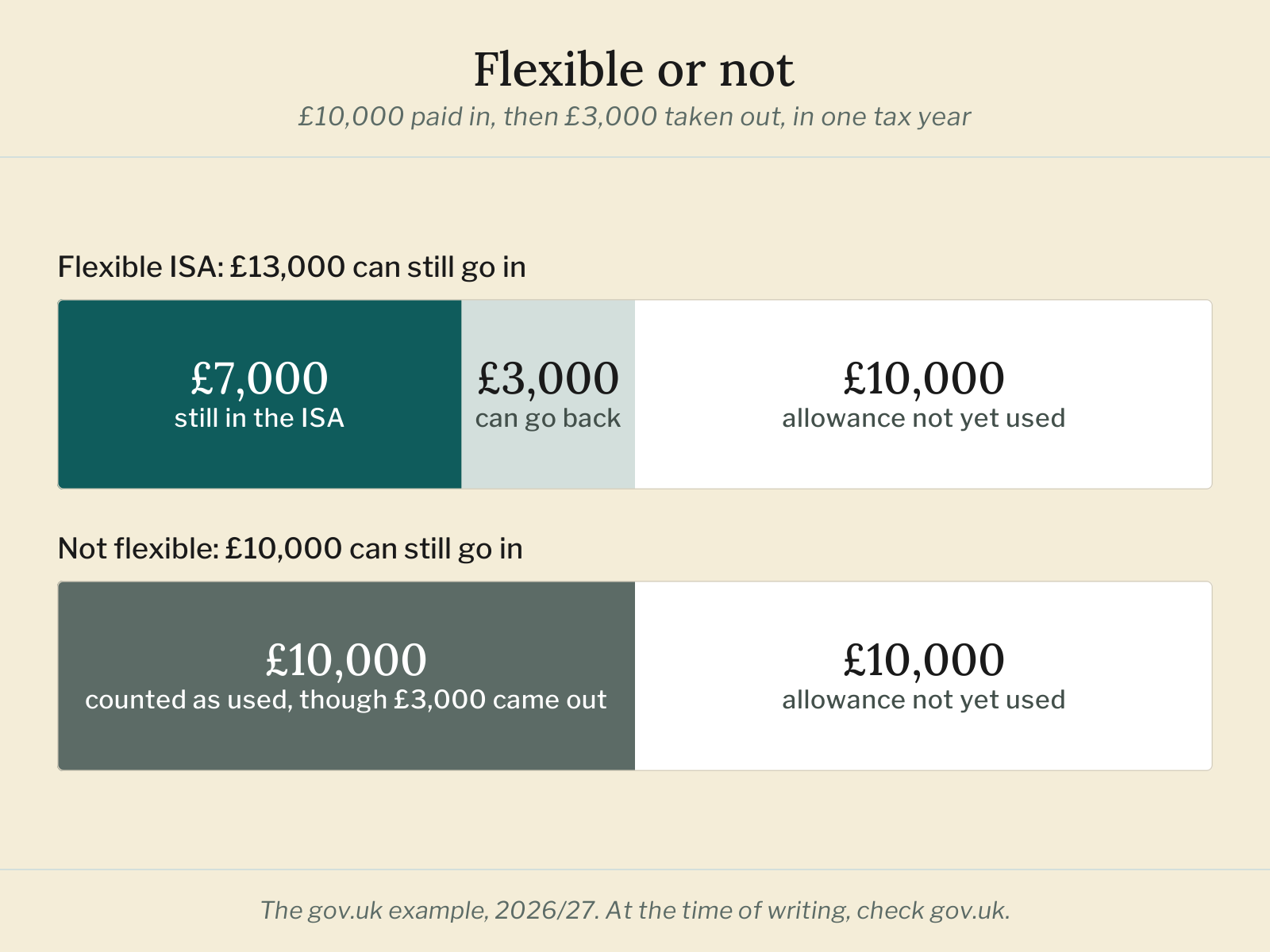
This is the example gov.uk uses. Your allowance is £20,000, at the time of writing. You pay £10,000 into an ISA in the 2026/27 tax year, then take £3,000 out. If the ISA is flexible, you can still pay in £13,000 before the tax year ends: the £10,000 of allowance you hadn’t used, plus the £3,000 you took out. If it isn’t flexible, you can pay in only £10,000, because the £3,000 you withdrew still counts as used.
It works within one tax year
The money has to go back in the same tax year it came out. The tax year runs from 6 April to 5 April, so £3,000 taken out in March has until 5 April to go back. After that, the flexibility on that withdrawal ends, and anything you pay in uses the new year’s allowance.
It covers money from earlier years too
In a flexible ISA you can also take out money you paid in during earlier tax years and put it back, as long as it goes back in the same tax year and into the same ISA it came out of. That’s set out in HMRC’s guidance for ISA providers.
It’s the cash that’s flexible, not your investments
Flexibility applies to cash. In a stocks and shares ISA, that means the cash in the account, including cash from selling investments. So getting money out of a stocks and shares ISA usually means selling something first, and what goes back in is cash that then has to be invested again.
Which ISAs can be flexible?
| ISA type | Can it be flexible? |
|---|---|
| Cash ISA | Yes, if the provider offers it |
| Stocks and shares ISA | Yes, for the cash held in it, if the provider offers it |
| Innovative finance ISA | Yes, if the provider offers it |
| Lifetime ISA | No |
| Junior ISA | No |
Rules at the time of writing, from HMRC’s guidance for ISA managers. Check gov.uk for the current position.
A Lifetime ISA has its own rules for taking money out, and an early withdrawal carries a 25% charge, at the time of writing. A Junior ISA is locked until the child turns 18.
How do you know if yours is flexible?
Offering flexibility is optional for providers, and plenty don’t. The account’s terms and conditions will say, or the provider can tell you, which is what gov.uk says too. It’s one of the details that varies between accounts.
What are the catches?
The money has to go back in time, and some of it into the same account
Miss 5 April and that room is gone. Where the money can go back depends on which money it was. Taking out money you paid in this tax year frees up that part of your allowance, and it can go into any ISA, including a different one. Money from earlier tax years, and anything above what you’ve paid in this year, such as growth or interest, can only go back into the ISA it came out of; paid in anywhere else, it counts as a new payment against your allowance. That matters more now that so many people hold more than one ISA.
Selling investments to get cash out has a cost
In a stocks and shares ISA, money taken out has usually come from selling something, perhaps after a fall, and while it’s out of the market it isn’t growing. Selling turns a fall on paper into a real loss, which is the case I set out in should you cash in your stocks and shares ISA.
Without flexibility, a withdrawal uses that part of the allowance for good
If your ISA isn’t flexible, the £3,000 in the example is gone from this year’s allowance the moment it comes out. You can still take your money out whenever you like. You just can’t put it back without using more allowance.
A transfer isn’t a withdrawal
Moving an ISA to another provider through a proper transfer doesn’t use any allowance and doesn’t need flexibility at all. Taking the money out and paying it in somewhere else does. How to transfer an ISA covers the difference.
What changes in April 2027
The Autumn Budget on 28 October 2026 kept the cash ISA limit at £20,000 for all savers over 18, so the planned £12,000 limit from April 2027 won’t go ahead. Two other April 2027 rules, no transfers from a stocks and shares or innovative finance ISA into a cash ISA for under-65s and a charge on interest from cash in a stocks and shares ISA, were set in regulations made in September 2026 and are still to be confirmed after the Budget. That’s at the time of writing, so check gov.uk for the latest. I go through what changed in the Autumn Budget 2026 and your ISA and the 22% charge on cash in a stocks and shares ISA.
Where flexibility fits in a plan
Flexibility is a safety valve, not a reason to treat a long-term ISA like a current account. What stops most people needing to dip in at all is a cash buffer of three to six months’ spending, kept somewhere instant, which is the first step in the order of operations. With that in place, a stocks and shares ISA can be left alone to do its job, which is the whole difference between the two accounts in cash ISA vs stocks and shares ISA.
If you’re new to all this, Getting Started lists the articles in the order to read them. My free ISA Starter guide walks through opening an ISA step by step, and the book sets out how I use the allowance year after year.
Is my ISA flexible?
Only if your provider’s terms say so. It’s optional for providers: the terms will say, or the provider can confirm.
Does it work with a stocks and shares ISA?
Yes, if the provider offers it, but it’s the cash in the account that’s flexible. Money usually comes out after selling investments, and it goes back in as cash.
What happens if I don’t put the money back by 5 April?
The flexibility on that withdrawal ends. Anything you pay in from 6 April uses the new tax year’s allowance.
Can I put the money back into a different ISA?
Partly. Taking out money you paid in this tax year frees up allowance you can use in another ISA. Money from earlier years, and anything above this year’s payments, such as growth or interest, can only go back into the ISA it came out of without using allowance.
Can a Lifetime ISA or a Junior ISA be flexible?
No. HMRC’s rules exclude both.
Do I need to tell HMRC when I take money out or put it back?
No. There’s nothing to fill in. Your provider keeps track.
Key takeaways
All figures are correct at the time of writing and can change, so always check gov.uk for the current numbers. The value of investments can go up and down, and you can get back less than you put in. This is general information, not financial advice. If you are unsure, speak to a regulated financial adviser.