

Should You Cash In Your Stocks and Shares ISA?
Markets have had a bad month, or the boiler’s gone, or you’ve looked at the balance and thought: I could actually use that. So the question is whether you can take it out.
You can. You can cash in a stocks and shares ISA whenever you want, in whole or in part, and there’s no tax to pay on the way out. That part is genuinely simple. The cost sits somewhere else, and most people don’t see it until it’s too late to undo: you usually cannot put the money back.
Can you cash in a stocks and shares ISA whenever you want?
Yes. gov.uk puts it plainly: you can take your money out of an ISA at any time without losing any tax benefits. No capital gains tax, no income tax, nothing to put on a tax return. The tax-free treatment applies on the way out as much as while the money sits there.
Two practical points before you do it.
Selling is not instant.
You have to sell the investments first, and that trade takes time to settle, typically a few working days for funds, before the cash can leave for your bank. If you need the money on a particular day, work backwards from it.
Check your provider’s terms.
Exit fees are less common than they were, but withdrawal charges, minimum balances and account-closure conditions still exist. They will be in your terms, not in the headline rate.
What it actually costs you
Not tax. The allowance.
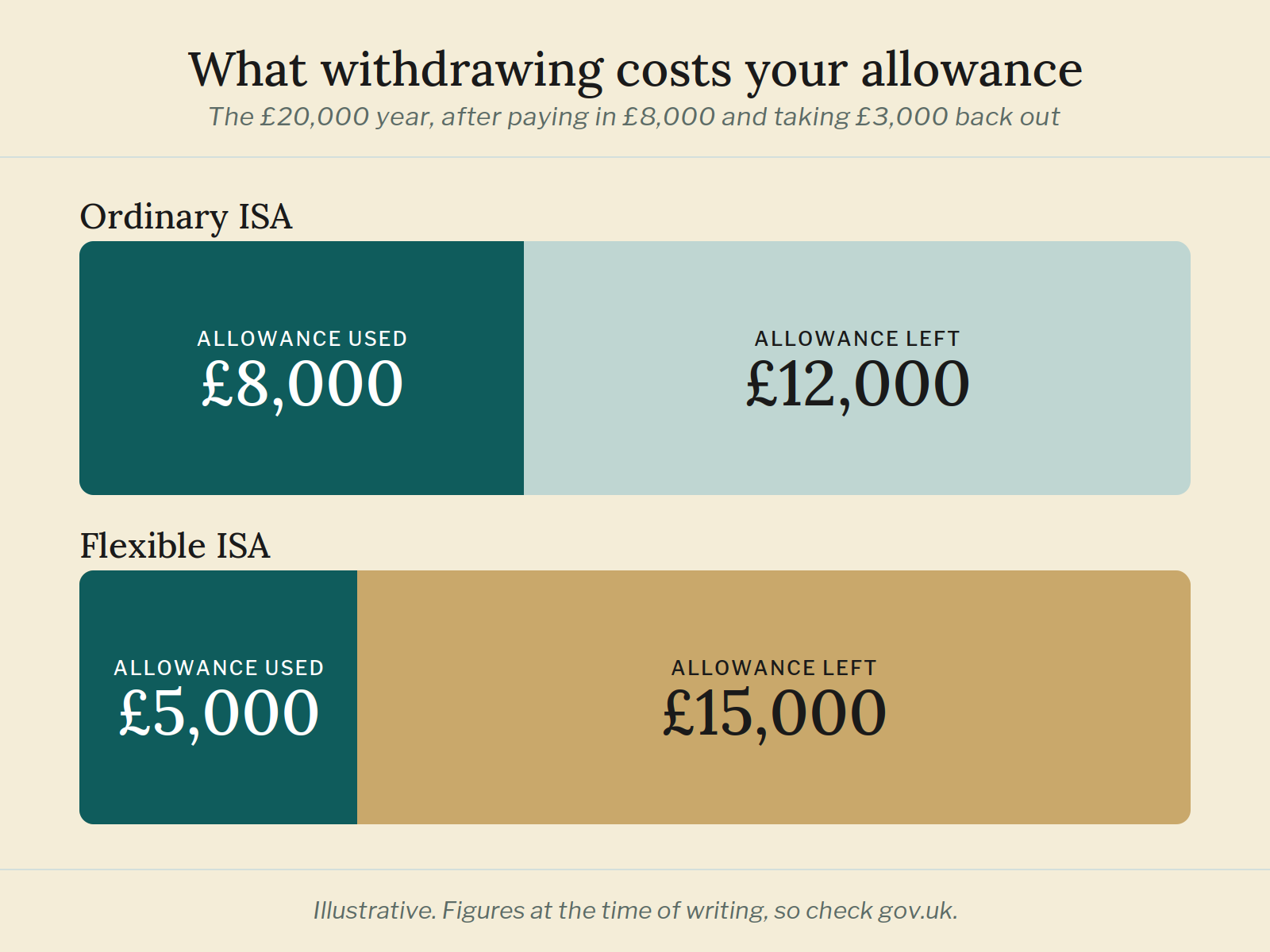
You can pay £20,000 into ISAs each tax year at the time of writing, and here is how the ISA allowance works. Say you have paid in £8,000 so far this year and you take £3,000 back out. On an ordinary stocks and shares ISA your remaining allowance is still £12,000, not £15,000. The £3,000 you withdrew does not return to your allowance. You have spent it, and for that tax year it is gone.
That is the trap. The money is yours and you can have it whenever you like, but the tax-free room it was sitting in does not come back with it.
Is your ISA flexible?
Some ISAs are what HMRC calls flexible. On a flexible ISA you can take money out and put the same amount back during the same tax year without it counting against your allowance a second time. It is the difference between the £12,000 above and £15,000.
Whether that applies to you depends on two things people routinely get wrong.
It is your provider’s choice, not a right.
Flexibility only exists where the terms and conditions of your account provide for it. Plenty of stocks and shares ISAs are not flexible. It is worth checking rather than assuming, because the assumption is what costs you the allowance.
On a stocks and shares ISA it only covers cash.
This is the part almost nobody mentions. The rules let providers offer flexibility on cash ISAs and on cash held inside a stocks and shares ISA. Not on the investments themselves. So the behaviour you get after selling a fund and withdrawing the proceeds may not be the behaviour you expected.
Two more details worth having. The tax year is the boundary, so money replaced after 5 April counts as a fresh subscription. And money you paid in during earlier tax years has to go back into the same ISA you took it from, while money paid in during the current year can go into any of them.
If you are changing providers, transfer, do not withdraw
This is the most expensive version of the mistake. Withdrawing from one ISA and paying into another uses your allowance twice over for the same money, and anything above £20,000 simply cannot go back in. An ISA transfer moves it directly between providers with the tax-free status intact and the allowance untouched. The mechanics are in transferring an ISA without losing the tax break.
Should you cash in when markets fall?
This is the most-asked version of the question, so it deserves a straight answer rather than a shrug. The evidence points firmly one way, and it is worth knowing which way before you act.
A fall on screen is a loss on paper. Selling is what converts it into a real one, and it takes you out of the recovery at the same time. That is the mechanism behind most poor outcomes in investing, and it is arithmetic rather than a failure of willpower. It is the same trap I write about in the behaviour gap.
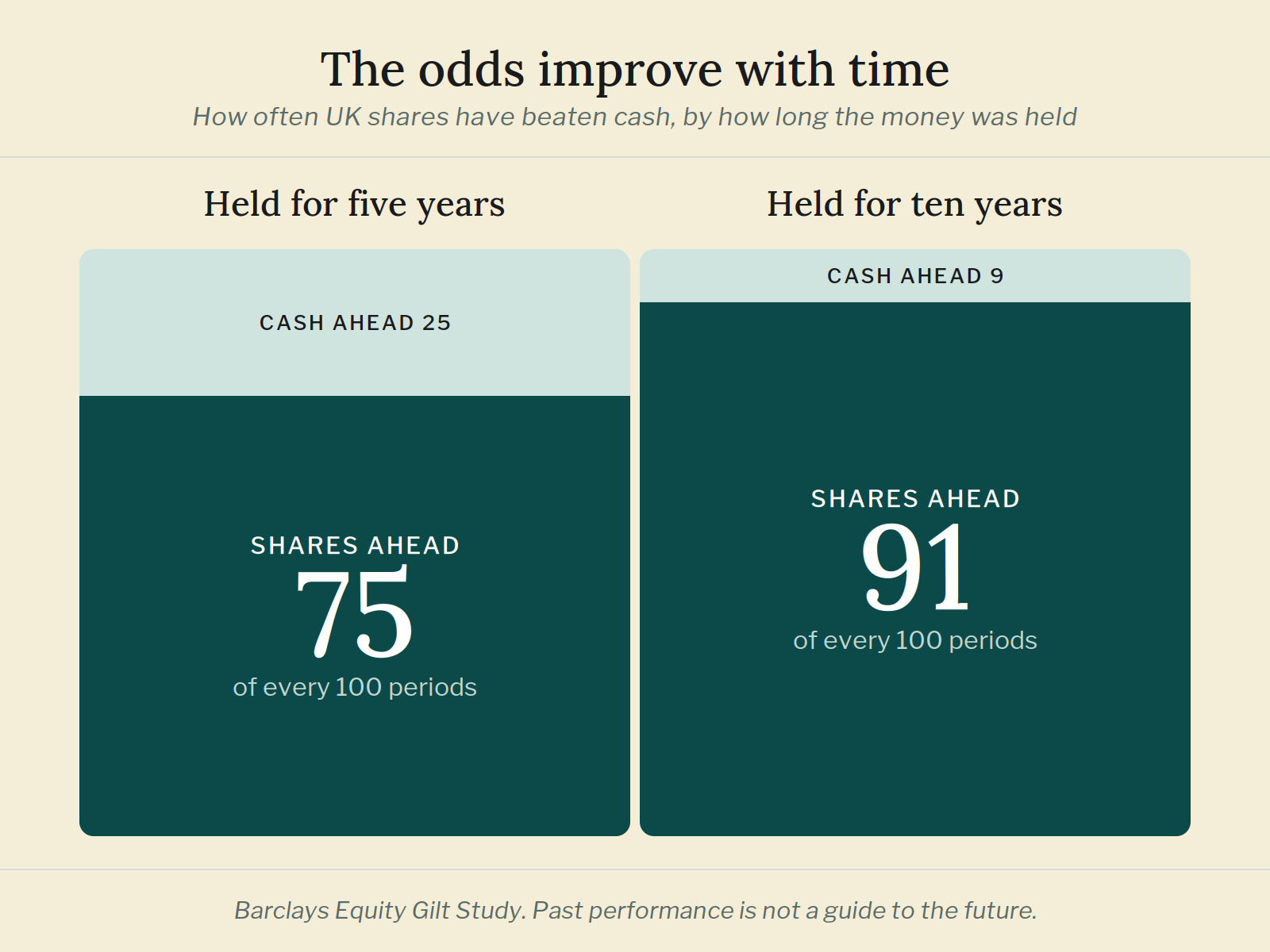
The scale of it is measurable. The Barclays Equity Gilt Study has tracked UK shares against cash since 1899. Over the periods it covers, shares beat cash in 91% of ten-year stretches and 75% of five-year stretches. Over one or two years, cash wins more often than it loses. The odds move in your favour the longer you stay in, and selling during a fall is precisely the act that shortens your holding period.
None of that is a promise. Past performance is not a guide to the future, the value of investments rises and falls, and you can get back less than you put in.
When cashing in is the right call
Plenty of the time it is, and treating every sale as a mistake would be its own kind of nonsense.
Cashing in because you have reached what you were saving for is the plan working, not failing. The same goes for money whose job has changed: if what was long-term money is now needed inside two years, it stops being money for a stocks and shares ISA, and the sensible home for it is cash. I go through where each type of money belongs in the difference between a cash ISA and a stocks and shares ISA.
The harder case is money that should never have been invested in the first place, usually because there was no emergency fund behind it. Selling at a bad moment to cover something urgent is not a discipline problem. It is a sequencing one, and the answer is the buffer, not more willpower.
Selling because you have arrived and selling because you are frightened look identical from the outside. They are opposites. The useful question is not whether to cash in, it is which of the two you are doing.
How long does it take to cash in a stocks and shares ISA?
Usually a few working days. The investments have to be sold and the trade settled before the cash can be paid out, and the payment to your bank adds a day or two on top. It is rarely same-day.
Do I pay tax when I cash in a stocks and shares ISA?
No. There is no capital gains tax or income tax on money coming out of an ISA, whatever it has grown to, and nothing to declare on a tax return.
Can I take out just part of it?
Yes. There is no requirement to close the account or sell everything. A partial withdrawal leaves the rest invested and still inside the wrapper.
Does cashing in close the account?
Not automatically. Most providers leave an emptied ISA open, which matters, because keeping it open preserves your ability to pay back into it later in the same tax year if it is flexible. Check before you empty it.
Can I put the money back later?
Only within the limits above: the same tax year, and only if the account is flexible. Otherwise you are paying in fresh money against whatever allowance you have left. If you are weighing up a withdrawal, my free ISA Starter guide covers how the allowance works alongside the basics of running the account, and the book sets out the longer method.
Allowances and rules change, so check gov.uk for the current figures before you act.
Key takeaways
All figures are correct at the time of writing and can change, so always check gov.uk for the current numbers. The value of investments can go up and down, and you can get back less than you put in. This is general information, not financial advice. If you are unsure, speak to a regulated financial adviser.