

How to Spot Investment Hype, Scams and Finfluencer Noise
The surest sign of an investment scam is a promise of returns that are quick, safe and effortless: real investing never offers all three. Check any firm on the FCA (Financial Conduct Authority) Register before paying a penny, walk away from pressure to act fast, and treat anyone selling a course, a coin or a tip as selling, not advising.
If something promises to make you rich quickly, safely and with no effort, it is lying. That one sentence would protect more people’s money than any amount of financial education. The trouble is that the lie has got very good at dressing up as opportunity.
Here is how to spot investment hype, scams and finfluencer noise before they cost you: the red flags that give them away, how to check whether something is legitimate, and why the boring, government-backed alternative usually wins.
The red flags
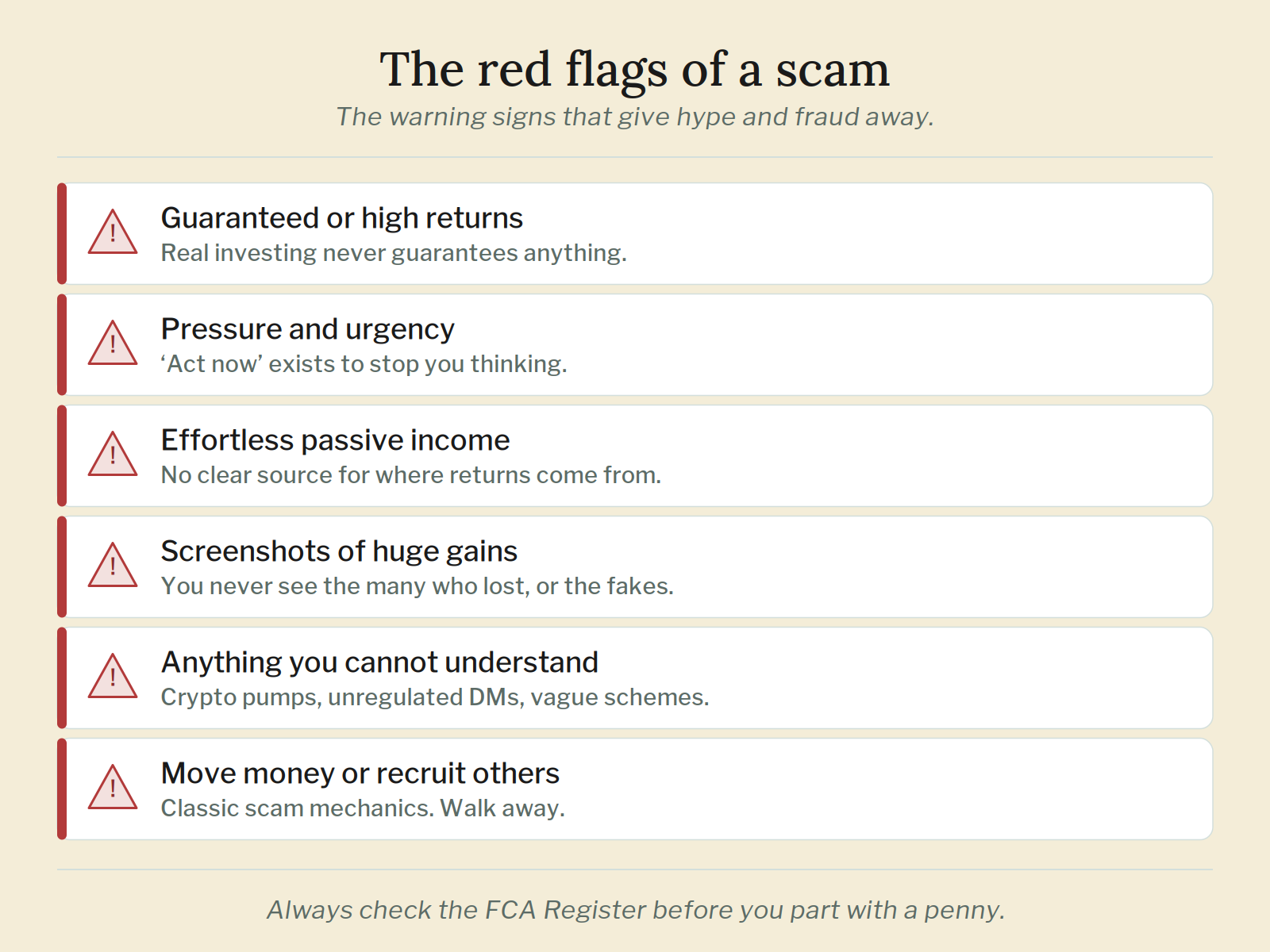
- Guaranteed or unusually high returns. Real investing never guarantees anything. ‘12% a month’ or ‘risk-free returns’ is the oldest tell there is.
- Pressure and urgency. ‘Closing soon’, ‘only a few spots left’, ‘you have to act now’. Urgency exists to stop you thinking.
- Get-rich-quick and effortless passive income, with no clear explanation of where the returns actually come from.
- Finfluencers posting screenshots of huge gains. You only see the winners, never the thousands who lost, and a lot of those posts are paid promotion or simply faked.
- Anything you do not understand, especially crypto pump schemes and unregulated ‘opportunities’ pushed through direct messages.
- Being asked to move money off a regulated platform, act in a hurry, or recruit other people. Those last two are classic scam mechanics.
How to check before you part with a penny
Before giving anyone your money, check the Financial Conduct Authority (FCA) Register to see whether the firm is authorised. Use the FCA’s ScamSmart tool and its Warning List, which name known scams and unauthorised firms. If something touches your money and is not regulated, be very cautious. And watch for cloning: scammers copy the names and details of real, authorised firms, so check the contact details against the FCA Register directly rather than trusting the ones you were given.
Why the hype targets you
The honest version of building wealth, spread your money sensibly, contribute regularly, hold for years, does not sell courses or rack up views. The dramatic version does. The algorithms reward whatever keeps you watching, and ‘I got rich overnight’ keeps you watching far longer than ‘I invested steadily for fifteen years’. None of that makes the dramatic version true. It just makes it loud.
The boring alternative that actually works
A stocks and shares ISA is the opposite of a scam in almost every way. It is government-backed, tax-free, completely transparent, and there is no urgency, no secret and no pressure to recruit anyone. It will never trend online, because it works slowly. That is not a weakness. That is the whole point. The things that build real wealth are usually too dull to go viral.
One honest line about risk
Legitimate investing still carries risk, and your investments can fall in value. The difference between honest risk and a scam is not the presence of risk, it is honesty about it. A real product tells you that you can lose money. A scam tells you that you cannot.
How do I know if something is a scam?
Watch for guaranteed or high returns, pressure to act fast, vague explanations, unregulated firms, and anything that sounds too good to be true. Several of those together is a strong warning.
How do I check whether a firm is legitimate?
Use the FCA Register and the FCA’s ScamSmart tool and Warning List. Check contact details against the Register directly, as scammers clone real firms.
Are finfluencers trustworthy?
Treat them with caution. Many are not qualified, screenshots are easily faked or cherry-picked, and a lot of posts are paid promotion. Never act on a tip alone.
What if I think I have been scammed?
Report it to the FCA and to Action Fraud, and contact your bank straight away. Acting quickly gives the best chance of help.
Key takeaways
All figures are correct at the time of writing and can change, so always check gov.uk for the current numbers. The value of investments can go up and down, and you can get back less than you put in. This is general information, not financial advice. If you are unsure, speak to a regulated financial adviser.