

Diversification: What Actually Spreads Your Risk
Diversification means spreading your money across holdings that do not all move together, so one company, sector or country going wrong cannot sink the whole pot. Owning many things is not the same thing: twenty bank shares, or five funds holding the same big companies, carry much the same risk as one.
Owning twenty shares feels safe until the day you notice they are all banks. Diversification is one of the few things in investing that comes close to a free lunch, but only if you do the version that works. The version that does not, holding a lot of things that all move together, hands you the feeling of safety while you carry the same risk you started with.
The risk you are not paid to take
Markets pay you for one kind of risk: the risk of being invested at all, the chance that the whole market falls. They do not pay you for the risk of picking the single company that goes bust, because you could have avoided that by holding more than one. That second kind, specific risk, is what diversification removes. Spread your money across enough unrelated holdings and one failure dents you rather than sinks you, without lowering what you can expect to earn. You give up nothing but the extremes.
It is about correlation, not the number of holdings
Thirty UK banks is not a diversified portfolio, it is one bet placed thirty times. What matters is whether your holdings move together. Two things that rise and fall in step give you no protection, however many of them you own. Real diversification comes from owning things driven by different forces: different companies, yes, but also different sectors, different economies and different types of asset. A single global index fund holds thousands of companies across dozens of countries in one line, which is why it is often more diversified than a shelf full of hand-picked funds.
Most of us own too much of home
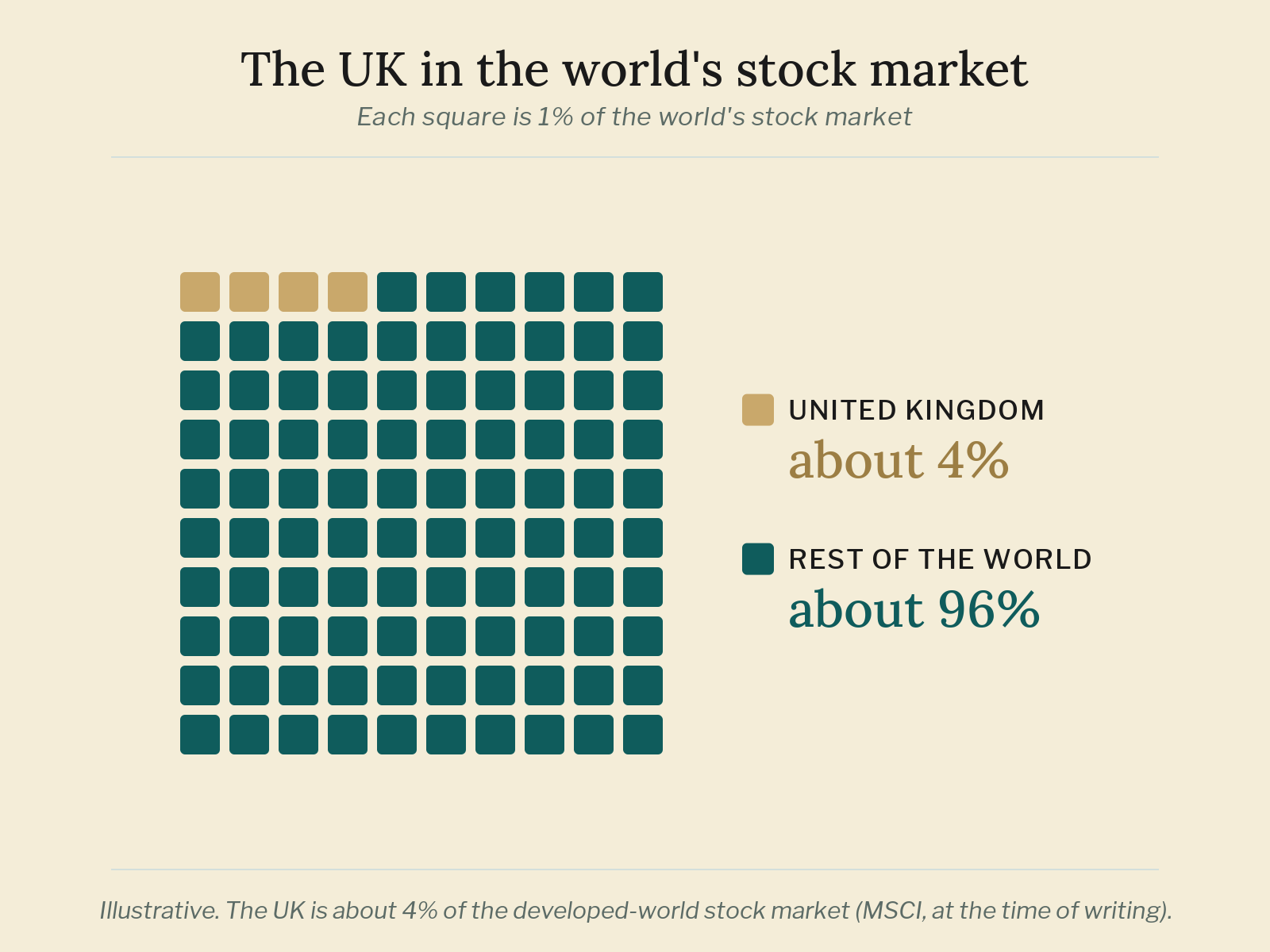
Left to instinct, people buy what they know, and for a UK investor that means UK shares. Yet the UK is a small part of the world’s stock market, around 4% at the time of writing. Tilt your whole portfolio towards it and you are making a large bet on one economy, its currency and the handful of sectors, oil, banks, miners and drugs, that happen to dominate the index. A broad global fund fixes that cheaply, and you can hold the whole thing inside your ISA, so the growth, dividends and interest stay tax-free while you diversify.
More funds is not more diversified
Once people catch the diversification bug, they tend to overshoot. Eight funds sounds safer than one, but if six of them hold the same large US companies, you have paid for overlap, not protection. This is diworsification: more cost and more admin for no extra safety, and sometimes less, because the clutter hides what you actually own. One or two broad funds usually cover more ground than a drawer full of niche ones. Diversification is about reach, not quantity.
What it cannot do
Diversification handles the risk specific to one company or sector. It does not remove market risk, the risk that everything falls at once. In a serious crash, correlations rise: assets that normally drift apart drop together, and a diversified portfolio still loses value. That is not a flaw, it is the point. You are paid over the long run precisely for bearing the risk that cannot be diversified away. Anyone selling you protection from all loss is selling you something else.
Let it drift, then bring it back
A diversified mix does not stay put. Winners grow into a larger share of the pot, rebuilding the concentration you spread out to avoid. Rebalancing, trimming what has run and topping up what has lagged, restores the mix you chose. Once a year is plenty for most people. Inside an ISA there is no tax to deal with when you do it, which makes the housekeeping simpler than in a taxable account.
How many funds do I actually need?
Often one. A single broad global index fund can hold thousands of companies across the developed and emerging world. Adding more only helps if each one reaches somewhere the others do not. Count coverage, not funds.
Does diversifying lower my returns?
It narrows the range of outcomes rather than the average. You give up the chance of picking the one huge winner, and in exchange you avoid picking the one disaster. Over a long horizon you capture the market’s return without staking it on a single name.
Is a UK index fund diversified enough?
Less than it looks. It is concentrated in a few big sectors and tied to one economy and currency. It is a reasonable slice of a portfolio, but as the whole thing it leaves you exposed to how one country fares. A global fund spreads that.
Does diversification protect me in a crash?
Only partly. It cushions blows that hit one company or sector. It does not save you from a broad market fall, when almost everything drops together. Nothing invested in the market does.
Key takeaways
All figures are correct at the time of writing and can change, so always check gov.uk for the current numbers. The value of investments can go up and down, and you can get back less than you put in. This is general information, not financial advice. If you are unsure, speak to a regulated financial adviser.