

FTSE 100 Tracker or Global Tracker? What You’re Actually Buying
A FTSE 100 tracker buys the 100 largest companies listed in London, and nearly half of your money ends up in just ten of them. A global tracker buys more than a thousand companies across 23 countries, and about three-quarters of it is invested in the United States. Both are cheap, simple index funds. What sits inside them is very different.
Most people choose between the two on a feeling: one sounds familiar and safe, the other sounds big and far away. Neither feeling tells you much. Here’s what each one actually holds, using the index providers’ own figures.
What does a tracker actually do?
A tracker fund doesn’t pick shares. It copies an index, a published list of companies with a set weight for each, and holds them in the same proportions. When the index changes, the fund changes with it.
So the question “which tracker?” is really “which list?”. The fund’s name tells you the list. The list tells you what you own.
Is a tracker the same as an index fund or an ETF?
A tracker is any fund that copies an index. It can be built as an index fund or as an exchange-traded fund, which you buy and sell like a share. The wrapper changes how you buy it, not what’s inside. I cover the difference in index funds, ETFs and individual stocks.
What’s inside a FTSE 100 tracker?
The FTSE 100 is the 100 largest companies on the London Stock Exchange, weighted by their size. At the end of October 2026, according to FTSE Russell:
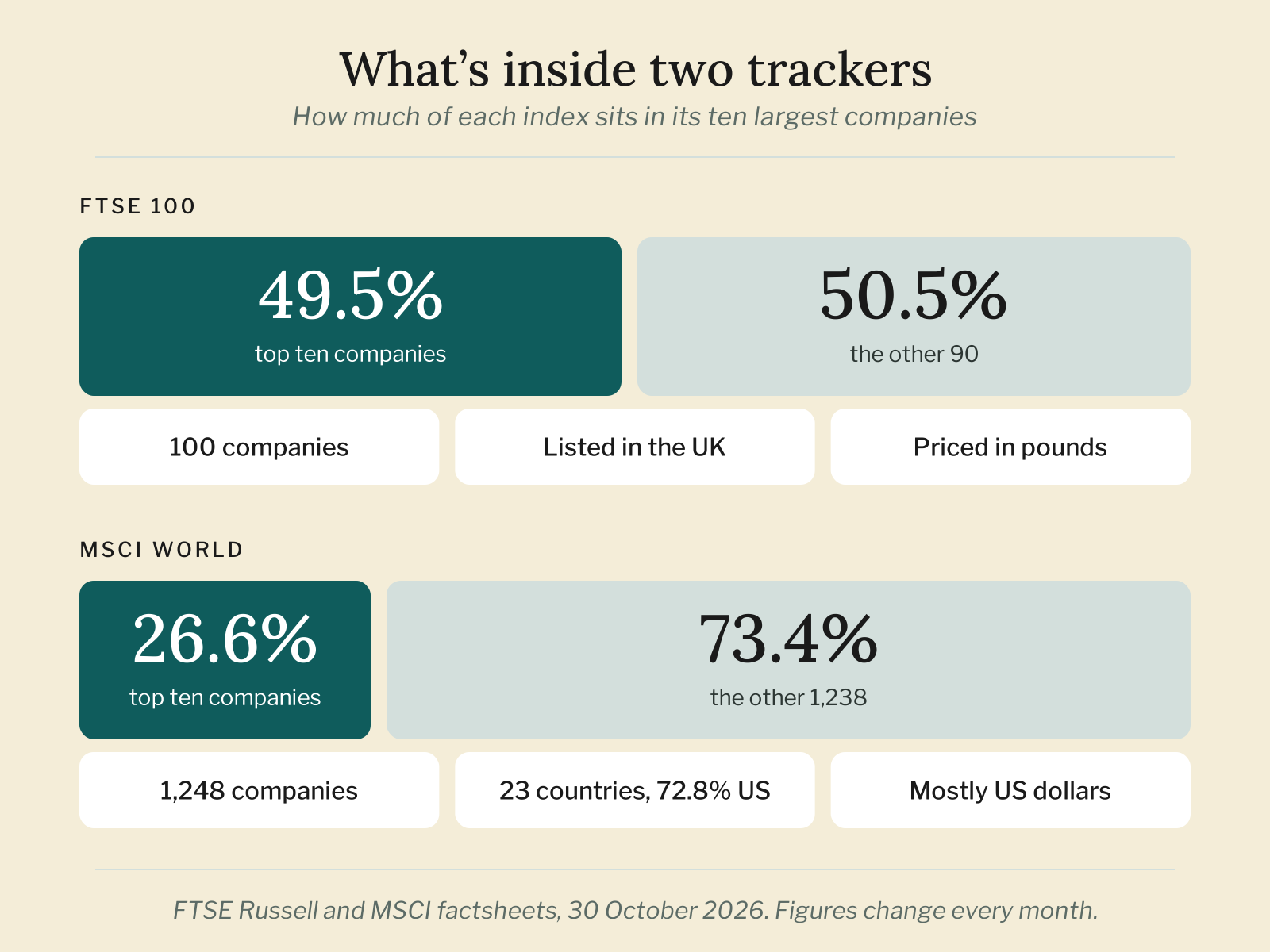
- The ten largest companies made up 49.5% of the index. Shell alone was 9.25%, HSBC 8.6% and AstraZeneca 8.2%.
- Five sectors made up more than half of it: banks (16.5%), energy (13.1%), health care (12.8%), industrial goods and services (11.1%), and food, drink and tobacco (7.3%).
- Technology was 2.7%.
- The dividend yield was 3.0%, about twice that of the global index below.
One thing surprises most people. “UK-listed” isn’t the same as “the UK economy”. About three-quarters of FTSE 100 companies’ revenue is earned outside the UK, according to the investment consultancy LCP. Shell sells oil around the world; AstraZeneca sells medicines in America, Europe and China. A FTSE 100 tracker gives you a set of large global businesses that happen to be listed in London, but it’s still a narrow set: a hundred companies, heavy in a few industries.
What’s inside a global tracker?
“Global tracker” covers more than one index, so it’s worth checking which one a fund follows. The most common are the MSCI World, which holds developed countries only, and the FTSE All-World, which adds emerging markets such as China and India. I’ve used the MSCI World here. At the end of October 2026, according to MSCI:
- It held 1,248 companies across 23 developed countries.
- The United States was 72.8%. Japan was 5.7%, the UK 3.5%, Canada 3.4% and Switzerland 2.3%.
- The ten largest companies made up 26.6%. Apple was 5.65%, NVIDIA 5.25% and Microsoft 4.1%. Eight of the ten are American technology and internet businesses.
- Information technology was the largest sector at 29.8%, followed by financials (16.2%) and industrials (10.8%).
- The dividend yield was 1.5%.
The FTSE All-World spreads a little further. At the end of September 2026, LSEG put its US weight at 62.3% and the UK at 3.1%.
So a global tracker isn’t an even slice of the world. It’s weighted by the size of each company, and the biggest companies in the world are mostly American. That’s the design, not a flaw, but it’s worth knowing before you buy.
FTSE 100 and MSCI World side by side
| FTSE 100 | MSCI World | |
|---|---|---|
| Companies | 100 | 1,248 |
| Countries | Listed in the UK only | 23 developed countries |
| Largest country | UK listing, but about three-quarters of sales abroad | United States, 72.8% |
| Largest sectors | Banks, energy, health care | Technology, financials, industrials |
| Top ten companies | 49.5% of the index | 26.6% of the index |
| Main currency | Pounds | US dollars |
Figures at 30 October 2026, from FTSE Russell and MSCI. The two providers group sectors slightly differently.
Why does the difference matter?
Concentration
Diversification is about spreading your risk so no single company or industry can sink you. In the FTSE 100, ten companies are about half the index and three industries are over 40%. In the MSCI World, the top ten are about a quarter, and the weight sits instead in one country and one sector. Each tracker is spread out in some ways and concentrated in others. I go into how to judge this in what actually spreads your risk.
Currency
A FTSE 100 tracker is priced in pounds, and most of a global tracker is priced in other currencies, mainly the dollar. When the pound falls against the dollar, a global tracker’s value in pounds rises, and when the pound rises it falls, even if the shares themselves haven’t moved. Over a few months this can make a noticeable difference. Over decades it tends to matter far less than what the companies earn.
Dividends
The FTSE 100’s 3.0% yield against the MSCI World’s 1.5% doesn’t make it the better earner. It reflects what’s inside: banks, oil companies and tobacco firms tend to pay out more of their profits, while technology companies tend to keep more and reinvest it. Inside an ISA, dividends are tax-free either way, and reinvesting them is what turns them into compound returns.
Costs
Both kinds of tracker are usually among the cheapest funds you can buy, so the choice between them rarely comes down to fees. What does matter is the gap between any tracker and a more expensive fund, which compounds every year. That’s in why fees decide your returns.
Why do so many UK investors hold mostly UK shares?
Investors everywhere tend to hold far more of their home market than its share of the world. It’s called home bias. The UK is about 3.5% of the MSCI World, yet a portfolio built only on a FTSE 100 tracker puts 100% of its money in UK-listed companies.
There are reasons people give for it: the companies are familiar, the dividends are higher, and there’s no currency to think about. There are reasons against it too: a single market of a hundred companies, a small technology sector and a heavy weight in a few industries. Neither list settles it. What matters is that the choice is deliberate, made knowing what’s inside, rather than a default because “UK” feels safer.
Can I hold both a FTSE 100 tracker and a global tracker?
Yes. Many people hold a global tracker and add some UK on top, or the other way round. Remember that a global tracker already holds the UK at about 3.5%, so adding a FTSE 100 tracker raises your UK share above that, rather than adding something new.
Is a global tracker better than an S&P 500 tracker?
The S&P 500 is 500 large US companies. A global tracker is already about three-quarters American, so the two overlap heavily. The difference is the remaining quarter, the rest of the developed world, which the S&P 500 leaves out. Neither is better; they’re different amounts of one country.
Can I hold either in a Stocks and Shares ISA?
Yes. Both are widely available inside a Stocks and Shares ISA, where any growth and dividends are free of UK tax. Check the specific fund’s details with your provider before you buy.
Do trackers fall when markets fall?
Yes. A tracker copies its index on the way down as well as on the way up, and there’s no manager trying to step out of the way. That’s the trade for low costs and no stock-picking. The investors who do best with trackers tend to be the ones who expect the falls and hold on through them, which is why I think in years and decades, not days and weeks.
If you’re just starting out, my free guide, The ISA Starter, walks through opening and using a Stocks and Shares ISA step by step, and it comes with the monthly newsletter.
Key takeaways
All figures are correct at the time of writing and can change, so always check gov.uk for the current numbers. The value of investments can go up and down, and you can get back less than you put in. This is general information, not financial advice. If you are unsure, speak to a regulated financial adviser.