

Lump Sum or Monthly? The Best Way to Invest in Your ISA
If you already have the money, investing it all at once has usually done better than feeding it in month by month. Markets rise more often than they fall, so money invested sooner has longer to grow. Monthly investing wins when prices drop soon after you start, and it’s a lot easier to live with. And if your money arrives from your pay each month, monthly investing isn’t really a choice at all: it’s simply investing as you earn.
Lump sum or monthly at a glance
| Lump sum | Monthly | |
|---|---|---|
| How it works | All the money invested on day one | The same amount invested every month |
| How often it came out ahead | About two times in three | About one time in three |
| The main risk | Investing just before a fall | Missing rises while money waits |
| The main strength | More time in the market | Easier to stick with, and smooths the price you pay |
| Best for | Money you already have: a bonus, savings, an inheritance | Money you earn as you go |
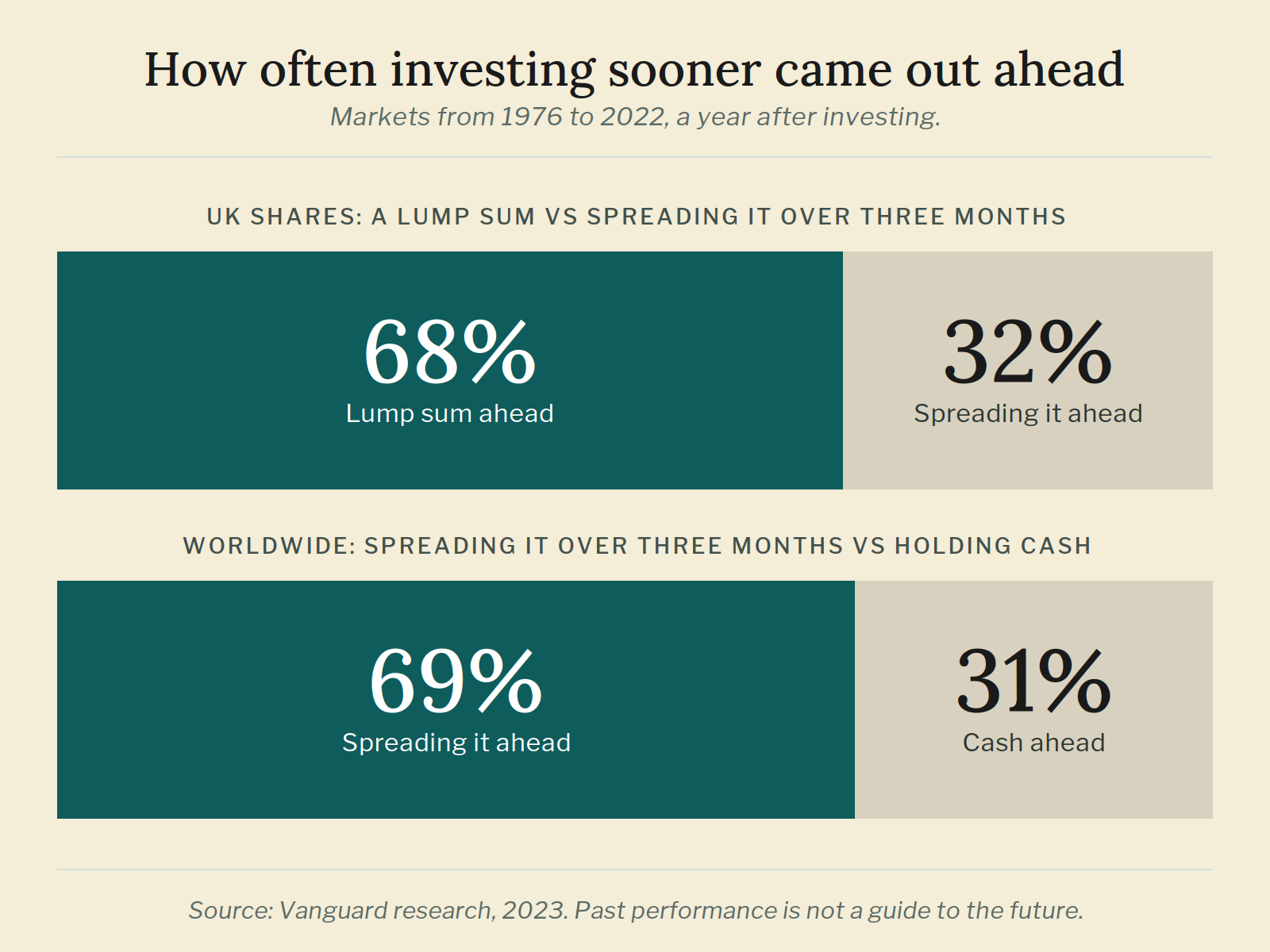
The “how often” row comes from Vanguard’s research on markets from 1976 to 2022, set out below. Past performance is not a guide to the future.
Why does a lump sum usually win?
Vanguard, the fund manager, looked at markets from 1976 to 2022 and compared investing a lump sum straight away with splitting it into three equal parts invested a month apart. Over the following year the lump sum came out ahead about two thirds of the time worldwide, and 68% of the time in UK shares. Spreading it over six months did worse still.
The reason isn’t clever. Over most periods markets have risen, so every month your money waits in cash is a month it isn’t growing. Feeding money in slowly is really a bet that prices are about to fall, and most of the time that bet loses.
The same study found something that matters just as much: drip-feeding still beat leaving the money in cash about 69% of the time. The worst option isn’t picking the wrong method. It’s waiting for the perfect moment and never investing at all. Time in the market does the work, which is the whole argument of thinking in years and decades.
What if the market falls the week after I invest?
Then a lump sum will look like a mistake for a while, and that feeling is the real case for drip-feeding. Nobody can tell you in advance which month is the good one. What the figures show is that, more often than not, the money invested earlier ended up ahead.
When does monthly investing make more sense?
Drip-feeding costs a little on average. Sometimes that’s a price worth paying.
When a fall would make you sell.
If putting £20,000 in on Monday and seeing it drop 10% by Friday would make you pull out, a lump sum is the wrong choice for you, whatever the averages say. Selling after a fall turns a paper loss into a real one, and it’s how most investors end up with less than their own investments made: the behaviour gap. A method you’ll stick with beats a better one you’ll abandon.
When your money arrives monthly.
Most people don’t have a lump sum. They have a salary. Investing a set amount each payday is how most ISAs get built, and it comes with a useful side effect: when prices are low your fixed amount buys more, and when they’re high it buys less. That’s pound-cost averaging, and it takes the timing question off the table.
When regular buying costs less.
Many platforms charge less, or nothing, to buy through a regular monthly plan than to place a one-off trade. It’s worth checking before you choose, because fees compound just like returns.
The ISA catch: your allowance, and April 2027
Your £20,000 allowance runs from 6 April to 5 April, and whatever you haven’t used by then is gone for good. If you’re drip-feeding a lump sum, make sure it’s all inside the ISA before the deadline. How the ISA allowance works covers the rules.
One common way to drip-feed is to move the whole sum into your stocks and shares ISA as cash, then invest it bit by bit. That keeps it inside the allowance. From 6 April 2027, though, interest on cash held in a stocks and shares ISA carries a 22% charge, so money left waiting in there will earn less than it does now. I explain the change in the 22% charge on cash in your stocks and shares ISA. Figures are at the time of writing, so check gov.uk for the current rules.
If you’re starting from scratch, my free ISA Starter guide walks you through setting up your first ISA and a monthly plan, and the book sets out the whole method.
What is pound-cost averaging?
Investing the same amount at regular intervals, whatever the price. Your money buys more when prices are low and less when they’re high, so you never put everything in at a single price.
Should I wait for a crash before investing?
Almost nobody gets the timing right, professionals included. Markets have spent far more time rising than falling, so money waiting in cash for a crash usually misses more than it saves.
Is it better to invest my whole allowance on 6 April?
On the same logic, money invested at the start of the tax year has had longer to grow than money invested at the end. It only matters if you have the money to hand. If you don’t, investing monthly through the year is perfectly sound.
Can I do both?
Yes. Plenty of people invest a lump sum when they have one and keep a monthly plan running alongside. The two aren’t rivals.
Does monthly investing reduce risk?
It reduces the risk of bad timing on day one. It doesn’t reduce the risk of the investments themselves, which comes down to what you hold and how widely it’s spread.
Key takeaways
All figures are correct at the time of writing and can change, so always check gov.uk for the current numbers. The value of investments can go up and down, and you can get back less than you put in. This is general information, not financial advice. If you are unsure, speak to a regulated financial adviser.