
How to Transfer an ISA Without Losing the Tax Break
If you want to move your ISA somewhere better, a cheaper platform, a higher rate, or just everything in one place, you can, and it needn’t cost you any of your tax-free status. One rule matters above all the rest: you transfer it through the new provider, you never take the money out yourself. Get that right and the rest is straightforward.
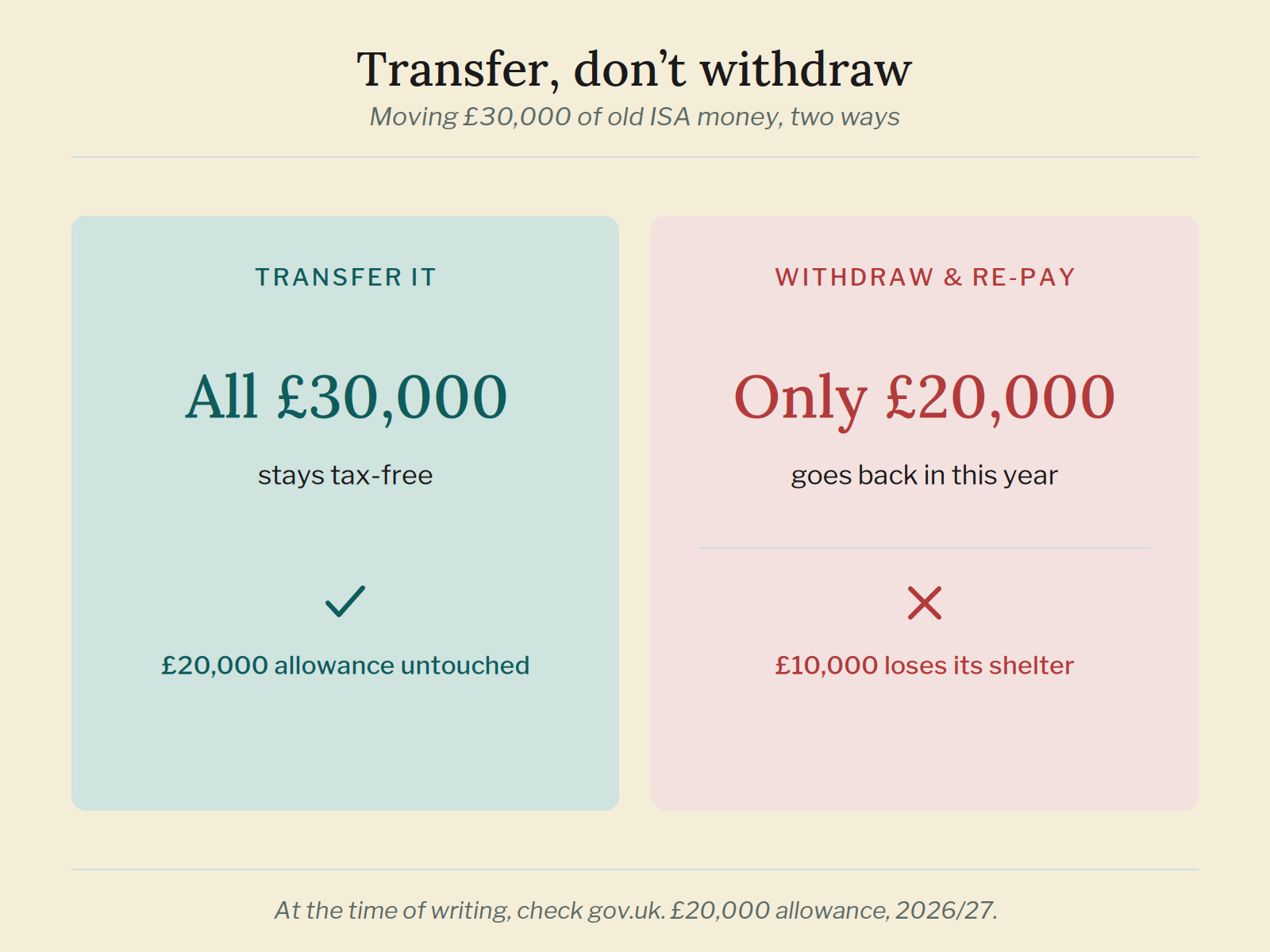
The reason it matters is that a transfer and a withdrawal look similar but do opposite things. A transfer moves your money from one ISA to another with the tax-free wrapper intact, and it doesn’t touch your annual allowance. Withdraw the same money and you’ve stripped the wrapper off: to get it back inside an ISA you’d have to pay it in as a fresh contribution, using up this year’s £20,000 allowance, and anything over that has lost its tax-free home for good.
How a transfer actually works.
You pick the account you want to move to, then ask that new provider to do the transfer. They give you a short ISA transfer form, and they pull the money across from your old provider for you. You don’t handle the cash at any point. That’s the whole safeguard: because it goes provider to provider, the money never leaves the ISA system.
What you’re free to do
Transfers don’t use your allowance.
This is the part people miss. Moving £30,000 of old ISA money to a new provider doesn’t cost you a penny of this year’s £20,000, because the allowance is only for new money going in. So you can transfer a large old pot and still pay in your full £20,000 on top (£20,000 is the 2026/27 figure; at the time of writing, check gov.uk). If you’re fuzzy on the limit, here’s how the ISA allowance works.
You can move all of it, or part.
You don’t have to transfer everything. You can move part of an old ISA and leave the rest, or split it across providers. Since April 2024 you can even partially transfer money you’ve paid in during the current tax year, not just previous years’.
You can change type as you go.
A transfer can move you from a cash ISA to a stocks and shares ISA, or the other way, not only between two of the same kind. So if your money has outgrown a cash ISA, or you want to steer some of it back to safety, the transfer is how you switch. From 6 April 2027, if you’re under 65, you won’t be able to transfer from a stocks and shares ISA into a cash ISA. It’s one of the November 2025 ISA reforms, now law. This is correct at the time of writing, so check gov.uk before you rely on it.
It takes days, not weeks, mostly.
Cash-to-cash transfers should complete within 15 working days; anything else, including any transfer involving a stocks and shares ISA, is allowed up to 30 calendar days. If it drags well past that, chase the provider you’re moving to, since they run the process.
Check two things before you start.
First, any exit or transfer-out fees on the account you’re leaving. Second, with a stocks and shares ISA, whether your actual investments move across as they are, or are sold to cash first and rebought, which briefly takes you out of the market. Neither is necessarily a dealbreaker, but both are worth knowing before you commit.
One timely reason to get this right: from April 2027, cash left sitting in a stocks and shares ISA faces a 22% charge on the interest it earns. If you’re moving that cash somewhere it can work properly, transfer it, don’t withdraw it. I go through that change in the April 2027 charge on cash.
Where you move to is worth a moment’s thought, mostly on cost, because over the long run fees decide your returns more than almost anything else. The same decisions that go into opening a stocks and shares ISA apply when you’re choosing where to transfer one to.
If you’d like the essentials as a short, jargon-free guide you can keep, The ISA Starter covers them in about ten minutes. And if you want the whole picture in one place, that’s what my book is for.
Does transferring an ISA count towards my annual allowance?
No. Transfers of money already inside an ISA don’t use any of your £20,000 for the year, that limit is only for new contributions. You can transfer an old pot and still pay in your full allowance on top.
Can I transfer just part of my ISA?
Yes. You can move part and leave the rest, or split it between providers. Since April 2024 that includes partially transferring money paid in during the current tax year.
Can I move a cash ISA into a stocks and shares ISA?
Yes, and for now the other way round. A transfer can switch you between types, not just between two of the same, so you can move from cash to investing, or back toward cash. From 6 April 2027, under-65s won’t be able to transfer from a stocks and shares ISA into a cash ISA.
How long does an ISA transfer take?
Cash-to-cash should be done within 15 working days; other transfers, including any involving a stocks and shares ISA, within 30 calendar days.
What happens if I just withdraw the money and move it myself?
You lose the tax-free status on that money. Paying it back into an ISA counts as a new contribution against this year’s £20,000, and anything above the allowance can’t go back in this year at all. Always use the transfer form instead.
Key takeaways
All figures are correct at the time of writing and can change, so always check gov.uk for the current numbers. The value of investments can go up and down, and you can get back less than you put in. This is general information, not financial advice. If you are unsure, speak to a regulated financial adviser.