

How to Open a Stocks and Shares ISA
Opening a stocks and shares ISA takes about ten minutes online: you pick a provider, prove who you are, and either move money in or set up a monthly payment. You have to be 18 or over and resident in the UK, and the account itself is free to open.
The sign-up isn’t the part worth slowing down for. The four or five decisions you make around it are, because those are what shape how much of your money you actually keep over the next twenty years. I’ll assume you already know what a stocks and shares ISA actually is, so this is about opening the right one and setting it up so it works as hard as you do.
The admin, in a nutshell.
Choose a provider, open the account on their website, then add money by bank transfer, debit card or a monthly direct debit. You’ll want your National Insurance number and a debit card to hand. You don’t have to choose a single investment on day one. That really is all there is to the paperwork. Now the parts that matter.
Which provider should you choose?
This is the decision that counts most, and it comes down to two things: what the platform lets you hold, and what it charges.
Cost is the one lever you fully control.
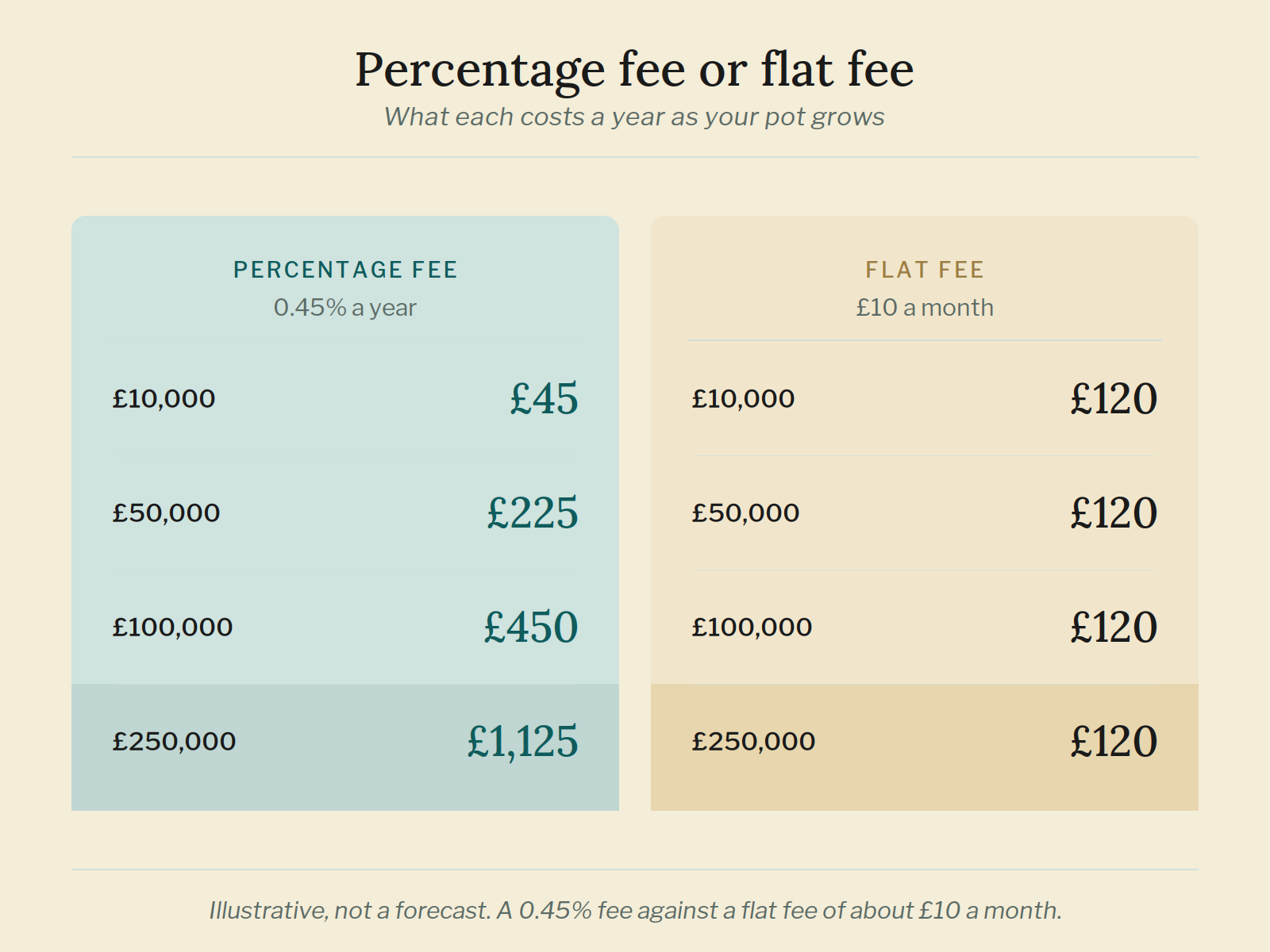
Platforms charge in one of two shapes: a percentage of your pot each year, or a flat monthly fee. On a small pot a percentage is cheap. As your pot grows, a percentage keeps taking more while a flat fee stays put. A 0.45% charge is £45 a year on £10,000, but £1,125 a year on £250,000, for the same service. Over decades, that gap compounds against you, which is the whole argument in why fees decide your returns.
Check what you can actually buy.
Some platforms are built around funds, others around individual shares and investment trusts. Pick the one that holds what you intend to own, not the one with the biggest advertising budget.
You’re allowed more than one.
Since April 2024 you can open and pay into more than one stocks and shares ISA in the same tax year. The catch is that your £20,000 allowance is shared across all of them, not handed out per account (£20,000 is the 2026/27 figure; at the time of writing, check gov.uk). If you’re unsure how that ceiling works, here’s how the ISA allowance works.
How should you set it up?
A few settings decide whether the account works for you or gets in your way.
Flexible, or not?
A flexible ISA lets you take money out and put it back within the same tax year without losing that slice of your allowance. A non-flexible one doesn’t: once the allowance is used, a withdrawal is gone for that year. If there’s any chance you’ll need to dip in, a flexible ISA is worth having. Providers don’t always flag which they offer, so check before you commit.
Income, or accumulation?
Where you’re offered a choice of units, accumulation units reinvest the dividends for you, income units pay them out as cash. For a pot you’re trying to grow rather than draw on, accumulation does the compounding without you having to lift a finger.
An ISA is a wrapper, not an investment.
Money you pay in sits as cash until you actually buy something with it. Cash left in a stocks and shares ISA does little for you, and from April 2027 any interest it earns there will face a 22% charge (at the time of writing, check gov.uk). If you’re not ready to invest it yet, that’s fine, just decide where it should really live. I wrote about that change here.
Transfer, don’t withdraw.
If you already hold an ISA elsewhere and want it under your new roof, use the new provider’s transfer form. Never pull the money out and pay it back in yourself: that turns years of sheltered savings into a brand-new contribution and burns through this year’s allowance. Transfers don’t count towards your £20,000, and you can move part or all of it.
If you’d like this as a short, jargon-free guide you can keep, The ISA Starter covers the essentials in about ten minutes. And if you want the whole journey in one place, from opening the account to what to do with it over the decades, that’s what my book is for.
How long does it take to open a stocks and shares ISA?
Usually about ten minutes online, provided you have your National Insurance number and a debit card to hand. The account is normally open the same day.
Can I open one if I already have a stocks and shares ISA this year?
Yes. Since April 2024 you can open and pay into more than one in the same tax year. Your £20,000 allowance is shared across all of them, not renewed for each.
Do I have to choose my investments straight away?
No. Opening the account and choosing what to hold are two separate steps. Your money sits as cash until you buy something, so take your time, just don’t leave it as cash indefinitely.
Can I move an existing ISA into a new one?
Yes, through the new provider’s transfer process. Do it that way rather than withdrawing the money, so you keep the tax-free status and don’t use up this year’s allowance.
What do I need to open one?
You need to be 18 or over and resident in the UK. To hand, you’ll want your National Insurance number, a debit card and a way to prove your identity.
Key takeaways
All figures are correct at the time of writing and can change, so always check gov.uk for the current numbers. The value of investments can go up and down, and you can get back less than you put in. This is general information, not financial advice. If you are unsure, speak to a regulated financial adviser.