

The 22% Charge on Cash in Your Stocks and Shares ISA, from April 2027
Most of the noise about the April 2027 ISA reforms has been about one number: the cash ISA allowance dropping to £12,000 for under-65s. There’s a second change that has had far less attention, and if you keep money in a stocks and shares ISA it matters just as much. From 6 April 2027, cash left sitting in a stocks and shares ISA will face a flat 22% charge on the interest it earns. It was confirmed at the Autumn 2025 Budget, and the draft legislation was published in July 2026 (details at the time of writing, check gov.uk).
The headline sounds worse than it is for most people, and the fix is simple. Here’s what the charge actually does.
What the charge actually hits
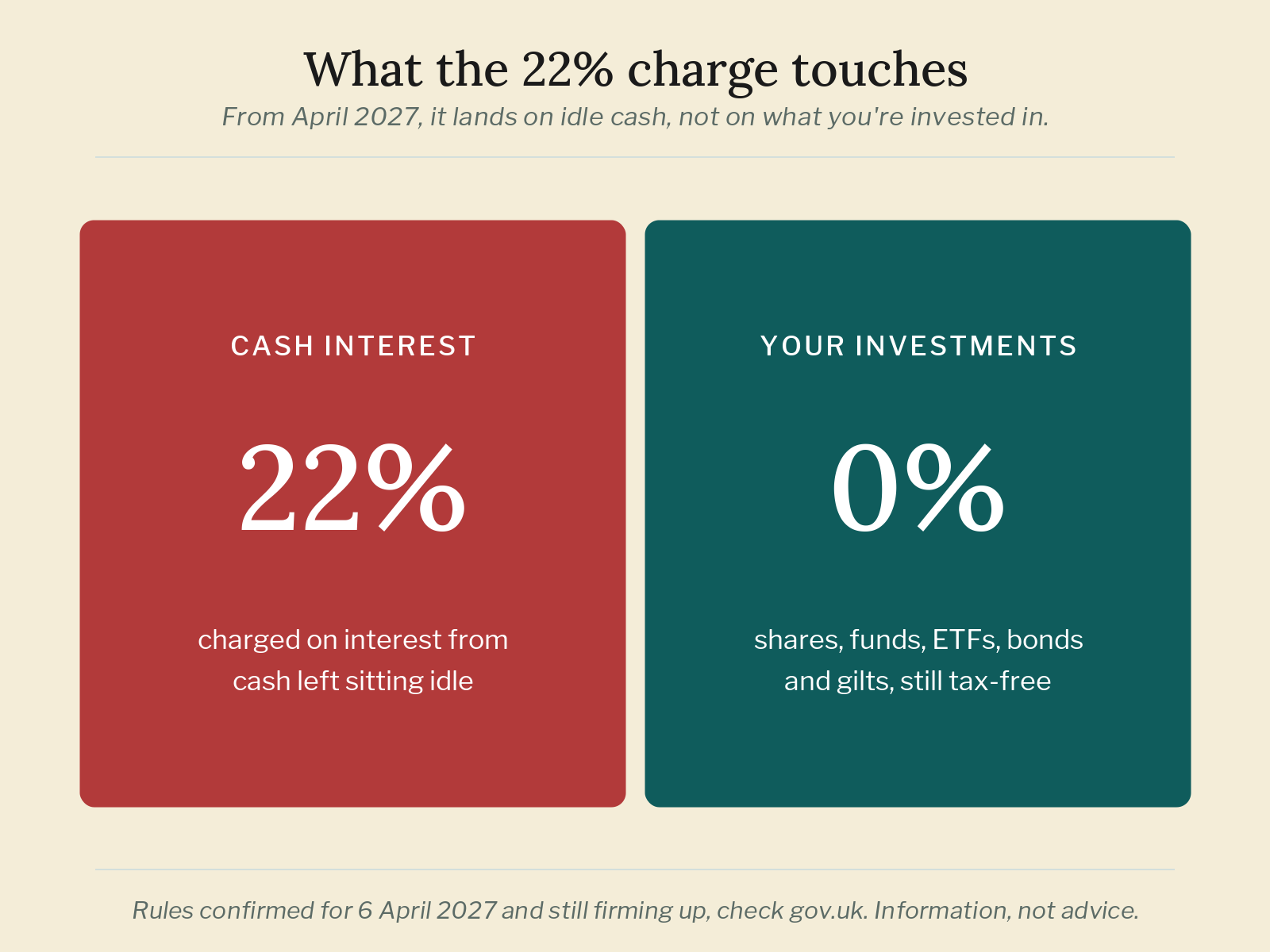
The rule is narrow. From 6 April 2027, a flat 22% charge applies to any interest, or equivalent return, paid on cash held inside a stocks and shares ISA or an innovative finance ISA. That’s it. It does not touch a single one of your investments.
It’s the interest on cash, not your holdings
Your shares, funds, investment trusts, exchange-traded funds (ETFs) and bonds, including UK gilts, are left completely alone. They don’t pay interest, they pay dividends and capital growth, and inside an ISA those stay fully tax-free, as they are now. The charge bites only on interest paid on an uninvested cash balance sitting in the account.
Why the government is doing it
It’s an anti-circumvention measure. Once the cash ISA limit falls to £12,000, someone could sidestep it by putting the full £20,000 into a stocks and shares ISA as cash and leaving it there to earn tax-free interest. The 22% charge closes that door, so a stocks and shares ISA can’t be used as a cash ISA in disguise. That’s the whole intent: it’s aimed at long-term cash parking, not at investing.
What it means for how you hold cash
For most investors this changes very little. It’s worth knowing where the line falls.
Cash waiting to be invested is fine
Money that lands from a sale, or from a fresh subscription, and sits for a few days or weeks before you put it to work earns almost nothing in interest, so the charge on it is trivial. The normal flow of investing is not the target, and the government has been explicit that diversified portfolios holding some cash-like exposure are still allowed.
Long-term cash piles are the thing to move
If you’ve been holding a large cash balance in a stocks and shares ISA to earn interest, that’s exactly what the charge is designed to catch. From April 2027, cash you want to keep as cash belongs in a cash ISA, up to the £12,000 under-65 limit, or in savings outside an ISA, not sitting in your investment account.
The money market fund route is capped too
Cash-like holdings, which the rules define as money market funds (MMFs, low-risk funds that hold short-term debt), can still sit inside a stocks and shares ISA, but not as the whole of it. A portfolio that is 100% cash-like will stop qualifying from April 2027. A slice alongside real investments is fine.
Does this touch my actual investments?
No. Shares, funds, ETFs, investment trusts and bonds are not affected, and their dividends and growth stay tax-free inside the ISA. The 22% charge applies only to interest on cash.
I’m over 65, am I exempt?
Not from this. Over-65s keep the full £20,000 cash ISA limit and are freed from the ban on transferring into a cash ISA, but the 22% charge on cash interest in a stocks and shares ISA applies to everyone, whatever your age.
What should I do before April 2027?
Nothing drastic, and nothing yet. Nothing changes before 6 April 2027, so the 2026/27 tax year runs under the current rules. Between now and then, it’s worth checking whether you’re holding cash in a stocks and shares ISA that isn’t waiting to be invested, and deciding where it should really live. I set out the wider April 2027 changes in the November 2025 ISA reforms article.
Key takeaways
All figures are correct at the time of writing and can change, so always check gov.uk for the current numbers. The value of investments can go up and down, and you can get back less than you put in. This is general information, not financial advice. If you are unsure, speak to a regulated financial adviser.