

Reinvesting Dividends: The Overlooked Half of Your Returns
Most people watch the share price and treat the dividend as pocket money. That gets the engine backwards. Over the long run, reinvested dividends have done a large share of the total work in stock market returns, and the choice to reinvest them or spend them is one of the few big levers you actually control.
Reinvesting a dividend means using the cash a company pays out to buy more of the same investment, rather than taking it as income. Do that consistently and each payment buys more units, those extra units pay their own dividends, and the pot starts to feed itself. That is compound returns in their most literal form: returns earning returns. It is also why total return, the growth in the price plus the income reinvested, is the number worth watching, not the price line on its own.
Two ways to reinvest
There are two common routes, and the difference decides how much you do by hand.
Accumulation units do it for you
Often shown as “Acc”, these keep the income inside the fund and reflect it in the unit price, so nothing lands in your account to deal with. The reinvestment is automatic and invisible.
Income units hand you the cash
Shown as “Inc” or “Dist”, these pay the money out and leave the next move to you. Most platforms offer an automatic reinvestment option on income units and individual shares, sometimes for a small dealing fee per holding. Check that fee before you rely on it: paying £1.50 to reinvest a £4 dividend is a bad trade, and at that point letting the cash build until it is worth deploying makes more sense.
For a hands-off investor, accumulation units remove a job and a temptation at once. The money never appears as spendable cash, so it never gets absorbed into everyday spending.
Why the wrapper decides how much you keep
Reinvesting works anywhere. It works far better where the taxman cannot reach it.
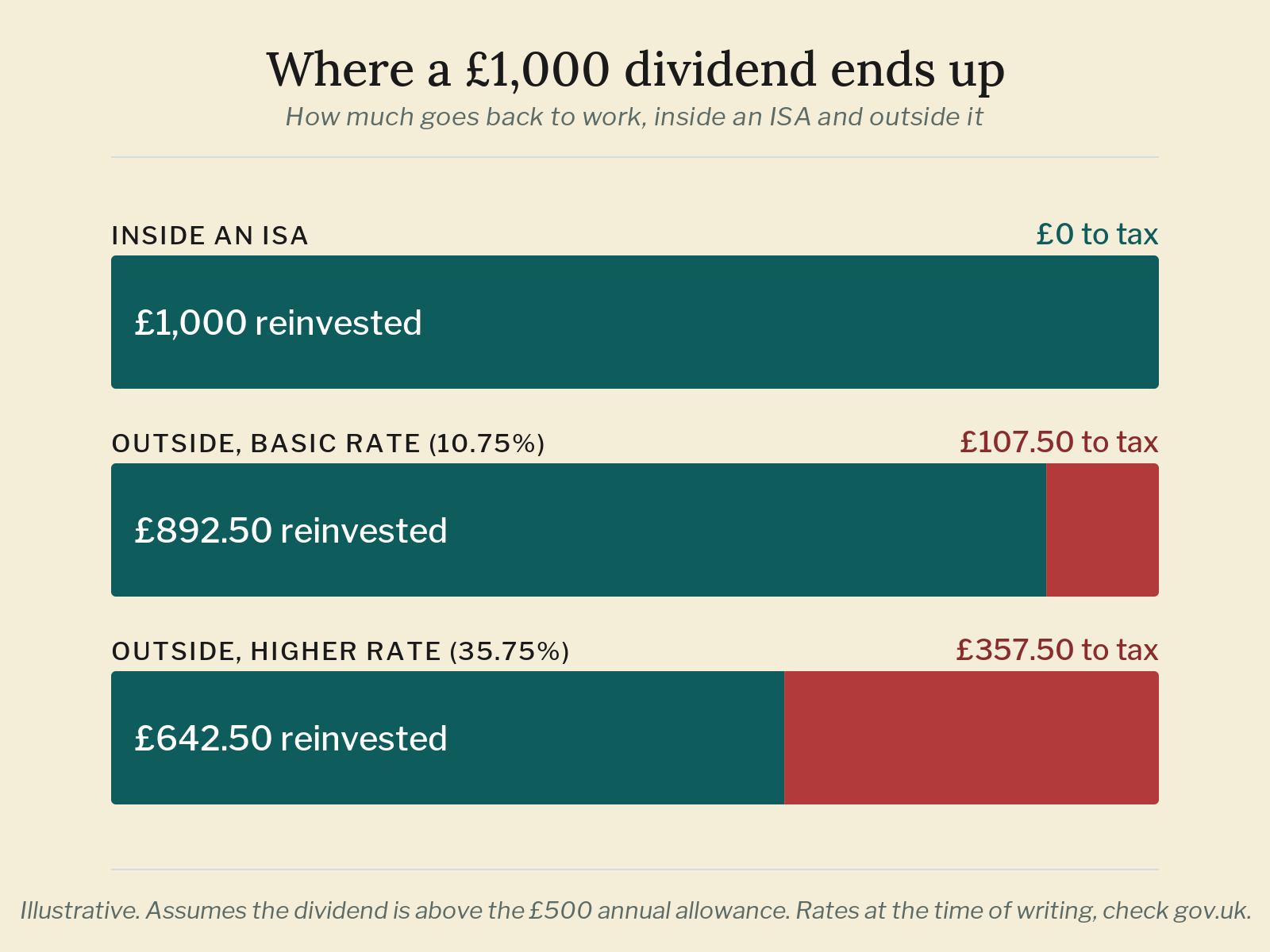
Outside an ISA, dividends above the £500 annual dividend allowance are taxed. From 6 April 2026 those rates rose by 2 points at the basic and higher bands, to 10.75%, 35.75% and 39.35% depending on your income (rates at the time of writing, check gov.uk). Reinvest a taxed dividend and you are compounding what is left after HMRC has taken its slice, year after year.
Inside a stocks and shares ISA, dividends are free of UK tax entirely, and they do not count towards that £500 allowance. Every penny a holding pays out goes straight back to work. On a growing pot, over decades, that gap compounds into real money. The £20,000 you can pay in each year (2026/27, check gov.uk) is the door; reinvesting inside it is what fills the room.
The drag nobody notices
The enemy of reinvesting is not spending the money on something nice. It is cash sitting idle. A dividend that lands and waits three weeks for you to get round to it is three weeks out of the market. Four payments a year over twenty years, and the uninvested days add up. Automation, whether accumulation units or an auto-reinvest setting, closes that gap without you having to think about it.
Fractional shares help too. If a dividend is £37 and a share costs £90, a platform that only deals in whole shares leaves that £37 stranded until it grows enough to buy one. A platform that reinvests in fractions puts the whole payment to work the day it arrives.
Should I ever take dividends as income instead?
Yes, when you need the money. In retirement, or whenever the income is the point, taking dividends is exactly what the pot is for. The choice is not moral, it is about the job the money is doing right now. While you are building, reinvesting compounds; when you are drawing, income units hand you the cash without forcing you to sell.
Does reinvesting guarantee my pot grows?
No. Reinvesting compounds whatever the investment does, up or down. It buys more units of a falling holding as readily as a rising one. What it removes is the slow leak of income drifting off the pile. The underlying investment still has to earn its keep.
Is a high dividend yield a good sign?
Not on its own. A yield is just the dividend divided by the price, so it climbs when a price falls. An unusually high yield often means the market doubts the payout will last. Chase the headline number and you can end up reinvesting into a shrinking company. Total return, growth plus income, is what matters.
Key takeaways
All figures are correct at the time of writing and can change, so always check gov.uk for the current numbers. The value of investments can go up and down, and you can get back less than you put in. This is general information, not financial advice. If you are unsure, speak to a regulated financial adviser.