

The Order of Operations: Where Your Money Should Go First
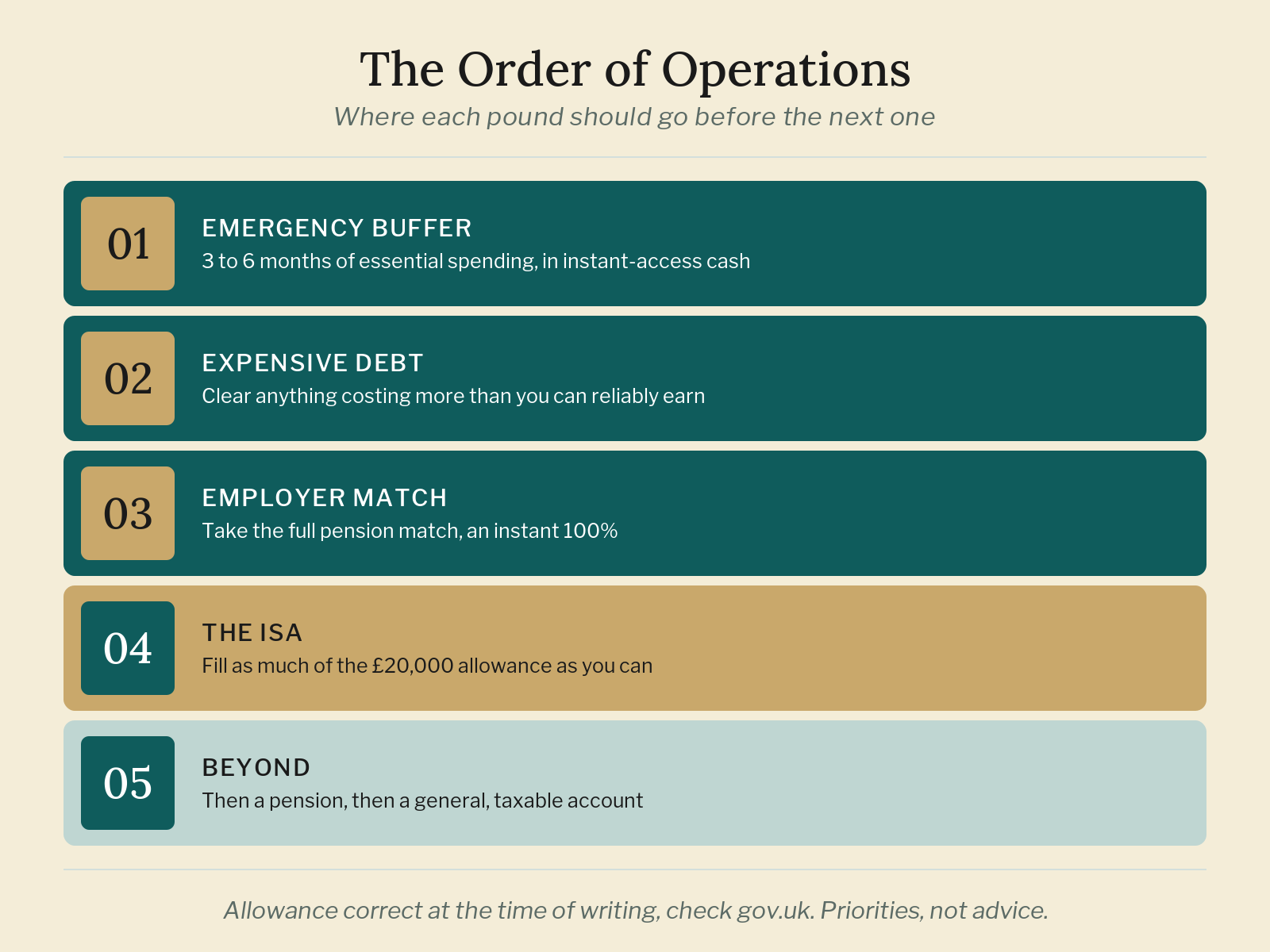
I know people who invest with real discipline and still fall behind, because they feed their money in the wrong order. They buy shares while a credit card charges them 24% a year. They walk past free money from an employer to chase a fund. How much you save gets all the attention, but the order you spend it in quietly decides how fast any of it compounds. Get the sequence right and every pound does its most useful job before the next one arrives.
Get the foundations down first
Before a single pound goes to work in the markets, three things come first. Skip them and the compounding you are trying to build gets undone the first time life sends a bill.
Start with a buffer you can reach in a day
Three to six months of essential spending, held somewhere dull and instant, is what stops a broken boiler or a lost job from forcing a sale at the worst possible moment. It can sit in an easy-access cash ISA if that suits your allowance, but the point here is access, not return. This money is not trying to grow. It is trying to be there.
Then clear debt that costs more than you can earn
A credit card at 24% APR (annual percentage rate) is charging you a guaranteed 24% a year. Clearing it is that same number in reverse: a guaranteed 24% return, no risk, no tax. Set against a long-run stock market return that has historically sat closer to 7% or 8% before inflation, and is never promised, the maths is not close. Cheap, patient debt is a different question: a student loan or a low fixed mortgage can reasonably run alongside your investing, because the rate is low and the same money can work harder elsewhere.
Take the free money before your own
If an employer matches pension contributions, that match is the best return you will ever be offered. Put in enough to earn the full match and you have doubled your money before it is even invested. Nothing in an ISA, or anywhere else, competes with an instant 100%. It is the one step worth taking even while you are still chipping at cheaper debt or topping up the buffer, because the offer does not wait for you.
Then let the ISA do the heavy lifting
With the buffer in place, the expensive debt gone and the match captured, you reach the part this whole site is about.
Fill as much of the allowance as you can, year after year
The £20,000 ISA allowance resets each tax year and does not roll over, so an unused year is gone for good. This is where long-term, tax-free compound returns do the real work, sheltered from tax on growth, dividends and interest. For most people building wealth over decades, filling that allowance consistently is the engine.
Then, and only then, look past it
Once the ISA is truly full, the order keeps going. A pension often comes next, especially for a higher-rate taxpayer, where the up-front relief is hard to beat and you are content to lock the money away until later life. After that, a general account outside any wrapper, accepting the tax that comes with it. Very few people run out of ISA allowance to fill, which is rather the point. For most of us the ISA is not the starting line, it is most of the race.
Should I pay off my mortgage or invest?
It depends on the rate and how you feel about debt. A low fixed mortgage costs little, so money invested over a long horizon has a fair chance of doing more than it would save you. A high rate tilts the other way. Neither choice is wrong, and clearing a mortgage is a guaranteed, risk-free return that some people value for the calm it brings alone.
What if I cannot do every step at once?
Almost nobody can, and you do not need to. The order is a set of priorities, not a checklist you finish before starting the next line. Most people run two or three steps together, a small buffer while grabbing the employer match, say. The sequence simply tells you where the next spare pound should go.
Does the right order ever change?
The principles hold, but the weighting is personal. Someone with a secure job and no debt might carry a smaller buffer and start investing sooner. Someone self-employed might want a larger one. Treat the order as a sensible default, not a rule about your particular life.
Key takeaways
All figures are correct at the time of writing and can change, so always check gov.uk for the current numbers. The value of investments can go up and down, and you can get back less than you put in. This is general information, not financial advice. If you are unsure, speak to a regulated financial adviser.