

How the ISA Allowance Works
Every year the government hands you a tax-free allowance worth £20,000, and every year, at midnight on 5 April, whatever you have not used disappears. No rollover. No second chances. It is one of the most valuable use-it-or-lose-it deals in the country, and most people let part of it slip away without ever noticing.
Quick reminder of what we are talking about. An ISA, an Individual Savings Account, is a tax-free wrapper you put around your savings or investments so that what they earn is not taxed. The allowance is the cap on how much new money you are allowed to put into ISAs each year.
Here is exactly how the allowance works: how much it is, what counts towards it, how to split it, and the one date that matters.
How much you get
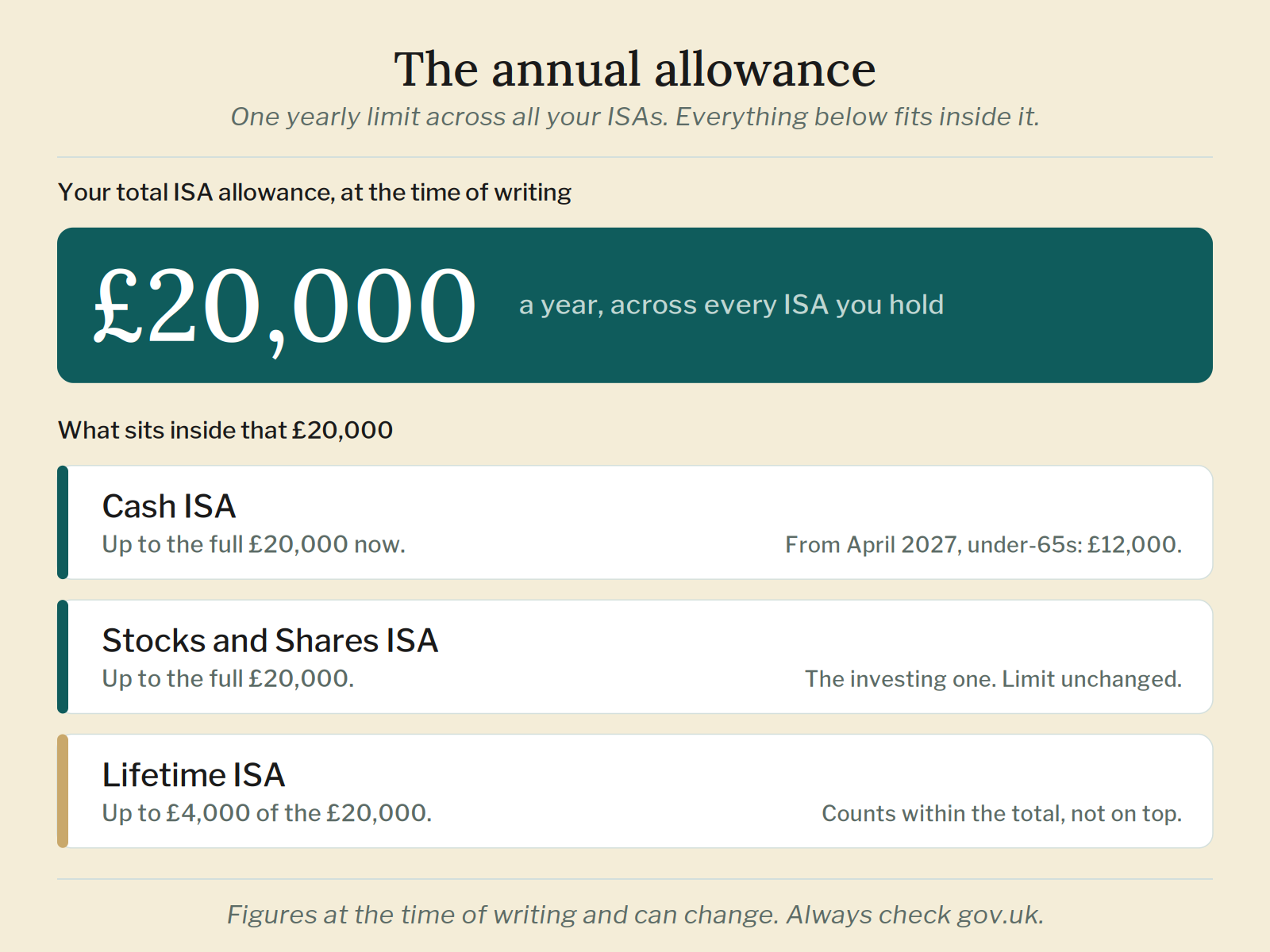
At the time of writing, the overall ISA allowance is £20,000 a year. The figure is set by the government and can change, so always check the current number at gov.uk.
It is a total, not a per-account limit
The £20,000 is the most you can pay in across all your ISAs combined, not £20,000 into each. You can spread it however you like: all of it into a stocks and shares ISA, split between cash and investments, or part of it into a Lifetime ISA, which has its own £4,000 cap within the overall limit.
The one date that matters
The ISA year runs from 6 April to 5 April. At the end of it, the allowance resets and any unused part is gone for good. You cannot carry it forward. This is why people who can afford to often top up before the 5 April deadline, rather than let the allowance lapse.
You can hold more than one of the same type
Since April 2024 you can pay into more than one ISA of the same type in a single tax year. So you could split your money across two different stocks and shares ISAs, for example, as long as your total contributions stay within the £20,000.
Transfers do not use up your allowance
This one trips a lot of people up. Moving money you paid into an ISA in a previous year from one provider to another, through a proper ISA transfer, does not count against this year’s £20,000. Only new money you add this year uses the allowance. So you can transfer an old ISA to a better provider without touching your current year’s room.
The cap is on what goes in, not what it grows to
The £20,000 limits how much new money you add each year. It does not limit how big the ISA can become. Once your money is invested and growing, there is no ceiling on what the pot can reach.
A change coming in April 2027
From 6 April 2027, if you are under 65, the share of your allowance that can go into a cash ISA falls to £12,000, with the remaining £8,000 needing to go into a non-cash ISA. The overall £20,000 does not change, and over-65s keep the full £20,000 in cash. More on that in the News piece on the Budget reforms.
Does unused allowance roll over?
No. Anything you do not use by 5 April is lost. The allowance resets to the limit on 6 April and you start again.
Can I have two stocks and shares ISAs?
Yes, since April 2024 you can pay into more than one ISA of the same type in a year, as long as your total stays within the allowance.
Do transfers count towards my allowance?
No. Transferring money from a previous year’s ISA does not use any of this year’s £20,000. Only new contributions do.
Does my partner have their own allowance?
Yes. Every UK adult has their own £20,000 allowance, so a couple has £40,000 between them.
Key takeaways
All figures are correct at the time of writing and can change, so always check gov.uk for the current numbers. The value of investments can go up and down, and you can get back less than you put in. This is general information, not financial advice. If you are unsure, speak to a regulated financial adviser.