

Index Funds, ETFs and Individual Stocks: What’s the Difference?
If you’re deciding how to invest in an ISA, index funds, ETFs and individual stocks aren’t really three rival products. They’re three points on one spectrum: how spread out your money is. A broad index fund or ETF owns the whole market, so your money sits across hundreds of companies. A sector or thematic ETF, say an AI or a tech fund, backs one slice of the market across the many companies in it. An individual stock puts your money behind a single company. The more concentrated you go, the more you’re relying on being right, and the harder it can swing.
So the useful question isn’t “which is best”, it’s “how concentrated do I want to be, and how much time and risk am I willing to take on”. None of what follows is advice, but here’s how the three compare.
How the three compare
| Broad index fund or ETF | Thematic or sector ETF | Individual stock | |
|---|---|---|---|
| Spread | Hundreds or thousands of companies | Many companies in one theme | One company |
| Typical cost | Usually the lowest | Often more than a plain tracker | Dealing costs each time you buy or sell |
| Time needed | Hands-off | Some keeping an eye on | Hands-on research |
| How hard it can swing | Least of the three | More, if the theme falls out of favour | Most |
| Can go in a stocks and shares ISA | Yes | Yes | Yes |
What each one actually is.
An index fund buys a whole market in one go and holds it for a small annual charge, rather than choosing companies. An ETF, an exchange-traded fund, is a fund you buy and sell on the stock market like a share. Most ETFs are index trackers, so a broad index fund and a broad index ETF are basically the same idea in two wrappers. What ETFs add is range: they come in many types, from broad-market and regional trackers to sector, thematic, bond and dividend funds, so “ETF” really describes the wrapper more than any single strategy. An individual stock is a stake in one company you pick yourself.
The real question is how concentrated you want to be.
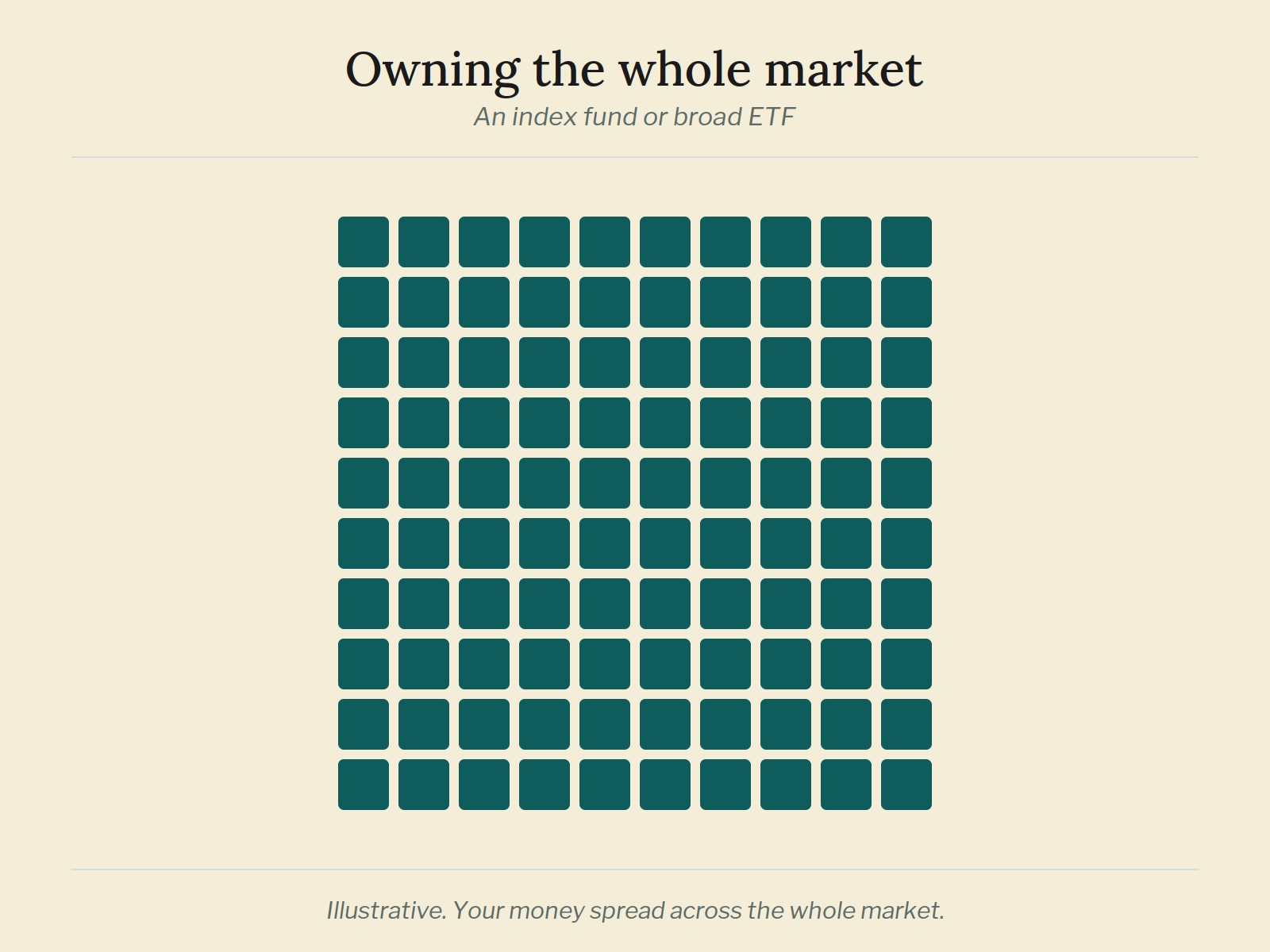
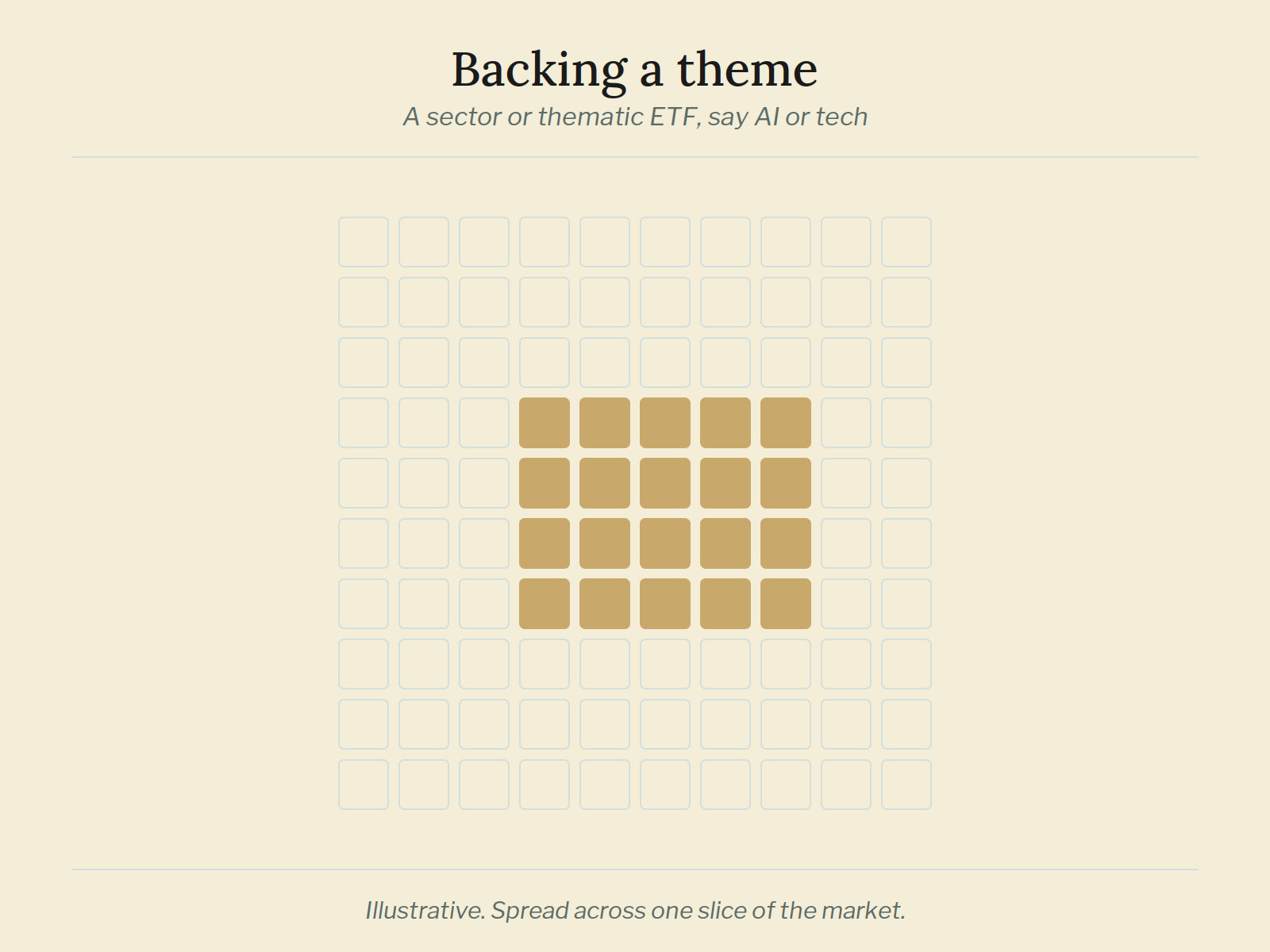
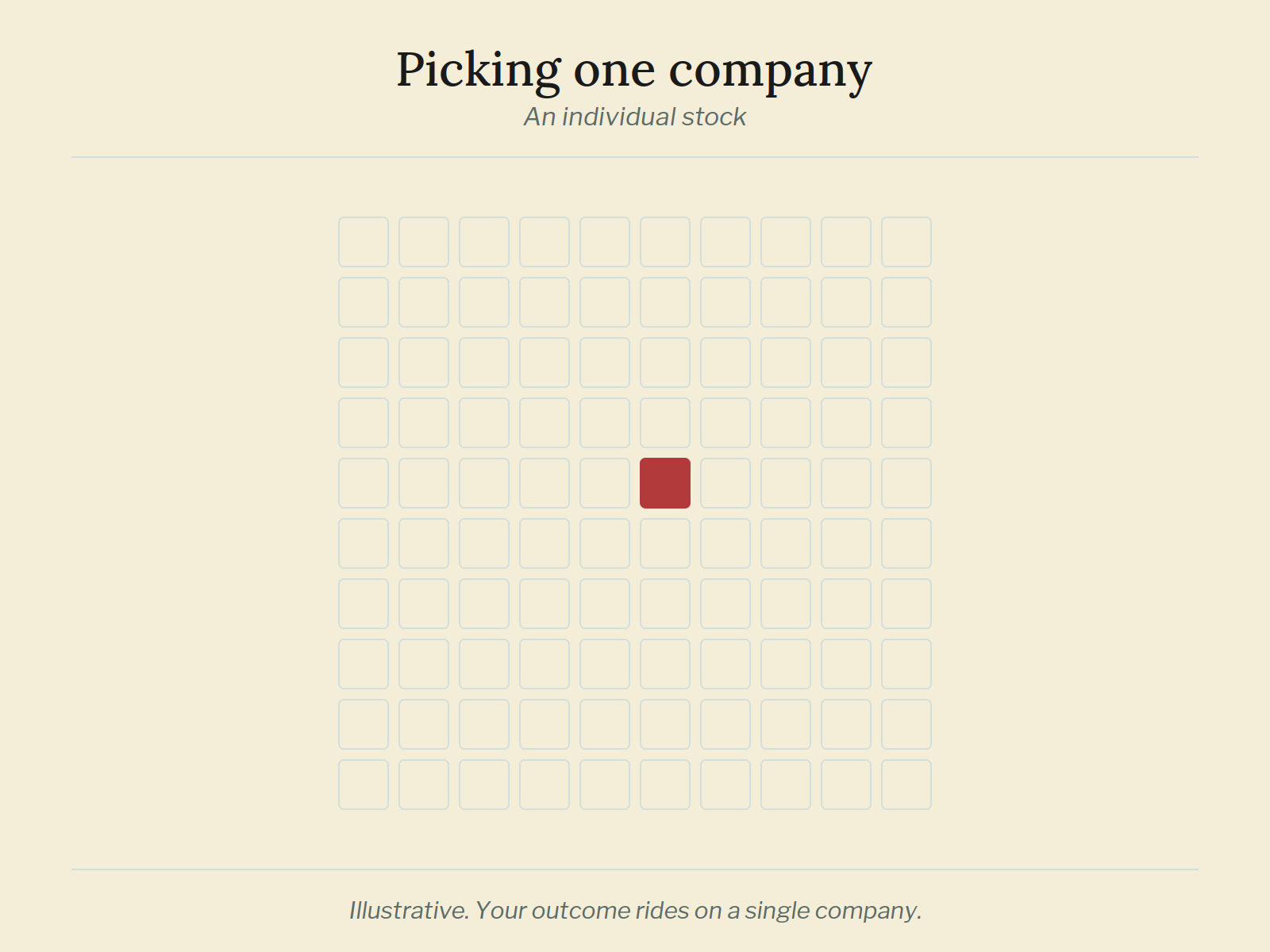
Line them up and it’s one spectrum. A whole-market index fund or ETF at one end, spread across hundreds of companies. A thematic or sector ETF in the middle, spread across the companies in a single theme. A single stock at the other end, all on one company. Diversification falls as you move along it, and with less diversification, more of your outcome rests on one call being right.
Owning the whole market
A broad index fund or ETF is the most spread-out option, usually the cheapest, and the most hands-off. It also has the weight of evidence behind it: the professionals whose whole job is picking shares mostly fail to beat a simple index over ten or fifteen years (S&P’s long-running SPIVA studies; the exact figures move each year, so check the latest scorecard). Cost is a big reason, every layer of charges is a drag that compounds against you, which is the argument in why fees decide your returns, and so is spread, which is what diversification is really about.
Backing a theme without betting on one company
A thematic or sector ETF, an AI or tech fund for instance, sits in the middle. It lets you lean into an area you believe in without staking everything on a single company, because your money is spread across many firms in that theme. The trade-offs are real: it’s more concentrated than the whole market, so it swings harder if that theme falls out of favour; it often costs more than a plain index tracker; and buying a theme after it’s already been in the headlines is its own risk. It’s a way to express a view, with more diversification than one stock but less than the market. Whether that suits you is your call, and it isn’t advice.
Picking individual companies
Individual stocks are the most concentrated end. Stock-picking isn’t foolish, plenty of thoughtful investors do it, it can be genuinely engaging, and some of the best-known investing books, The Naked Trader among them, are built around it. The honest point is that it’s harder than it looks and rides on you being right more often than the average professional manages, with the least diversification to fall back on if you’re wrong.
Where people tend to land
A lot of long-term investors use a mix: a low-cost, whole-market index fund or ETF as the core, and, if they enjoy it and can afford the risk, a smaller slice for a theme they like or a few shares they choose. That keeps most of the money spread wide while leaving room for conviction. Whatever the split, the things that matter most are not over-concentrating, keeping costs down, and not letting the ups and downs push you into selling at the wrong moment, which is the behaviour gap, and it costs investors more than the fund-or-stock choice ever does.
All of these, index funds, ETFs and individual shares, sit happily inside a stocks and shares ISA, so the wrapper isn’t the deciding factor, what you can hold is broad. The deciding factor is how concentrated you want to be, and how much time and risk you want the job to take.
If you’d like the essentials as a short, jargon-free guide, The ISA Starter covers them in about ten minutes. And my book sets out the whole approach in one place.
What’s the difference between an index fund and an ETF?
Mostly the wrapper. Both can track a whole market cheaply; an ETF is bought and sold on the stock exchange like a share and priced through the day, while a traditional index fund is usually priced once a day. ETFs also come in narrower, thematic versions that broad index funds don’t.
Is an AI or tech ETF a good way to invest?
It’s a way to back a theme across many companies rather than one, so it’s more diversified than a single stock but more concentrated than the whole market, and it can swing harder and cost more. Whether it suits you depends on your risk appetite and your view. This is general information, not advice.
Should I buy index funds, ETFs or individual shares?
That’s your decision, and it comes down to how concentrated you want to be and how much time and risk you’ll take on. Broad and hands-off at one end, focused and hands-on at the other.
Are ETFs riskier than index funds?
A broad index ETF is much like a broad index fund. A narrow, thematic ETF is more concentrated and usually more volatile than a whole-market tracker. The risk depends on what the ETF holds, not the wrapper itself.
Can I hold a mix of all three?
Yes. Many investors keep a broad, low-cost core and add a theme or a few individual shares around it, which keeps most of the money diversified while leaving room to back their own ideas.
Key takeaways
All figures are correct at the time of writing and can change, so always check gov.uk for the current numbers. The value of investments can go up and down, and you can get back less than you put in. This is general information, not financial advice. If you are unsure, speak to a regulated financial adviser.