
The November 2025 ISA Budget Reforms: What Changed and What It Means
If you have a cash ISA, or you were planning to lean on one, the November 2025 Budget changed the rules, just not yet. The headline is a cut to how much you can shelter in cash. The detail, and the timing, matter more than the panic.
Here is what the Chancellor actually announced for ISAs in the Autumn Budget on 26 November 2025: what changes, when, and what it means in practice. The short version is that your overall £20,000 allowance is untouched, but from April 2027 a chunk of it can no longer go into cash if you are under 65.
The headline change
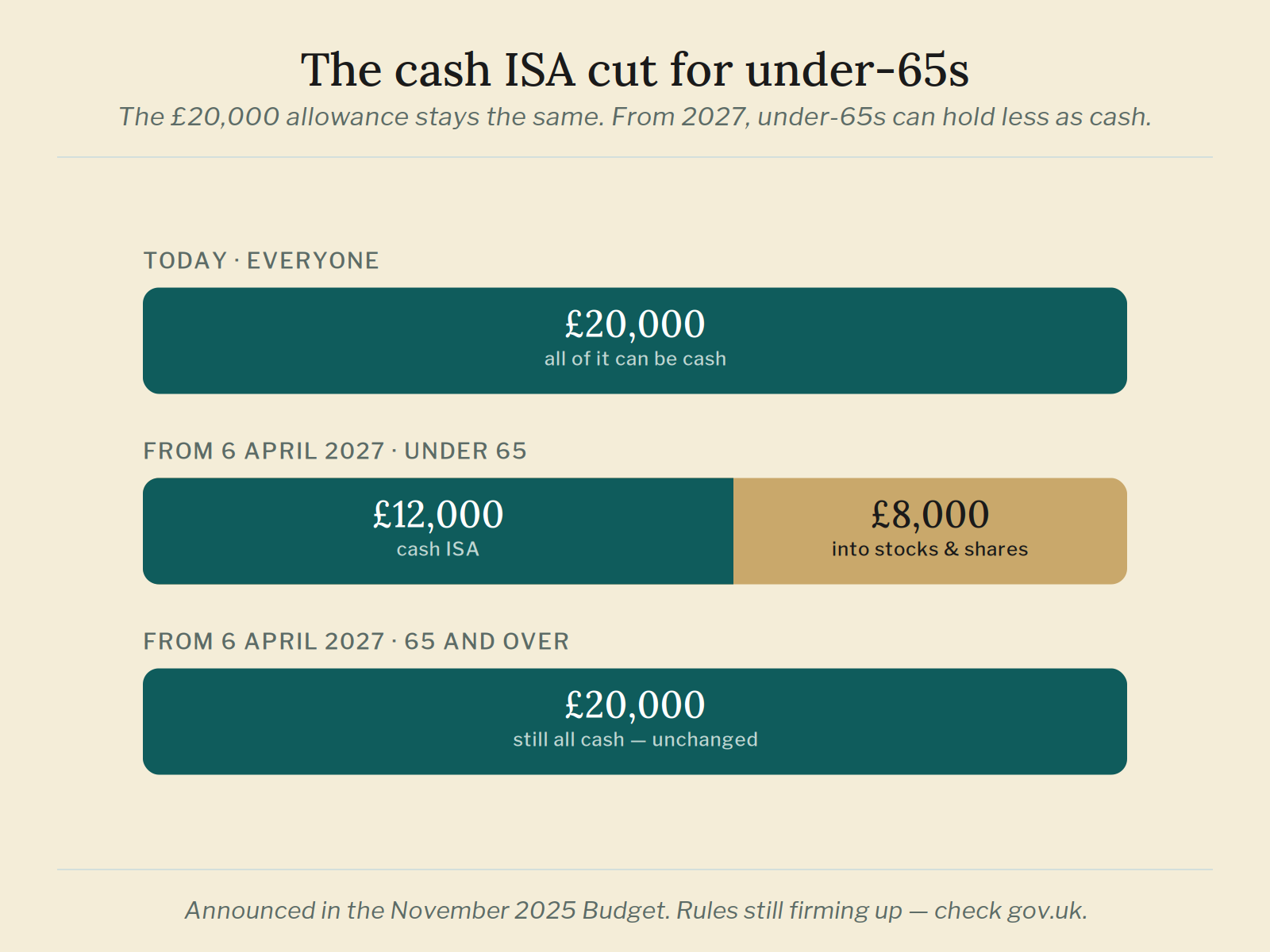
From 6 April 2027, the amount under-65s can pay into a cash ISA each year falls from £20,000 to £12,000. The rest of your allowance, the other £8,000, is still yours to use, but it has to go into a non-cash ISA, such as a stocks and shares ISA. The stated aim is to nudge more people from saving towards investing.
What is not changing
- The overall ISA allowance stays at £20,000 a year.
- The stocks and shares ISA and innovative finance ISA limits stay at £20,000.
- If you are 65 or over, you keep the full £20,000 cash ISA allowance.
- Nothing changes right now. The current rules run through the rest of 2025/26 and all of 2026/27, so you can still put the full £20,000 into cash until 6 April 2027.
A new transfer restriction
Alongside the cash cut, from April 2027 under-65s will not be allowed to transfer money out of a stocks and shares ISA or an innovative finance ISA into a cash ISA. Ordinary cash-to-cash ISA transfers carry on as before. It is an anti-avoidance measure designed to stop people sidestepping the new cash limit.
Tax rises that make the ISA matter more
Two other Budget changes quietly raise the value of sheltering money inside an ISA at all. The tax on dividends rose in April 2026, with the basic rate going from 8.75% to 10.75% and the higher rate from 33.75% to 35.75%. And the tax on savings interest rises by 2 percentage points from April 2027. Inside an ISA, none of those taxes apply, so as tax outside the wrapper goes up, the wrapper is worth more.
The Lifetime ISA
The Budget also confirmed that the Lifetime ISA will be replaced by a new First-Time Buyer ISA from April 2028, with a government consultation that, at the time of writing, closes on 17 August 2026. Existing Lifetime ISA holders can keep contributing under the current rules, so nobody with one is losing out. If you want to shape what replaces it, I explain what the consultation proposes and how to have your say in the First-Time Buyer ISA consultation.
A new 22% charge on cash inside investment ISAs
From 6 April 2027, interest earned on cash held inside a non-cash ISA, such as a stocks and shares ISA or an innovative finance ISA, will be charged at a flat 22%. HMRC confirmed this in a policy paper in June 2026. It is another anti-avoidance measure, aimed at stopping people using an investment ISA to shelter cash once the cash ISA limit is cut. Three things are worth knowing. The 22% is a flat rate, so it applies whatever your income tax band, and even if you pay no income tax. It bites only on interest from uninvested cash, not on your shares, funds or dividends, which keep their tax-free treatment. And the 22% deliberately matches the new basic rate on savings interest, which rises to 22% on the same date, so cash ends up taxed at a similar level wherever you hold it. At the time of writing the rules are still in draft and going through a technical consultation, with some operational detail to follow, so the fine print could shift before April 2027. I will update this piece as it firms up.
What it means in practice
If you are under 65 and rely on cash ISAs, the practical message is: nothing needs doing today, and you have until April 2027 under the current rules. The bigger picture is a clear government steer away from cash and towards investing. Whether that suits you depends on your own circumstances and timescales, and this is information, not advice. As ever, the official rules live at gov.uk, and the detail here can change.
What actually changed
From April 2027 the cash ISA limit for under-65s falls from £20,000 to £12,000. The overall £20,000 allowance and the stocks and shares ISA limit are unchanged.
When does it take effect?
6 April 2027. Nothing changes before then, so the full £20,000 cash limit applies for the rest of 2025/26 and all of 2026/27.
Am I affected if I am over 65?
No. Over-65s keep the full £20,000 cash ISA allowance.
What about stocks and shares ISAs?
The limit is unchanged at £20,000. The reforms are aimed at cash, and partly at moving more money towards investing.
Will cash inside a stocks and shares ISA be taxed?
From 6 April 2027, yes. Interest on uninvested cash held in a stocks and shares ISA or innovative finance ISA will face a flat 22% charge, whatever your tax band. Your investments themselves, the shares, funds and dividends, are not affected. The rules are still in draft at the time of writing, so check the current position before relying on it.
Key takeaways
All figures are correct at the time of writing and can change, so always check gov.uk for the current numbers. The value of investments can go up and down, and you can get back less than you put in. This is general information, not financial advice. If you are unsure, speak to a regulated financial adviser.