

The Maths That Changes Everything: Compound Interest Explained
Most people understand interest. You put money in, you get a bit more back. What almost nobody feels in their bones, until they see the numbers laid out, is what happens when that bit more starts earning its own bit more. That is compounding, and it is the closest thing to magic that ordinary money offers.
First, a quick correction that matters. You will hear this called compound interest, because that is the phrase everyone knows, but shares do not pay interest. What they pay is returns, so the accurate name is compound returns. The idea is the same either way: your money earns a return, then that return earns its own return, and so on, year after year. The longer it runs, the more the curve bends upwards. Time, not cleverness, is what makes it work, which is the most encouraging fact in all of investing.
The snowball
Picture a snowball rolling downhill. It picks up more snow with every turn, and because it is already bigger, each turn adds more than the last. That is compounding. Year one, your money earns a return. Year two, you earn a return on your original money and on last year’s return. Year three, on all of it again. Early on it looks unremarkable. Given enough time, it stops looking unremarkable very quickly.
What it looks like in numbers
Say you put away £300 a month and, purely for illustration, it grows at 8% a year. That 8% is the long-run historical average for a global spread of shares, not a promise, and real years are far lumpier than that. It is just a way to see the shape of the thing.
- After 10 years, you would have paid in £36,000, and it might be worth around £54,000.
- After 20 years, you would have paid in £72,000, and it might be worth around £177,000.
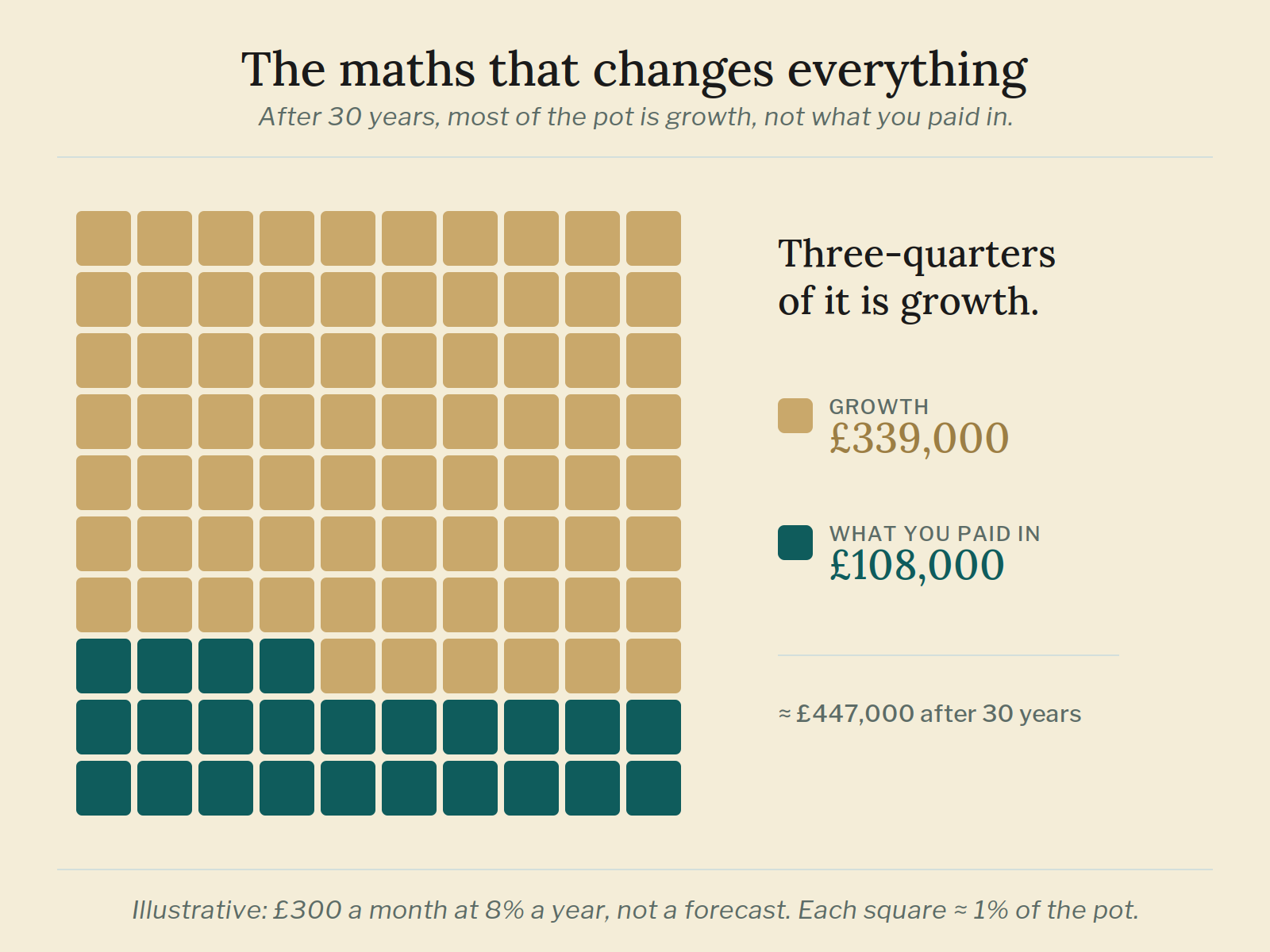
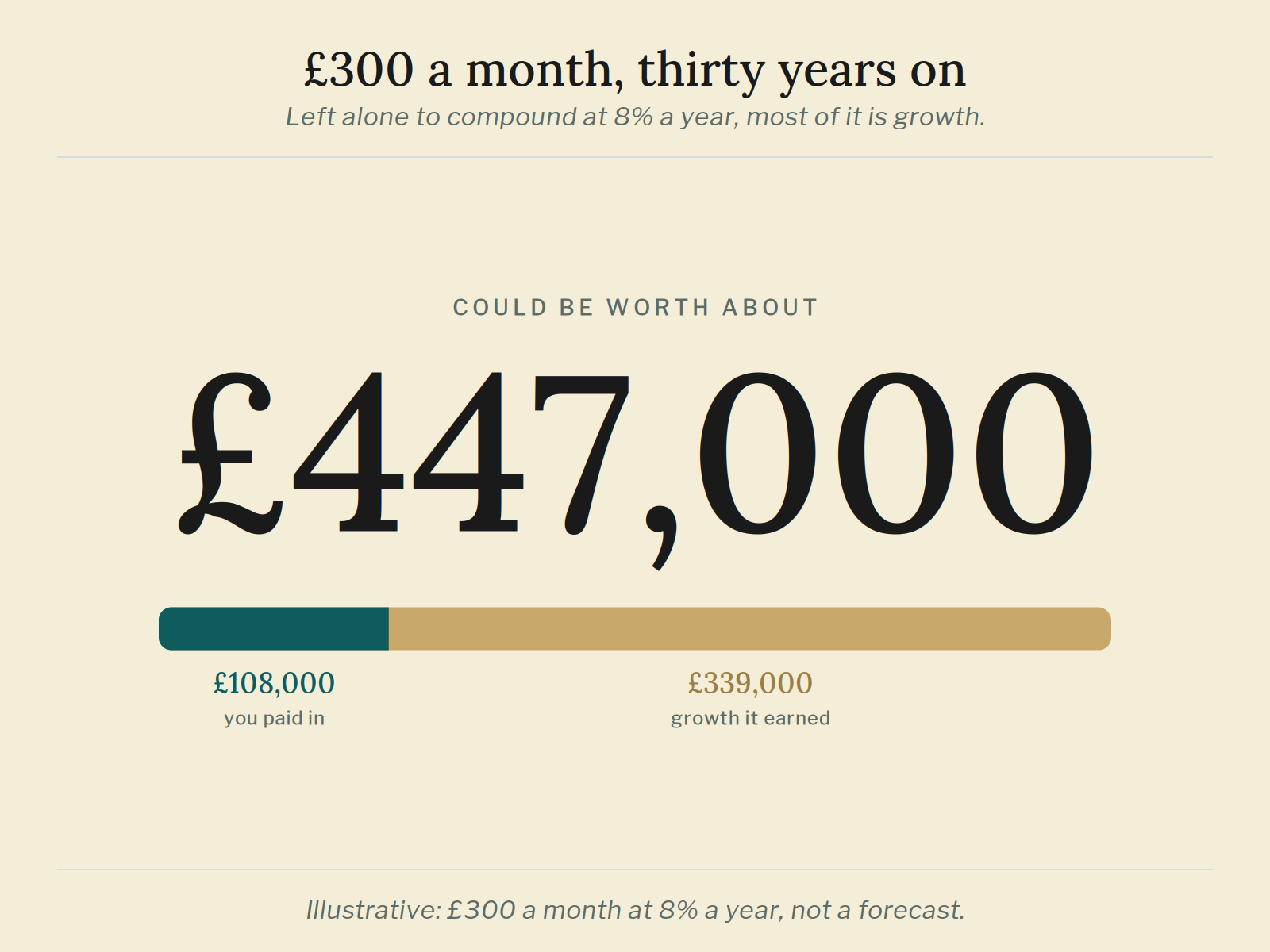
- After 30 years, you would have paid in £108,000, and it might be worth around £447,000.
Look at what happens across those three lines. In the first decade, growth adds a modest amount on top of what you paid in. By the third decade, the growth dwarfs the contributions. You did not pay in dramatically more. You simply gave it time.
Time is the real lever
Here is the part worth tattooing somewhere. The last decade of a long investment does far more work than the first, because the pot is biggest by then and the same percentage return is being applied to a much larger number. That is why starting earlier beats trying harder later. A smaller amount given more time will often overtake a larger amount given less. Time is the one ingredient you cannot buy back, which is the best possible reason to start sooner rather than waiting until the numbers feel worth it.
The ISA turns the dial up
Now add the wrapper. Outside an ISA, a slice of your growth is taxed each year, which shrinks the base the next year’s compounding works on. The tax drag compounds against you just as reliably as your returns compound for you. Inside a stocks and shares ISA, none of that happens. Every penny of growth stays in the pot, making more growth. Over decades, that difference is large.
An honest word about the numbers
Those figures are illustrations, not forecasts. Real returns are uneven, with some years up 20% or more and others down 30% or more. The numbers are shown before charges and before inflation, which reduces what the money will actually buy. The value of investments can fall, and you can get back less than you put in. Use the example to understand the mechanics, not as a prediction of what you will have.
What is compound interest?
It is returns earning their own returns. With cash that is interest; with shares there is no interest, so the same effect is called compound returns. Your money grows, then the growth itself starts to grow, and the effect builds on itself over time.
What return should I assume?
There is no guaranteed rate. The 8% used here is an illustrative long-run historical average for global shares, not a promise. Your own result will differ, and some years will be negative.
Does starting early really matter that much?
Yes. Time is the biggest single lever, because the later years compound on the largest balance. Starting earlier often beats contributing more later.
What happens when the market falls?
It will fall in some years. Compounding works over the long run, not every single year. Staying invested through the falls is what lets it do its job.
Key takeaways
All figures are correct at the time of writing and can change, so always check gov.uk for the current numbers. The value of investments can go up and down, and you can get back less than you put in. This is general information, not financial advice. If you are unsure, speak to a regulated financial adviser.