

Why Fees Decide Your Returns
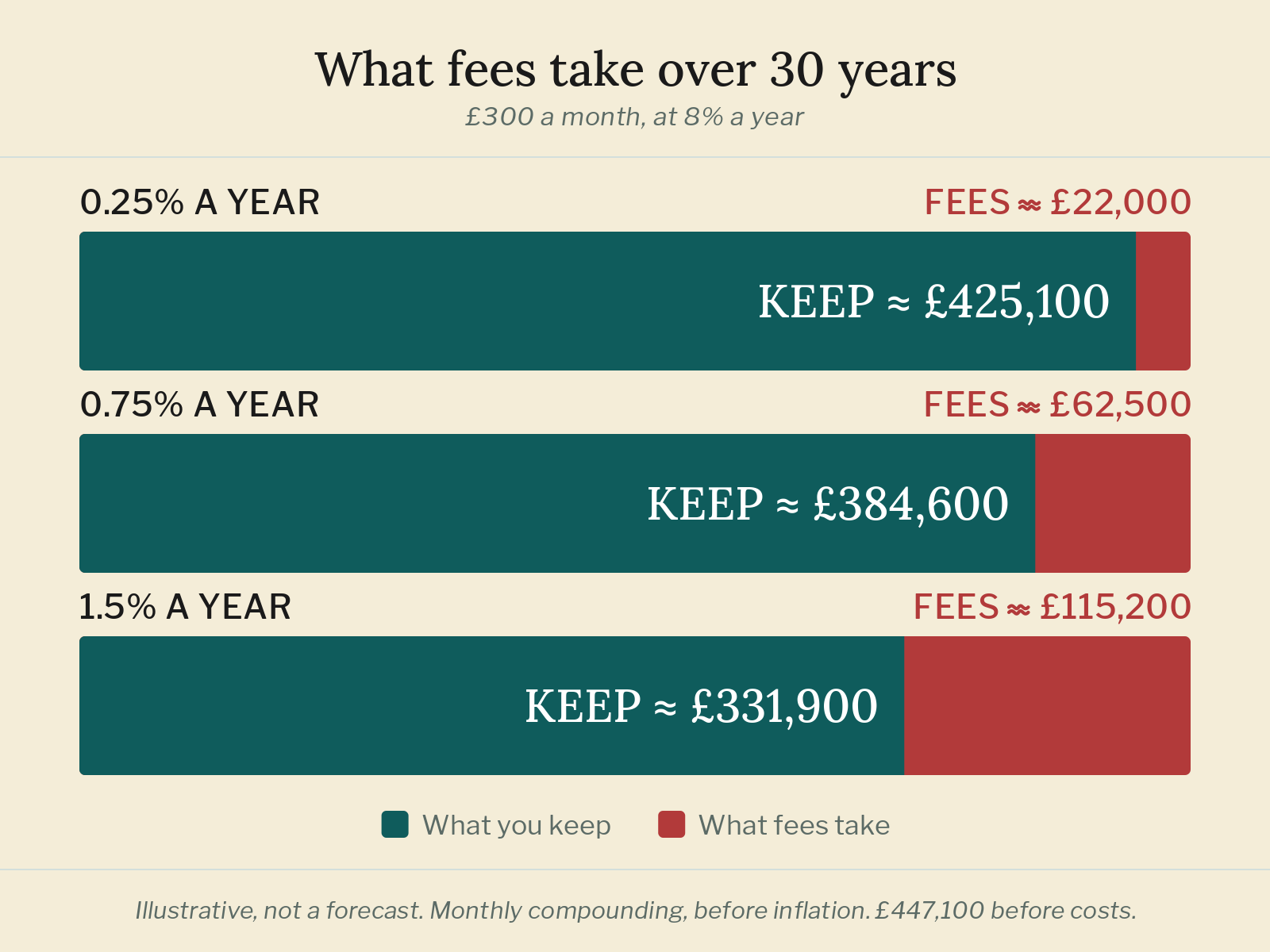
Investment fees matter because they compound: a charge of 0.75% a year can take around 14% of a 30-year pot, and 1.5% can take about a quarter. On £300 a month growing at an illustrative 8% a year, that is roughly £447,100 with no costs, about £384,600 at 0.75% and about £331,900 at 1.5%.
Almost everything about investing is a guess. What the market returns next year, whether your fund keeps up, how long you will stay invested: all unknowable. The fee is the exception. It is written down, agreed in advance, and it turns up whether the year was good or terrible. It is the only input you control with any precision, and it is the one most people look at last.
A fee is not a price, it is a share of the outcome
A percentage fee doesn’t take a slice of your gains. It takes a slice of everything you hold, every year, in the losing years too. And the pound it removes doesn’t simply vanish, it stops compounding, so you lose the pound plus everything that pound would have become. That is why a number that looks trivial on a statement lands so heavily at the end.
Put it against the illustration used in the maths that changes everything, £300 a month at 8% a year for 30 years, which gets you to roughly £447,100 before any costs. Take 0.25% a year off and you finish around £425,100, about 5% of the pot gone. Take 0.75% and it is about £384,600, roughly 14% gone. Take 1.5%, still a perfectly ordinary all-in cost for someone in an actively managed fund on a percentage platform, and you land near £331,900. That is about a quarter of the whole thing, handed over one small deduction at a time.
| All-in yearly cost | Pot after 30 years | Lost to costs |
|---|---|---|
| None | £447,100 | Nothing |
| 0.25% | £425,100 | about 5% |
| 0.75% | £384,600 | about 14% |
| 1.5% | £331,900 | about a quarter |
£300 a month at an illustrative 8% a year, not a forecast.
You pay in layers, not once
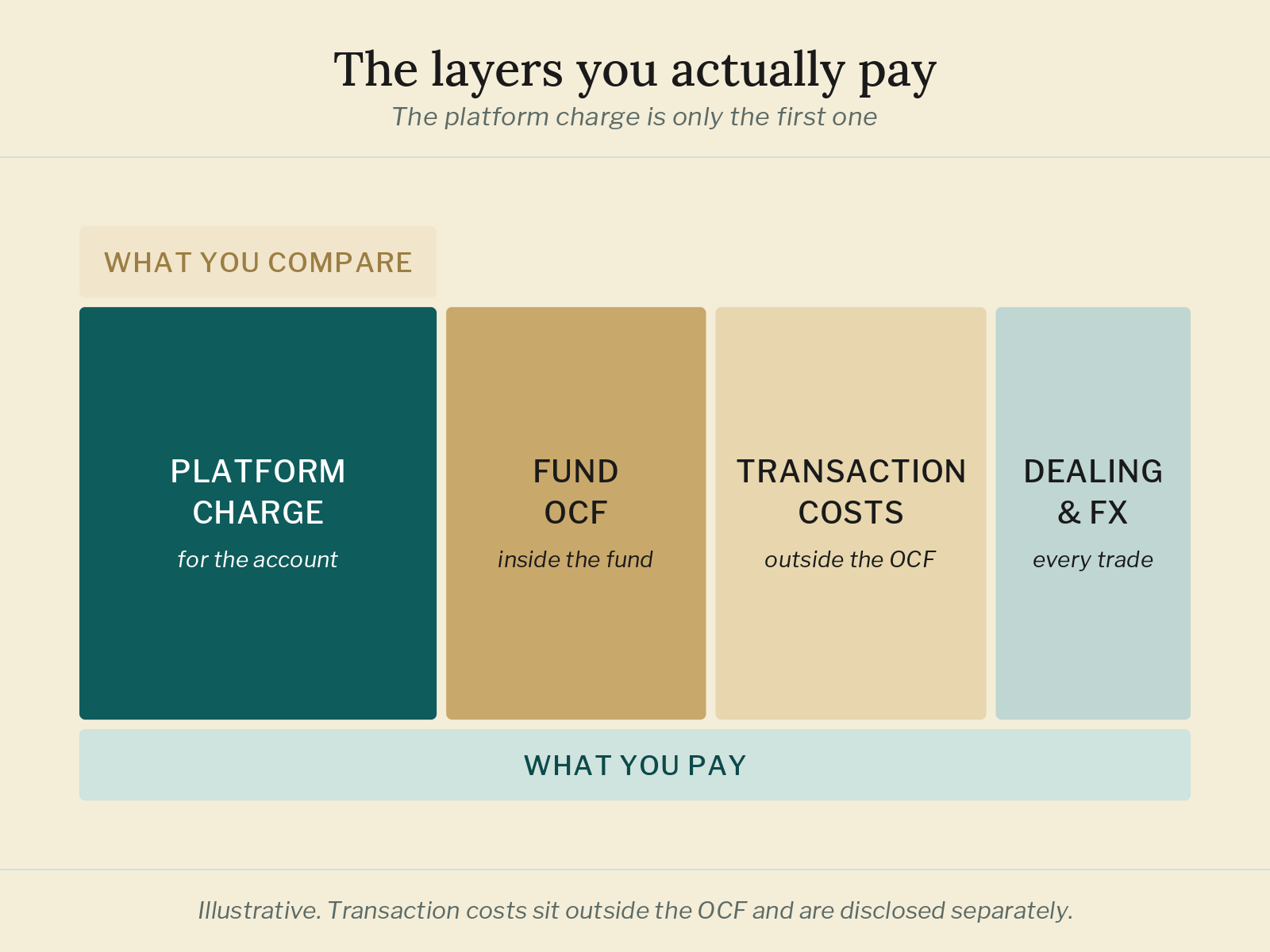
The mistake isn’t paying too much, it is comparing one number and assuming it is the total. The platform charge is only the first layer. On top sits the fund’s ongoing charges figure, and on top of that the fund’s own transaction costs, which are real, disclosed separately and left out of the OCF entirely. Then dealing charges each time you buy or sell, foreign exchange costs on anything priced in another currency, and a charge to leave if you ever transfer. Each one is defensible in isolation. Added up, they are the difference between the first bar and the third.
The percentage grows as you do
Here is the part that catches people who set things up once and never look again. A percentage fee is charged on a pot that compounds, so the bill compounds with it. At 0.30%, a £10,000 pot costs you £30 a year. The same 0.30% on £250,000 costs £750, for a service that hasn’t changed. This is why flat-fee and capped structures, which look expensive when you are starting out, become the cheaper option somewhere along the way. The crossover point is arithmetic, not opinion: divide the flat annual charge by the percentage and you have the pot size where they meet. Worth recalculating every few years rather than treating your first choice as permanent.
What is actually worth paying for
None of this argues for cheapest at any cost. It argues for knowing the number and knowing what it buys. The FCA’s asset management market study found no clear relationship between what retail active funds charge and what they earn before costs, and a negative relationship once costs come out. Paying more doesn’t buy better performance. It reliably buys less of your own.
Some costs earn their keep. A platform that stays up, transfers cleanly and doesn’t lose your records is worth a few basis points. Coverage you genuinely can’t get cheaper is worth paying for. Advice, if your situation is complicated enough to need it, can be worth many times its cost. What isn’t worth paying for is a percentage attached to a service you could get for a fraction, bought once and never reviewed.
Inside an ISA, every pound of fee is a pound off the compounding
Outside a wrapper, some costs are softened by how they interact with tax. Inside an ISA there is nothing to soften them. There is no tax relief to blunt the charge and no offset to claim, so the deduction hits your compounding at full strength. The flip side is the better half of the deal: every pound you don’t pay in fees stays in the wrapper, grows tax-free and is yours in full. The ISA protects your returns from tax. Only you can protect them from cost.
Is 1% really that bad?
Over a year it is barely noticeable, which is exactly the problem. Over thirty years, on the illustration above, it takes about 18% of the final pot. The damage isn’t in any single deduction, it is in the compounding you never see happen. To see what a percentage fee and a flat fee would cost on your own pot, use the ISA fees calculator.
Should I just move to the cheapest platform?
Not automatically. Check the exit and transfer charges, whether your holdings can move across as they are or have to be sold and rebought, and how long the transfer takes. A better structure is usually worth the move, but work out the payback period first rather than chasing a headline rate.
Do cheaper funds perform worse?
The evidence points the other way. Cost is one of the few characteristics that predicts relative returns at all, and it predicts them negatively: higher charges, lower net returns on average. Nothing guarantees that for any individual fund, but it is the direction the data runs.
How do I find out what I am actually paying?
Your platform must send you an annual costs and charges statement showing the total in pounds, not just percentages. Read that one figure. It is the number that matters, and it is usually the first time people see the layers added together.
Key takeaways
All figures are correct at the time of writing and can change, so always check gov.uk for the current numbers. The value of investments can go up and down, and you can get back less than you put in. This is general information, not financial advice. If you are unsure, speak to a regulated financial adviser.