

The Behaviour Gap: Why Most Investors Underperform Their Own Investments
Two people can buy exactly the same investment, hold it over exactly the same years, and walk away with very different amounts of money. Not because one got lucky. Because one kept their nerve and the other did not. That difference has a name.
It is called the behaviour gap, a term coined by the financial writer Carl Richards, and it describes the money lost not to bad markets but to our own reactions to them. Understanding it is worth more than any share tip, because it is the one part of your returns you actually control.
What the behaviour gap is
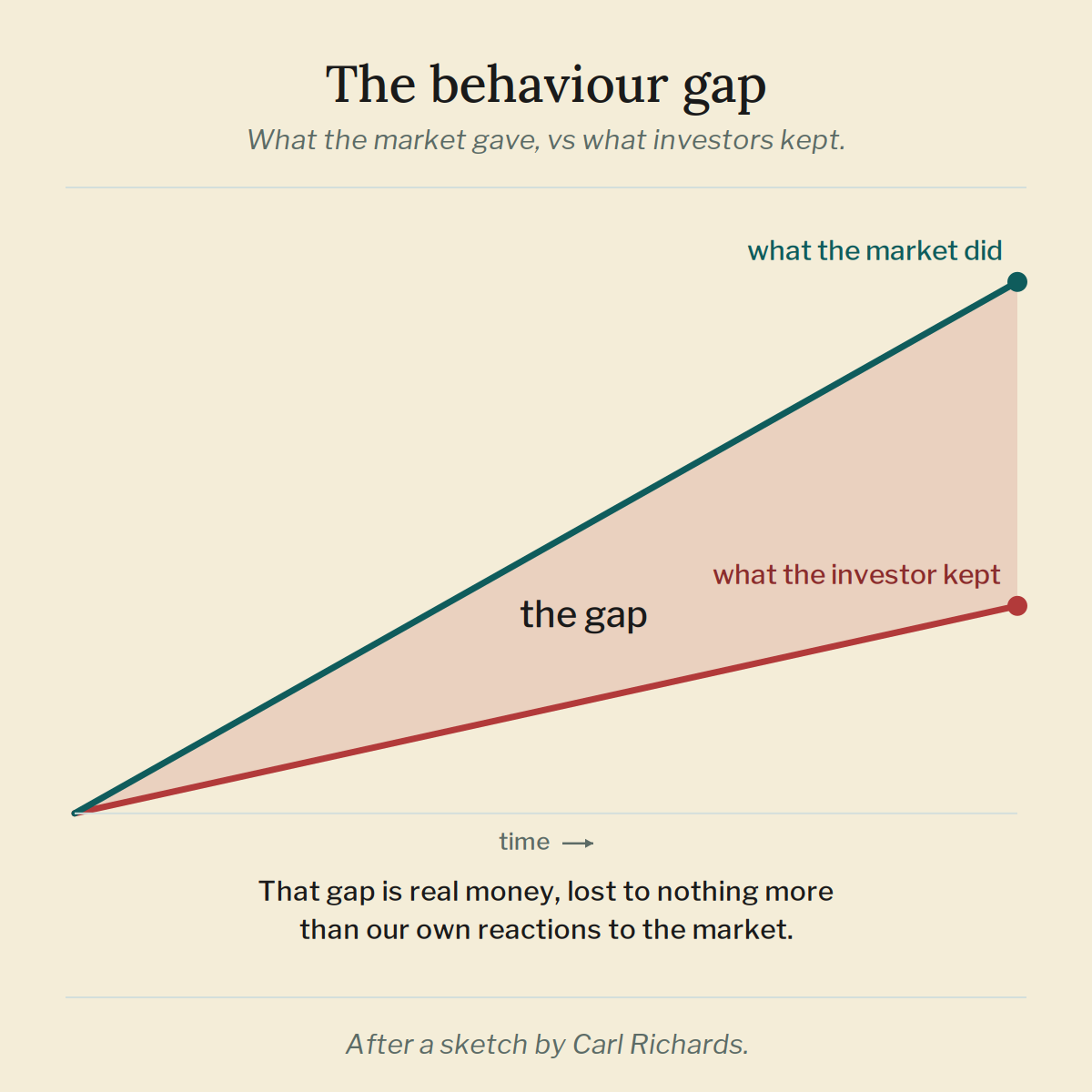
There is a well-documented difference between what an investment returns and what the investor who held it actually earned. Carl Richards drew it as a simple sketch: one line for what the market did, another, lower, for what the average investor walked away with. The space between the two is real money, lost to nothing more sophisticated than human nature.
Why it happens
We are wired to react. A fast response to threat and reward kept our ancestors alive, but it is a terrible setting for long-term investing. Robert Kiyosaki put it well in Rich Dad Poor Dad: most money decisions are driven by fear and desire, usually at the wrong moment. Fear makes us sell when prices fall. Desire makes us pile into whatever has just shot up. Neither is investing, and both are expensive.
The three mistakes that do the damage
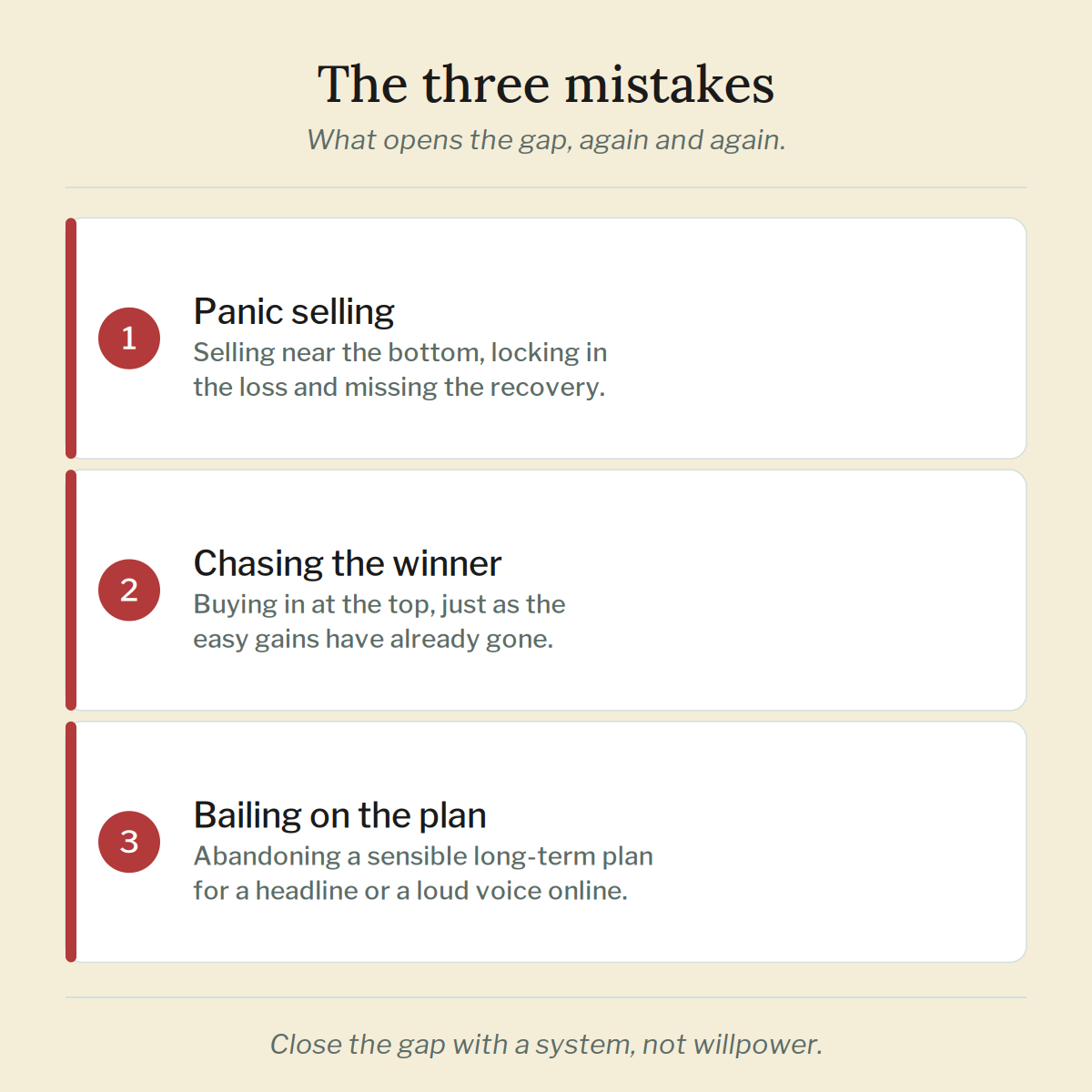
- Panic selling. The market drops, the headlines turn grim, the fear builds, and somewhere near the bottom the investor sells, locking in the loss and usually missing the recovery that follows.
- Chasing the winner. Something has already doubled, so it feels safe, so people buy in at the top, just as the easy gains have gone.
- Bailing on the plan. A headline, a scary forecast, a loud voice online, and a perfectly sensible long-term plan gets abandoned for a reaction.
The fix is a system, not willpower
You do not close the behaviour gap by becoming a calmer person. You close it by building a system that makes the good decisions automatic and the bad ones difficult. Decide your plan before markets fall, not during. Automate your contributions so the money goes in before you can second-guess it, the old pay-yourself-first principle from Clason’s The Richest Man in Babylon. Review on a schedule, say once a quarter, rather than every time the news flares up. And treat financial social media as entertainment, not instructions.
A quick illustration
Picture two people invested through a sharp market fall. The first watches the value drop, cannot bear it, and sells near the bottom. The second has already decided, in writing, that they hold through falls, so they do nothing. When the market recovers, as it has after every fall in history so far, the second person is whole again and the first is sitting in cash, having turned a temporary dip into a permanent loss. Same market. Different behaviour. That is the gap, in one story.
Why this matters for an ISA investor
The whole point of a stocks and shares ISA is long-term, tax-free compounding. Compounding only works if you stay invested, and staying invested is a behaviour, not a calculation. The biggest threat to your returns over the years is not the market. It is what you might do to your portfolio in a bad week.
What is the behaviour gap?
The difference between what an investment returns and what the investor actually earns, caused by the decisions they make in response to the market rather than by the market itself.
What is the most expensive mistake?
Panic selling during a fall. It locks in the loss and usually means missing the early part of the recovery.
How do I avoid it?
Set your plan in advance, automate your contributions, review on a schedule rather than on impulse, and reduce the financial noise you consume.
Does this mean I should never sell?
No. It means selling to a plan you set in advance, not in a panic. The problem is reacting emotionally, not selling itself.
Key takeaways
All figures are correct at the time of writing and can change, so always check gov.uk for the current numbers. The value of investments can go up and down, and you can get back less than you put in. This is general information, not financial advice. If you are unsure, speak to a regulated financial adviser.