

What Investing Actually Is, and What It Isn’t
For a lot of people, the word ‘investing’ brings up an image of men in suits shouting on a trading floor, or a teenager who turned £500 into £50,000 on some coin and will not stop posting about it. Both pictures are wrong, and both put people off the one thing that could quietly change their financial life.
Here is what investing actually is, with the noise stripped out. When you invest, you buy a small share of real businesses and let them grow over years. That is it. Not a casino. Not a get-rich-quick scheme. A slow, deliberate way of owning a slice of the economy and letting time do the heavy lifting.
What investing is
When you buy a share, you own a small piece of a real company, with real products, real customers and real profits. Over the long run, as those businesses grow and pay out some of their profits, you share in that growth. Buy a fund or an index fund and you own a slice of hundreds of companies at once, spreading your bet across the whole economy rather than resting it on one name. The returns come from real businesses doing real things, compounded over time.
What investing isn’t
It is not gambling. Gambling is a bet on a flip, where for you to win someone has to lose, and the house takes its cut. Investing is owning productive assets that tend to grow because the economy grows. It is not trading, which is the very different game of trying to guess short-term price moves. It is not get-rich-quick. And it is not predicting the future, which nobody can do reliably, no matter how confident they sound.
Why the hype works so hard against you
Social media sells the dramatic version, because dramatic gets clicks. Lottery-ticket bets dressed up as investing, screenshots of overnight fortunes, courses promising the one secret the banks do not want you to know. The boring, effective version, owning good assets and waiting, does not trend, because there is nothing to sell and nothing to film. That silence is not a sign it does not work. It is a sign it works slowly.
You do not need to be brilliant
This is the part I wish someone had told me sooner. You do not need to be clever, you do not need to predict markets, and you do not need to find the next big thing. The investor’s real edge is patience and temperament, doing less rather than more, as Robbie Burns puts it in The Naked Trader. Structure, discipline and time beat brilliance over a long enough horizon. That is genuinely good news, because patience is available to everyone.
The risk runs both ways
None of this means investing is risk-free. The value of investments rises and falls, and you can get back less than you put in. But it is worth being honest about the other side too: leaving money you will not need for decades sitting in cash carries its own risk, as inflation quietly erodes what it can buy. There is no option with no risk at all. There is only choosing which risk fits your timescale.
Is investing just gambling?
No. Gambling is a zero-sum bet; investing is owning productive assets that tend to grow with the economy over time. The risk is real, but it is a different thing entirely.
Do I have to pick the right shares?
Not necessarily. Many people invest through diversified funds rather than betting on individual companies. This article is not a recommendation of any particular approach or product.
Isn’t it too risky?
Investing carries real risk and the value can fall. So does leaving long-term money in cash, where inflation erodes it. Risk is managed mainly by time and by not putting everything in one place.
Do I need a lot of money to start?
No. You can start small and add regularly. Consistency over time matters far more than the size of the first deposit.
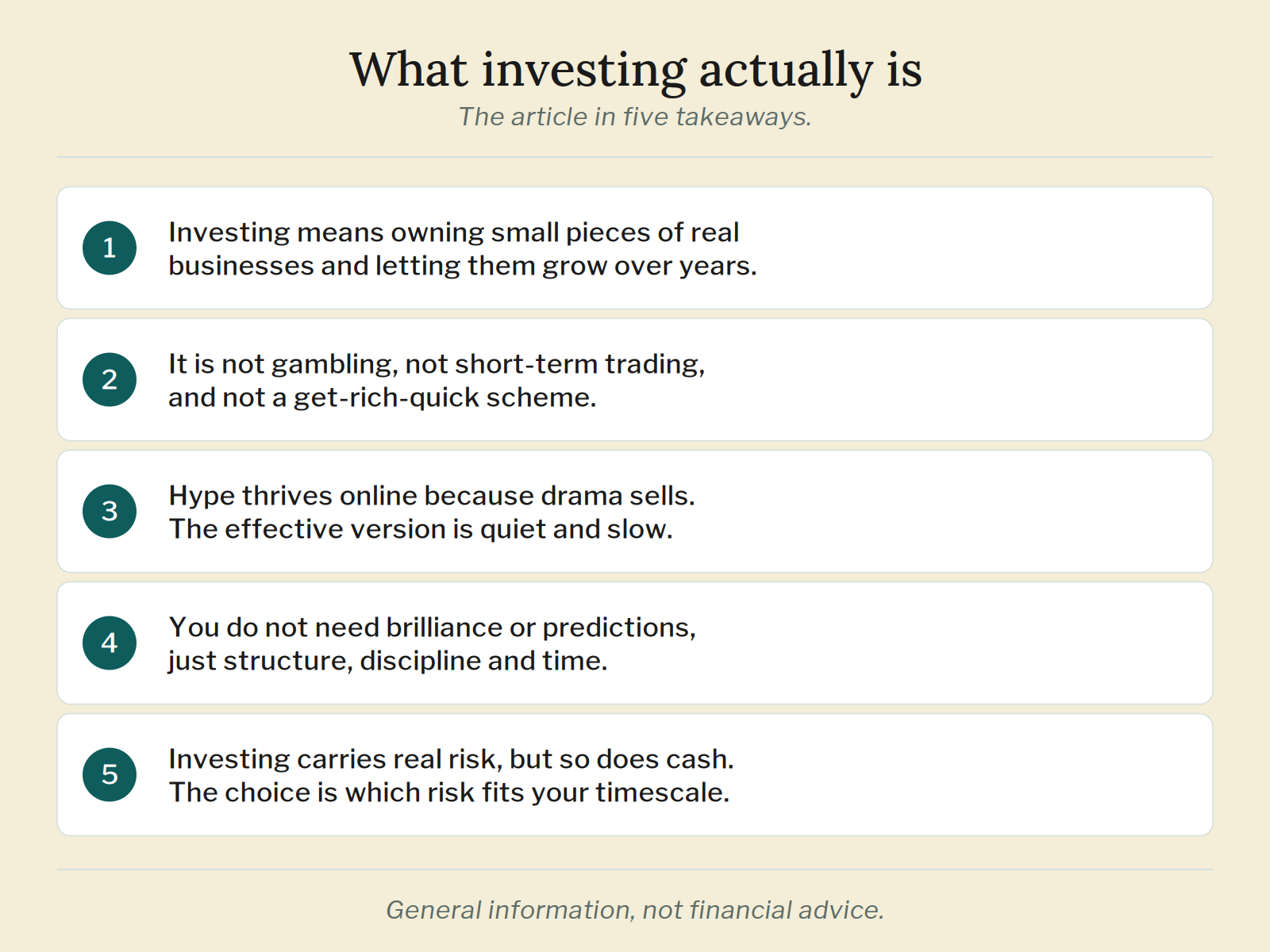
Key takeaways
All figures are correct at the time of writing and can change, so always check gov.uk for the current numbers. The value of investments can go up and down, and you can get back less than you put in. This is general information, not financial advice. If you are unsure, speak to a regulated financial adviser.